The Gaspé peninsula is the region south of the St. Lawrence River to the Gulf of St. Lawrence. It comes from a Mi’kmaq (First Nations people) meaning “end” referring to the end of the land. Traditionally the area relied on fishing, agriculture, and forestry. However, overfishing and overexploitation of resources have pushed much of the economy towards tourism and the service industry.
Quebec route 132 circles the peninsula, and it was the route we would be on for several travel days. From Camping Annies we were to go to a campground near Gaspé, QC. It was named Camping Baie de Gaspé and was very near the southern entrance to Forillon National Park.
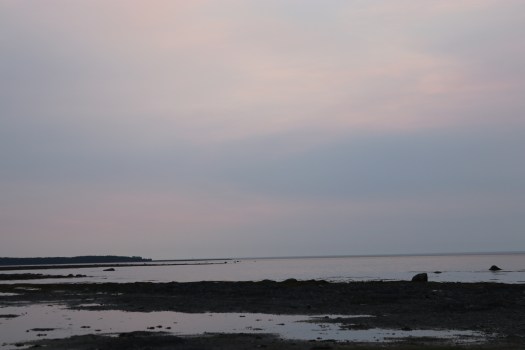
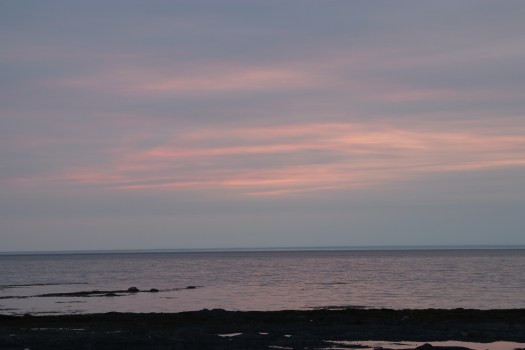
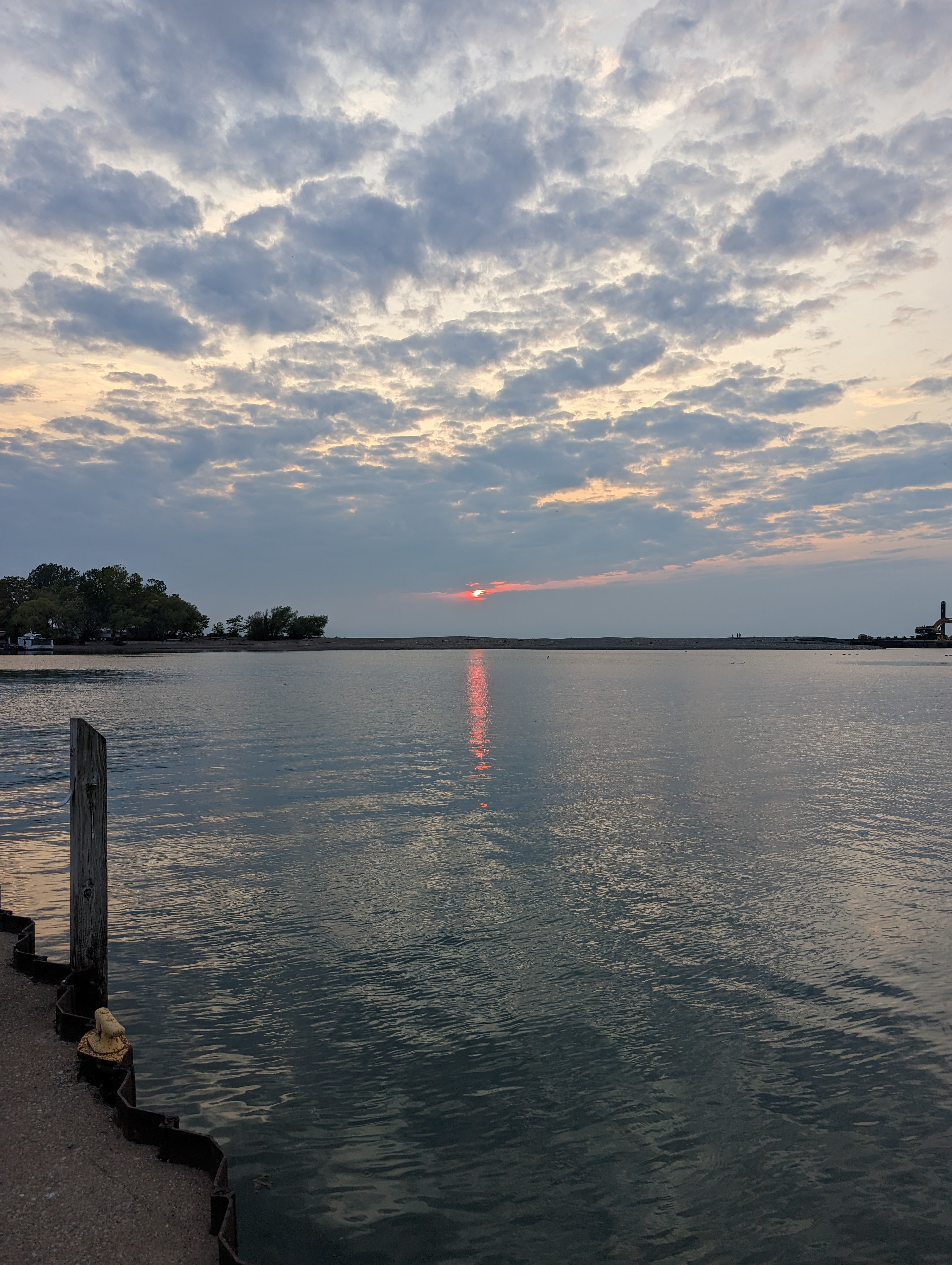
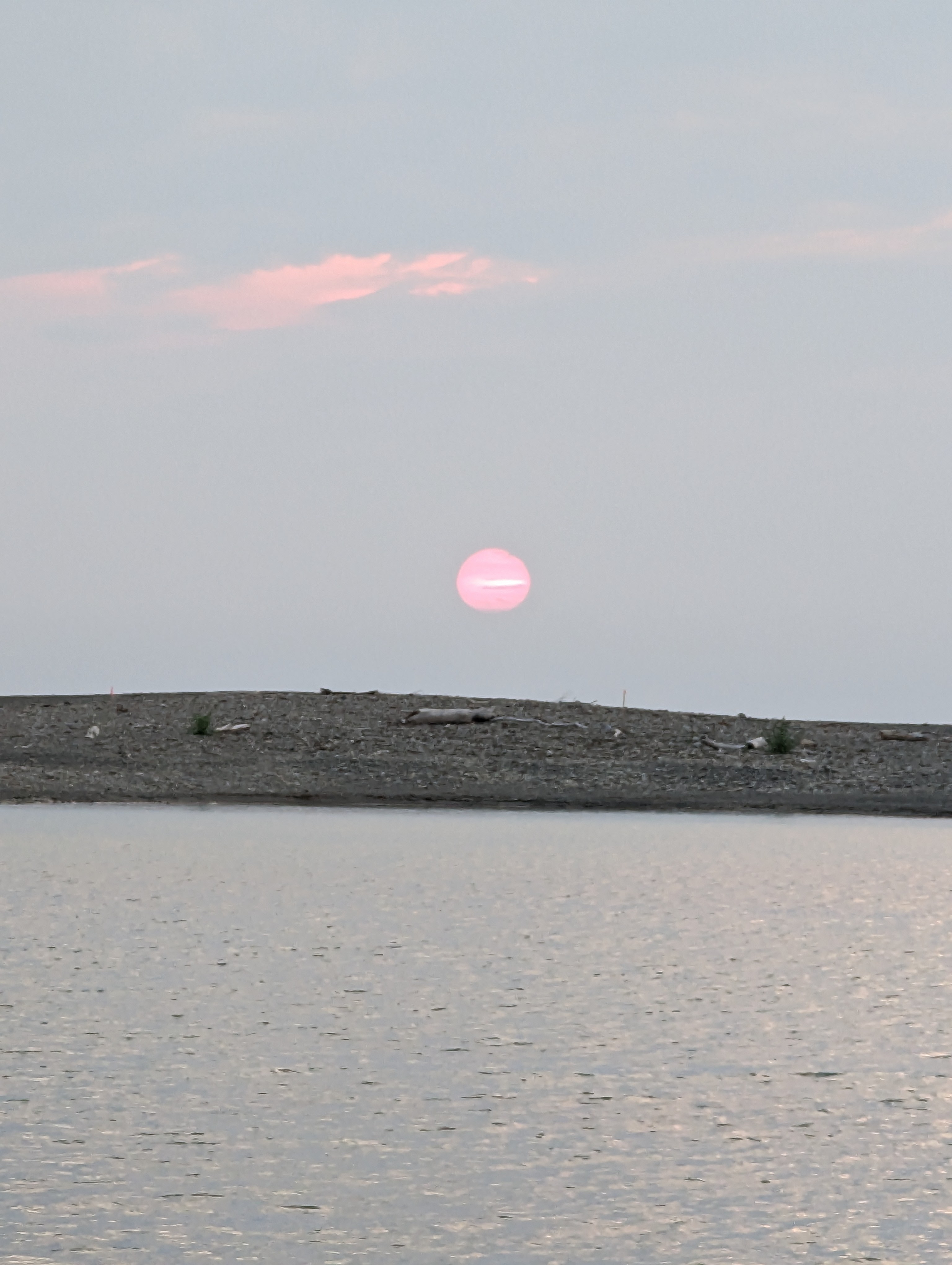
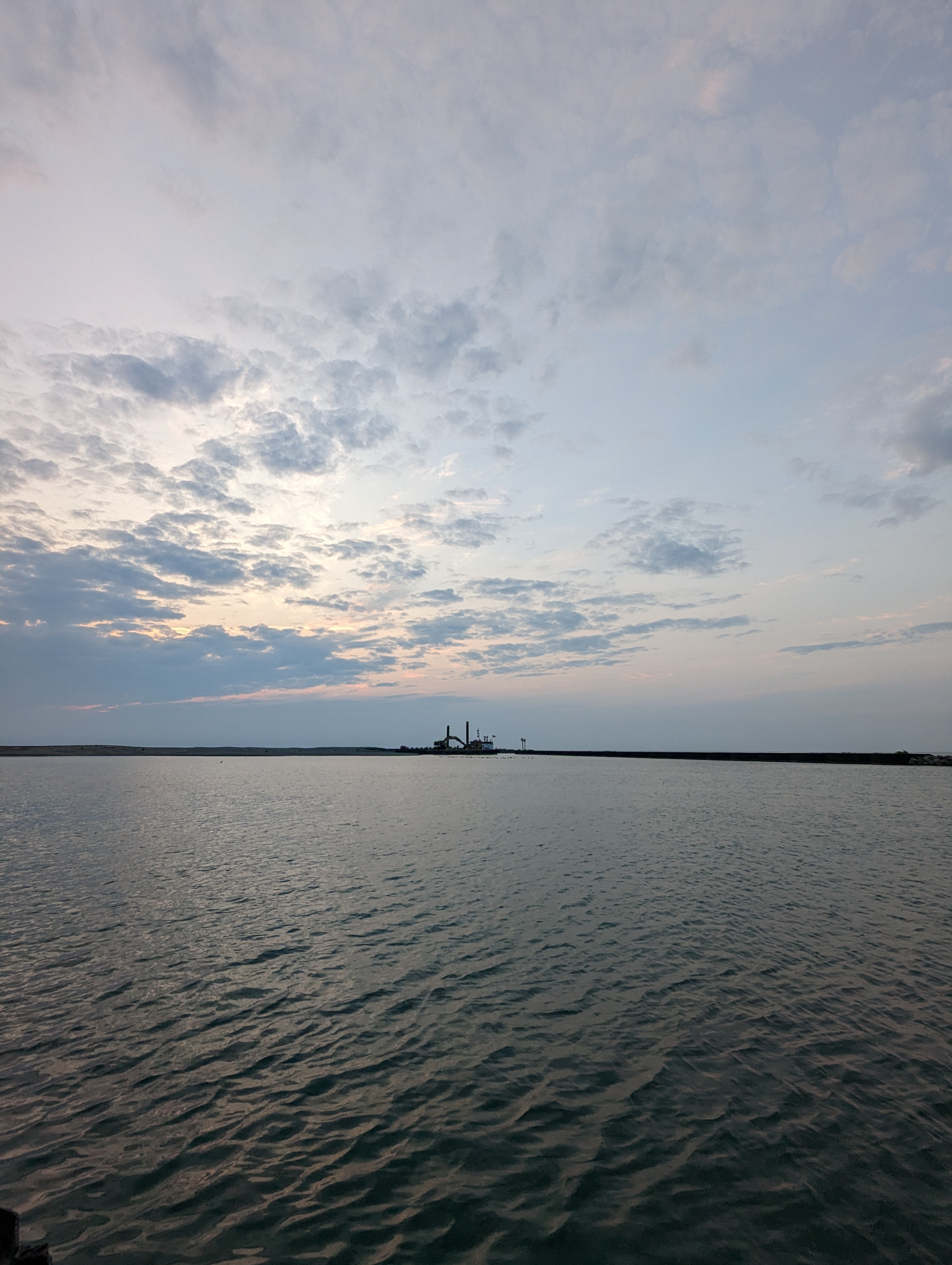
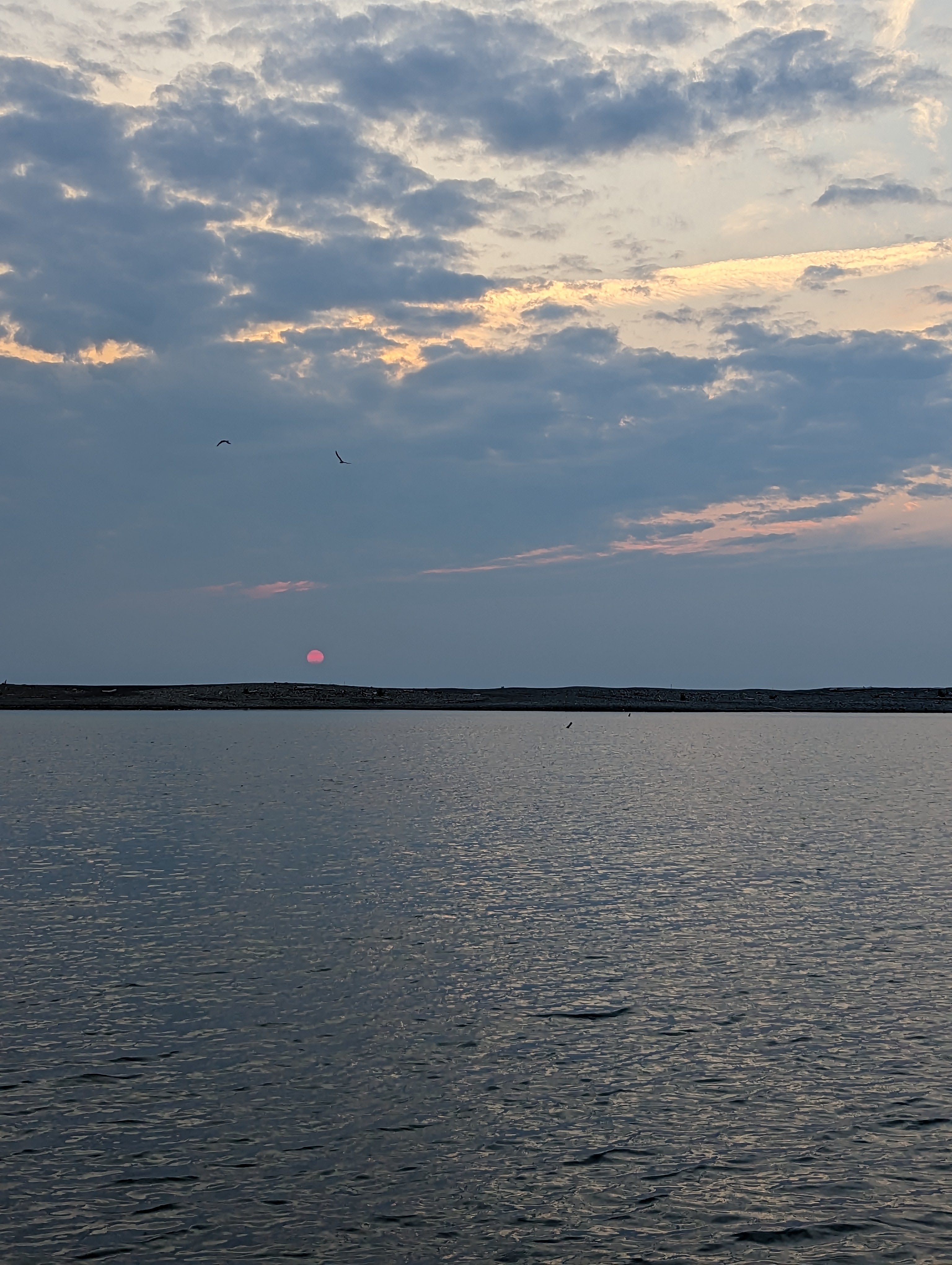
The last night we spent in Metis sur Mer, I drove into Mont Joli to get diesel. I was hoping the haze would give me a nice sunset as well, but it was only so-so. Still, I stopped at a local “halte” which are the numerous picnic spots found along route 132. Most of them won’t accommodate large vehicles, so we can’t use them as rest stops when towing. But this one was right on the water and certainly fit Rory. Even though this is still considered the St. Lawrence River, there are seashells on the beaches.
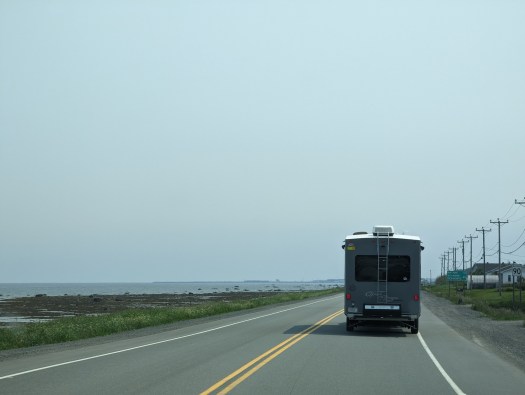
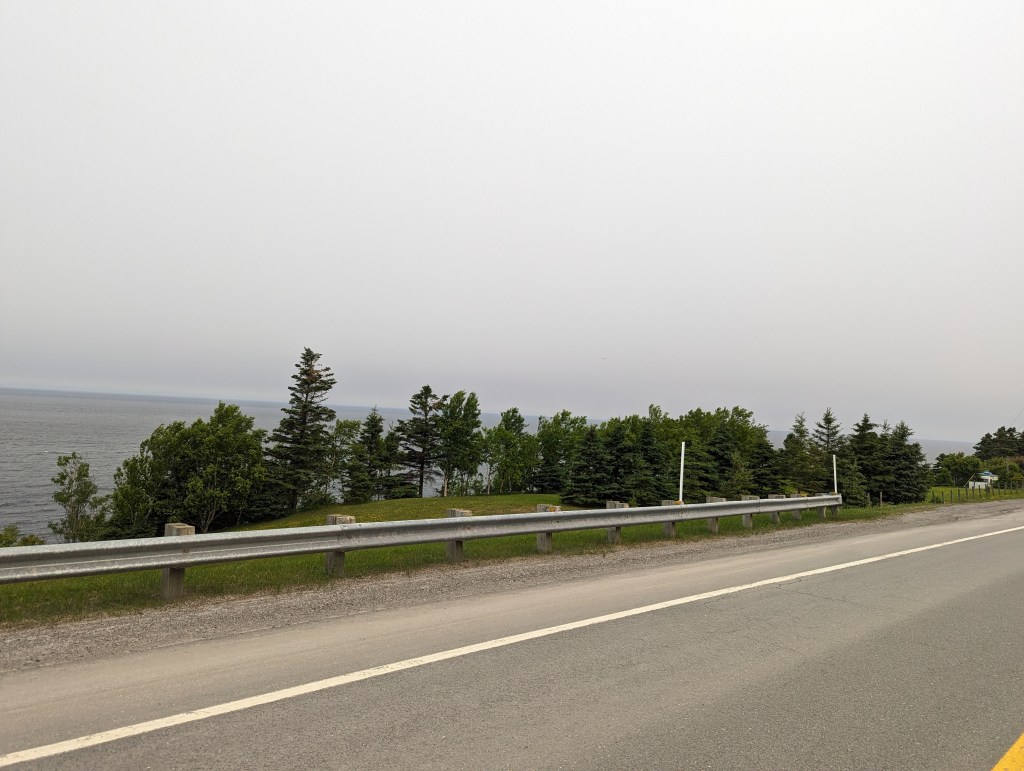
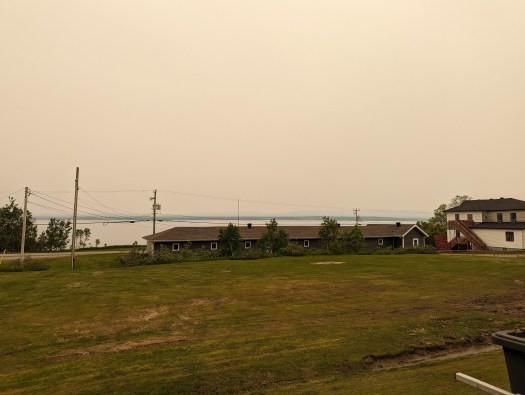
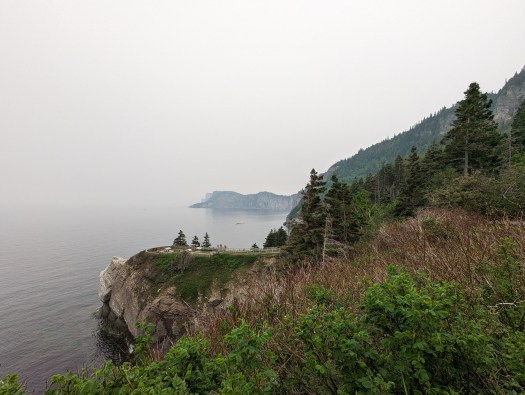
Sadly, we woke up to hazier conditions due to the wildfire smoke that so many have experienced. It would not leave us during our time in the area, so many of the photos are quite poor. Visibility was certainly not great.
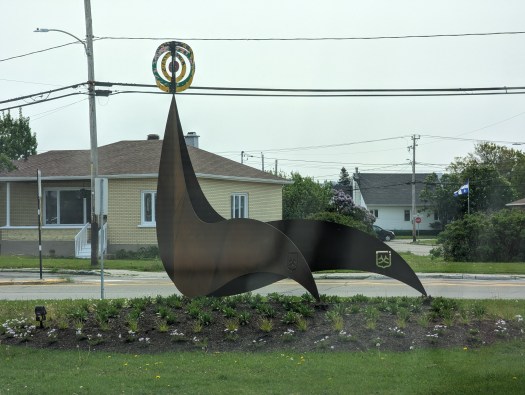
Following Jerry and Wendy, wishing it was less hazy. View to my left was still amazing despite the haze.Ran into construction multiple times. Thought this was a cool statue. It reminds me of a seal with a ball on it’s nose. The metal sphere spun with the wind.
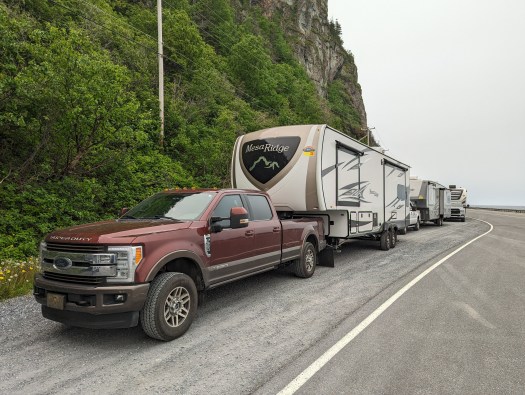
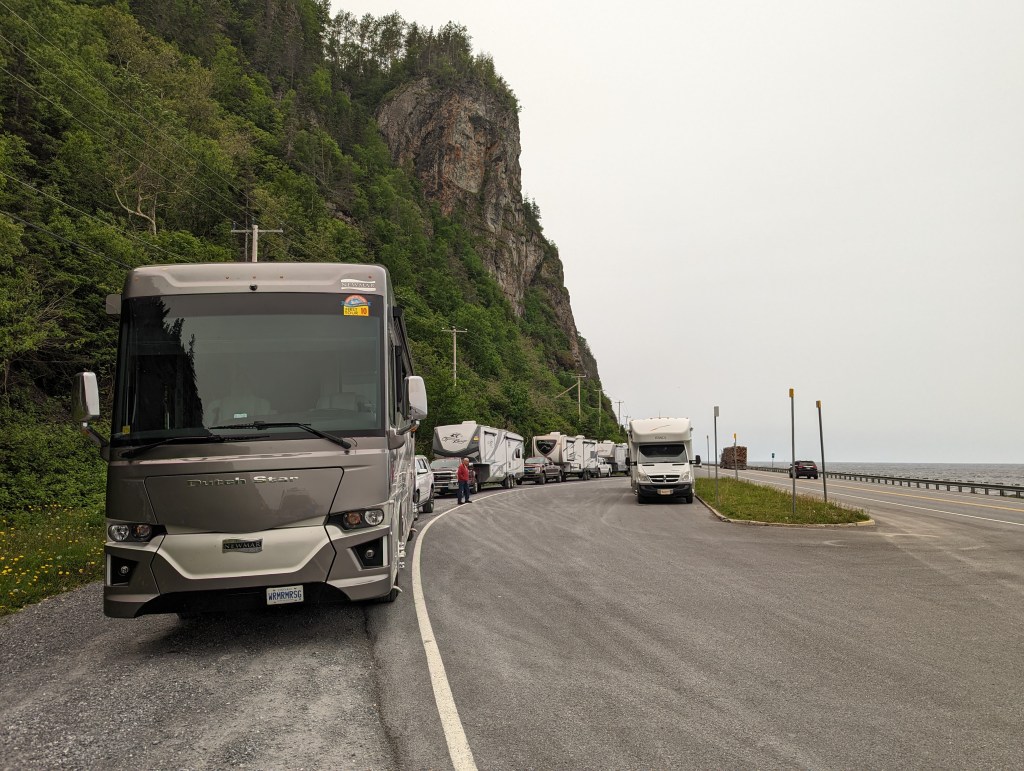
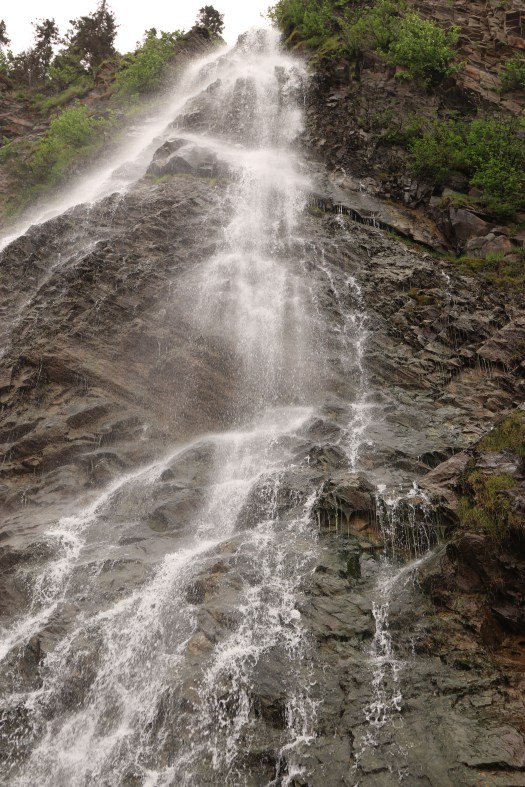
We had a stop marked in the book that mentioned a waterfall. It said the pull over would only fit about 5 rigs, but we made it work with more.
Rory at restA lot of Open Range products representedWaterfall was pretty
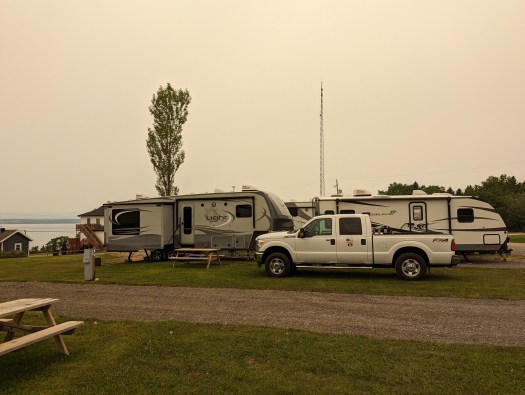
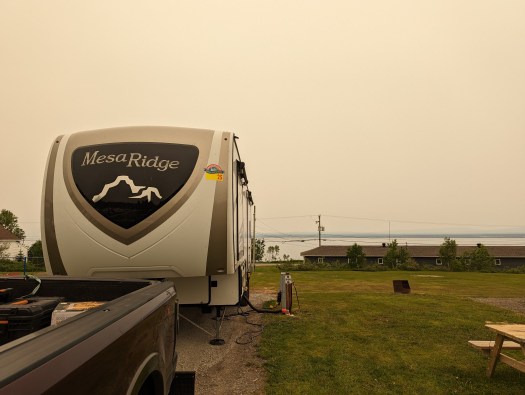
Sadly, the smoke and visibility seemed even worse when we arrived at our campground. Baie de Gaspe is, of course, pretty easy to translate: Bay of Gaspe. It was not near stores or towns; Gaspe itself was about 30 minutes south. But there was a nice plage, or beach, near it. And it had a water overlook, if only we could have seen it better.
There were a lot of seasonals up the hill from us; we were all down in back in spots. My power pedestal literally had a padlock on the 50 amp circuit, so I had to use the 30 amp. Which most of these campgrounds have been limited to, so no big deal. Still, I’ve never seen a circuit padlocked before.
View from my site to the left.View looking out to the back of my site.
We had a free day to explore Forillon National Park, the first national park located in Quebec. It was thought to have been named for a flowerpot seastack that’s since collapsed into the sea.
The park was created in 1970 after a subcontracting firm hired by the government bullied and harassed the 225 families living on the land to sell out at low fees. This expropriation eventually led to an official government apology in 2011.
We were closest to the south entrance for the park. There’s a road that runs along the sea cliffs until it ends in a walking trail; if you walk a few Km there’s a lighthouse at the end. I met Jerry, Wendy, Charlie, and Rae for a picnic lunch at the trail head. However, given the smoke, none of us wanted to hike the trail. Apparently, the end near the lighthouse is quite steep.
I really didn’t take any pictures; it didn’t seem worth it. However, not all is lost. Our next stop, in Perce, was only 60 some miles down 132. We would have a free day there, and I spent it driving back to Forillon as the day was beautiful, smoke free, and I wanted to see the park in all it’s glory. The other motive was to go to the IGA and Canadian Tire stores as they were closed when we were in Gaspe due to a national holiday (St. John the Baptists day). So you’ll see them in the next post.
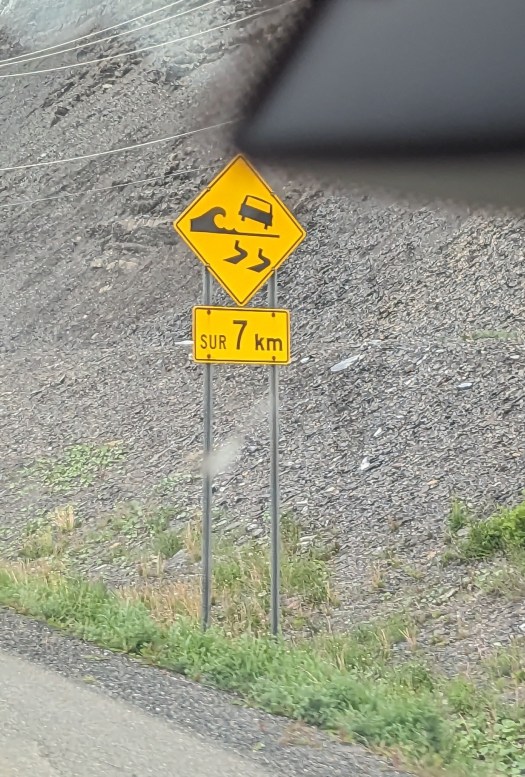
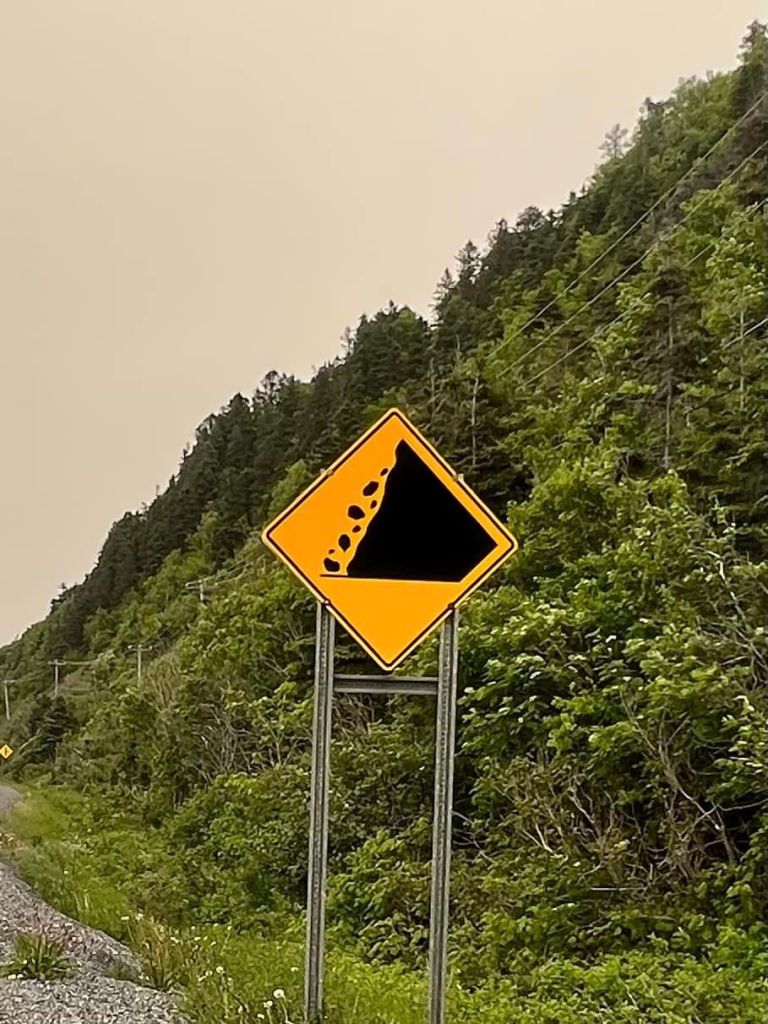
On a another note, we started to see some very interesting signs on 132. Some of which we could not interpret. Here are some examples.
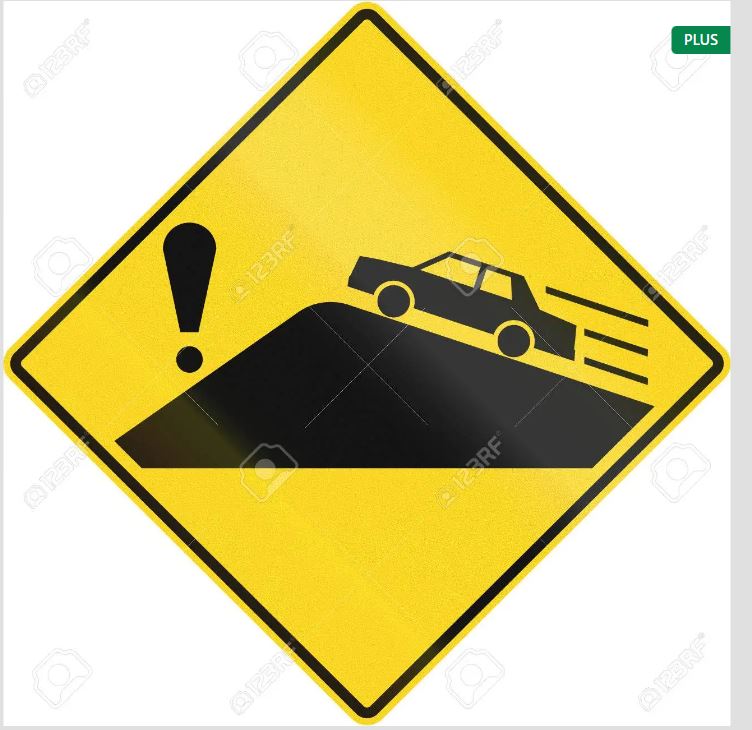
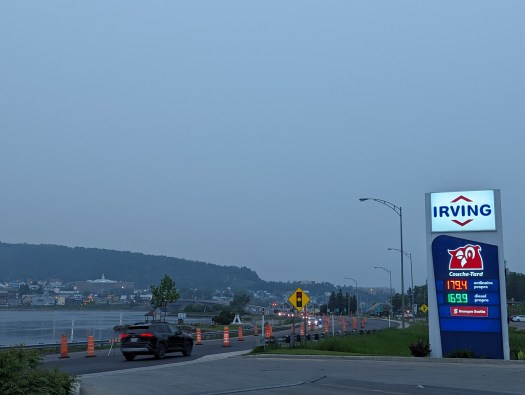
3 way stop15% down grade. A record at the time for me, it would be exceeded a few days later by a 17% grade into Perce. I have never seen such steep grades on a public road in my life. Alaska had some long grades, but I don’t think they ever exceeded 8-9%. Avalance dangerHigh wave danger for the next 7 km. 14% grade with curves. Not fun. Falling rockThis is the sign no one could figure out. It had no words, not French or otherwise. It wasn’t until we got to PEI that we finally figured it out; they had the same sign but with words beneath it. Any guesses?This was taken the night before we left Gaspe. It’s in the town, at an Irving gas station. Notice diesel is cheaper than gas, which has consistently been the case in Canada.
Next post we go to Perce, take a boat tour, and I fly some of my kites.
We had a completely free day on the fourth day in Quebec City. Jerry, Wendy and some others had talked about going zip lining at the Montmorency Falls. I don’t zip line. I don’t really zip anywhere. What I did instead was a bit boring, but one of those necessary days when you’re traveling constantly: a me day.
I slept in. Which was amazing. Did at least 3, maybe 4 loads of laundry, washed all the dishes, and figured out which of the 3 Costcos in the area was nearest and drove there.
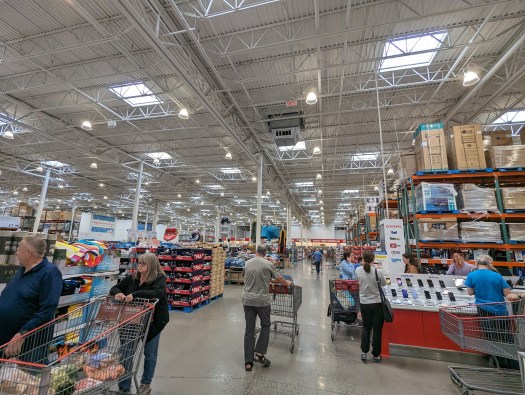
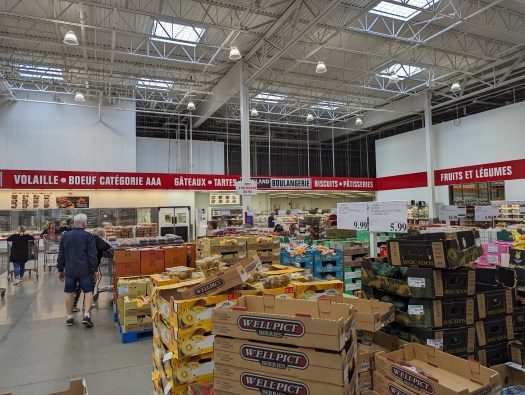
Costco Canada is comfortingly familiar, but also foreign. In Quebec, of course, everything is in French. But the layout and the stuff inside seem normal to this American. One thing I knew ahead of time was that they don’t accept Visa, only Mastercard. Which I don’t possess. But you can digitally buy a Costco shop card with your visa; it’s delivered to you via email and then you use it as a digital gift card. So, I bought one prior to leaving for the store.
I should know by experience in the States that no matter what day of the week or time of day, it’s going to be a zoo. But it was a Monday early afternoon. How busy could it be???? Oh, I’m so naive.
The parking lot was nearly completely full. I parked in the last row nearest the street and hoofed it in.
Looks fairly similar to U.S., right?Until you try to read the signs and realize some you can figure out…like fruits et legumes. And some you have no idea, like volalle
Something that threw me off slightly was they have a self checkout. There was an English option, so it went ok. Until I got to the lady checking receipts who spouted a torrent of French to me. When I said I didn’t speak French you could see the cogs turning in her head as everything shifted, and in perfect English she informed me that today was a great day to buy gas as it’s only $158/L today (which is a good price for gas–mostly it’s been $178/L). However, I already knew they didn’t carry diesel (which ironically has consistently been less expensive than gas here).
So, I had a productive day. And the ziplining apparently was closed on Mondays, so that crew came back and the guys all worked on getting John and Sherry’s trailer wheels remounted (or something).
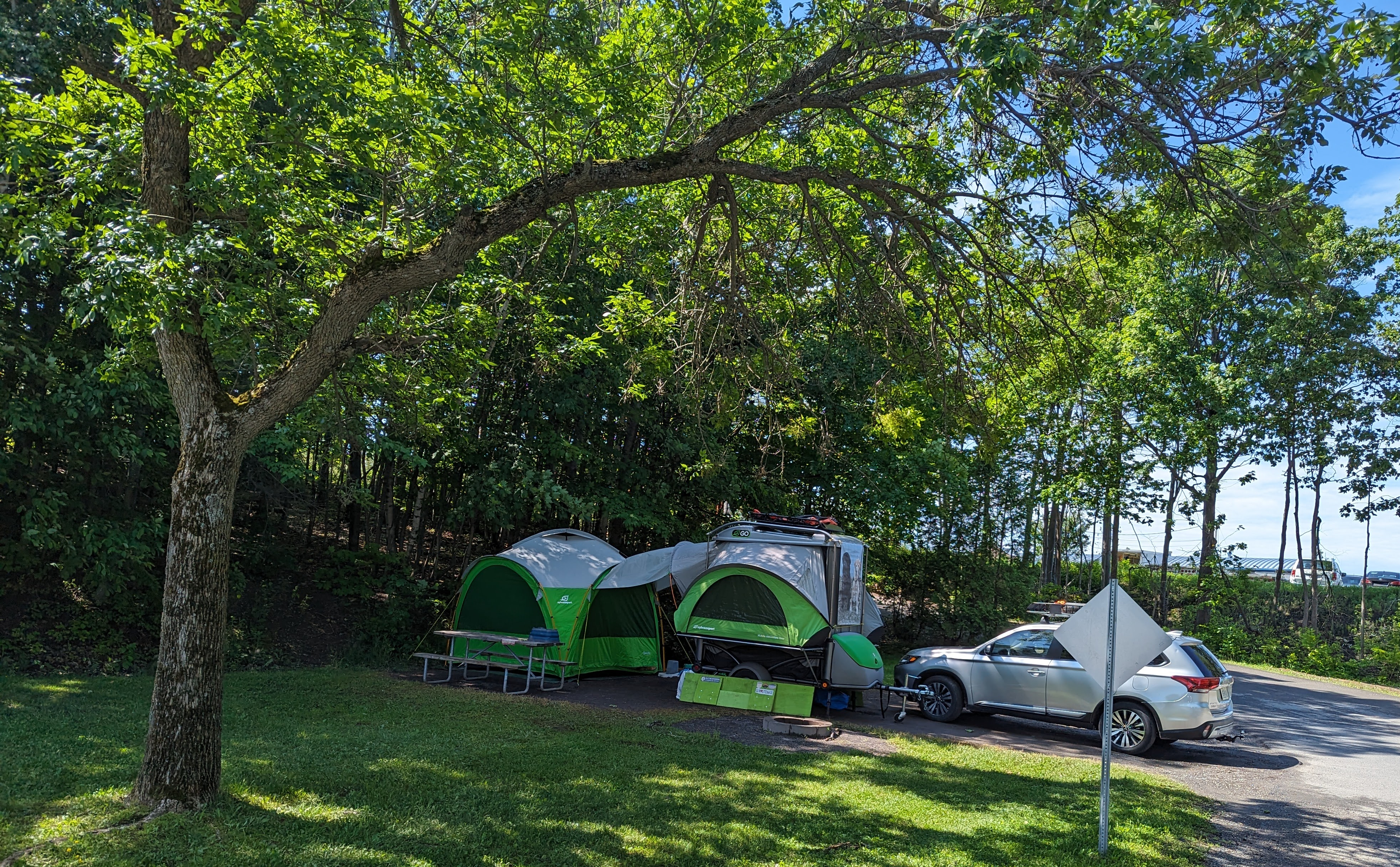
The next morning it was time to leave for our next destination, near Grand Metis. Much of the route followed the St. Lawrence river. As we exited the Quebec City KOA, I had to get a picture of a tent that had set up the day before. Quite the elaborate tent site!
Tent linked to tent linked to tent? With pic of their 2 dogs on the very front.
It was overcast; this was what a lot of my drive looked like to my left.
Not a bad way to spend a drive. We did leave the divided, 4 lane highway fairly quickly north of Quebec City. Jerry radioed me that it was likely the last we’d see a divided highway and so far he’s not wrong. We also went past the town of Rimouski, QC which I’ve long been passingly familiar with due to someone who once lived here. Bonus points to anyone who knows who I’m talking about, and here’s a bit of a hint:
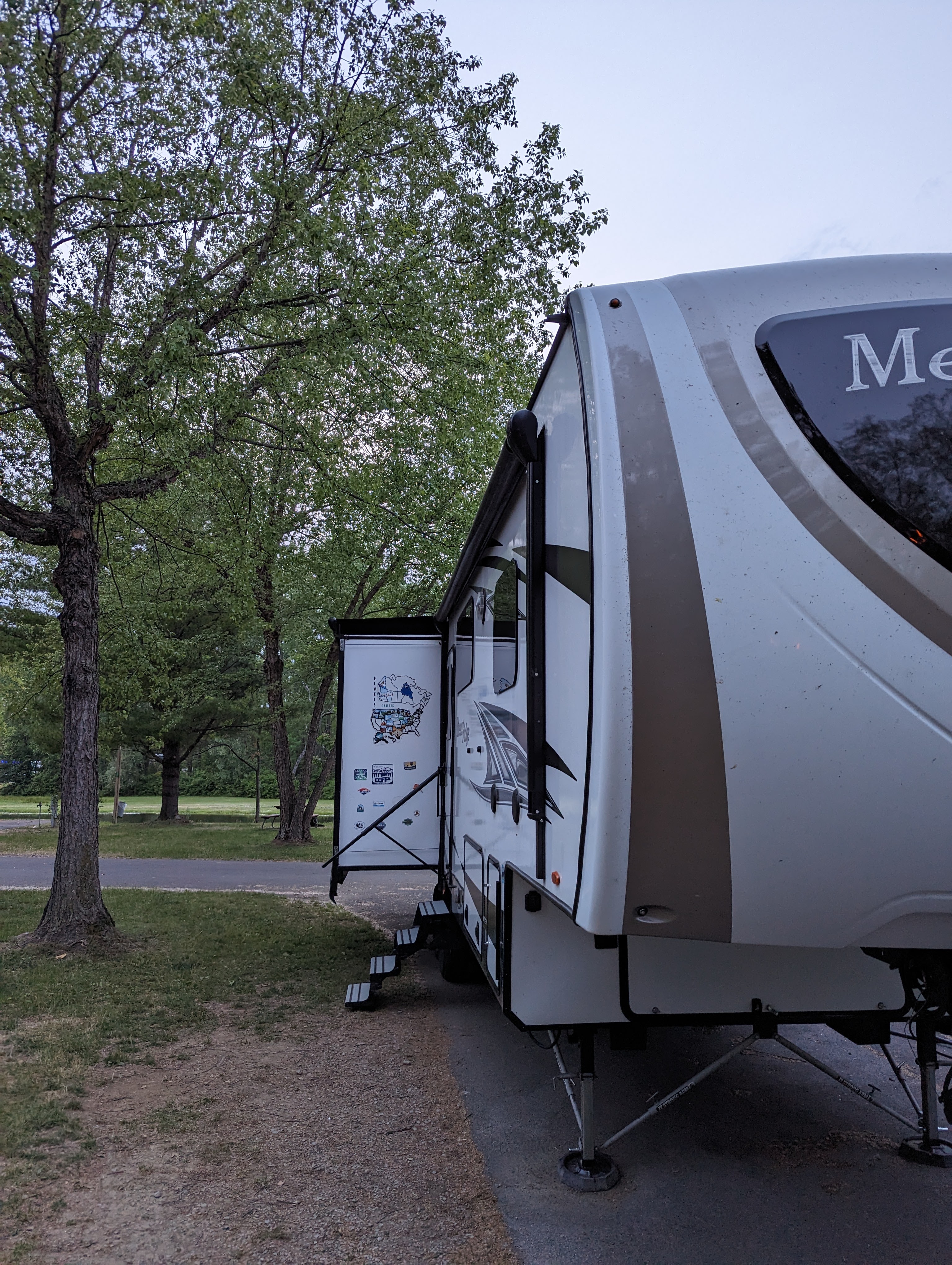
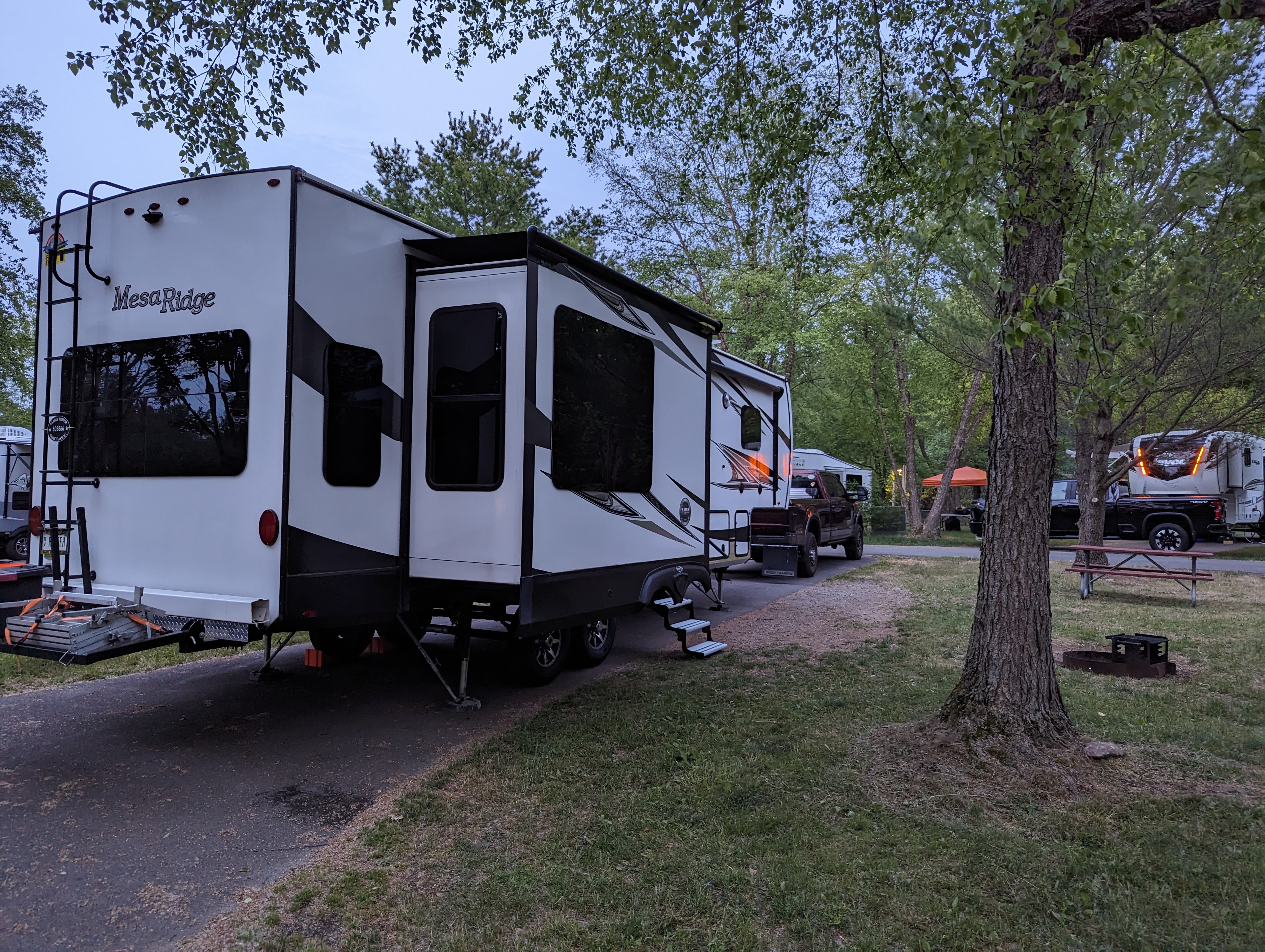
We drove 220 miles to get to our campground, Camping Annies. The sites were had mature trees but good space between them. Everything was back in, and I had lots of help getting myself into my spot. We were due to spend 2 days there. The campground is technically in Metis su Mer. Off route 132, which runs along the coast line of the St. Lawrence south bank all around the Gaspe peninsula. It’s a route we’d become very familiar with since we were going all the way around!
Up until this point I’d not really tried out my Starlink; it wasn’t until the last day in Quebec City that I opened the box and tried to set it up. I could not get it to work at all; frustrated I spent part of the evening on the phone with Home Depot, who really couldn’t help. I concluded it was a dud and was trying to figure out how to send it back. We’d been told the WiFi at Quebec City was the best we’d be able to expect the entire trip and let me tell you that was not encouraging. So, I was a bit desperate when I got to Camping Annies, which did have a decent view of the northern sky. I decided to give the Starlink another shot and actually was able to figure out the issue. After it was addressed, set up was relatively straightforward and I was very, very pleased with the speed of the connection. It’s truly the difference between being able to share my photos with you and not.
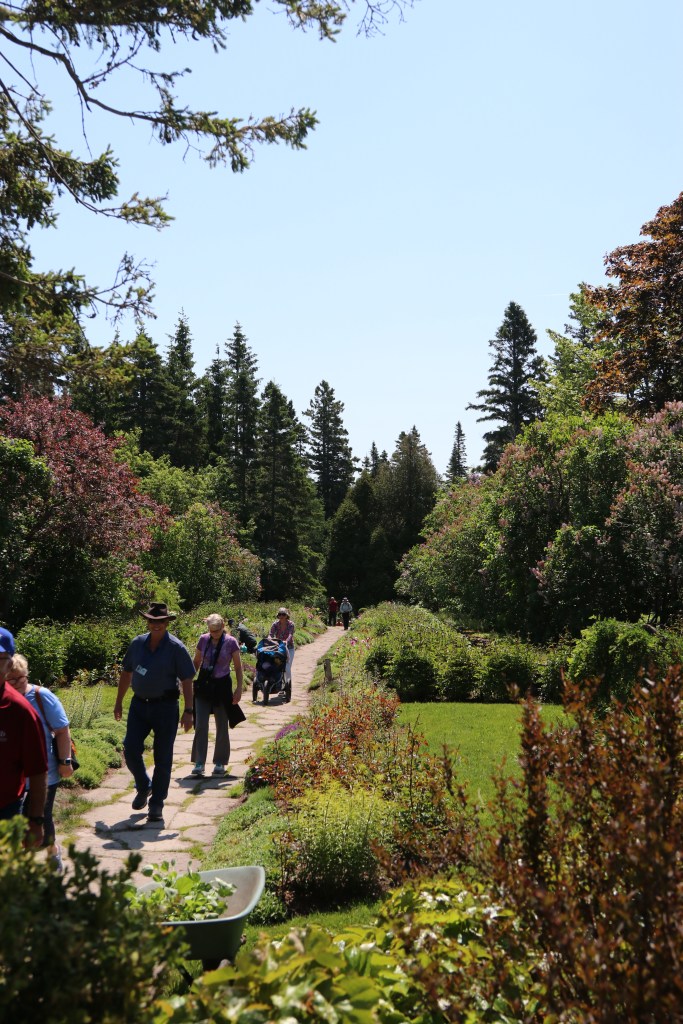
So, prepare yourselves. For we spent the morning the next day at the Redford Gardens, and I took a few (cough hundred cough) pics of the beautiful grounds.
Elsie Redford was born in 1872 in Ontario. Her parents had modest roots but her father worked his way up in his work and there was a marked emphasis on education for their 3 children, which meant that Elsie was sent to finishing schools in Dresden and Paris after completing school in Montreal. She returned to Canada ready to take her place in society; in 1894 she married Robert Redford, the son of a shipping magnate, and Elsie threw herself into various philanthropic endeavors. She was an avid horsewoman, and loved spending time hunting, fishing, and just being outdoors. She taught her 2 sons much of the same and the family often spent their summers at a fishing lodge belonging to her uncle near Grand Metis. When he died, the lodge passed to her.
When she was 53 she had surgery for appendicitis. Her doctor didn’t want her fishing, fearing the strain on her recent surgical site; he suggested gardening instead. As with all her endeavors, she went into it whole-heartedly. The lodge wasn’t an ideal place to garden; it was located for it’s fishing possibilities, not growing flowers. However, Elsie was persistent and traded salmon for better soil and composting materials. By the end of her life she was writing articles for the journals of the Royal Horticultural Society and the North American Lily Society.
The gardens were opened to the public in 1962; Elsie died in 1967. However, her incredible work to transform a spruce forest in Quebec to a beautiful garden remains her gift to this day.
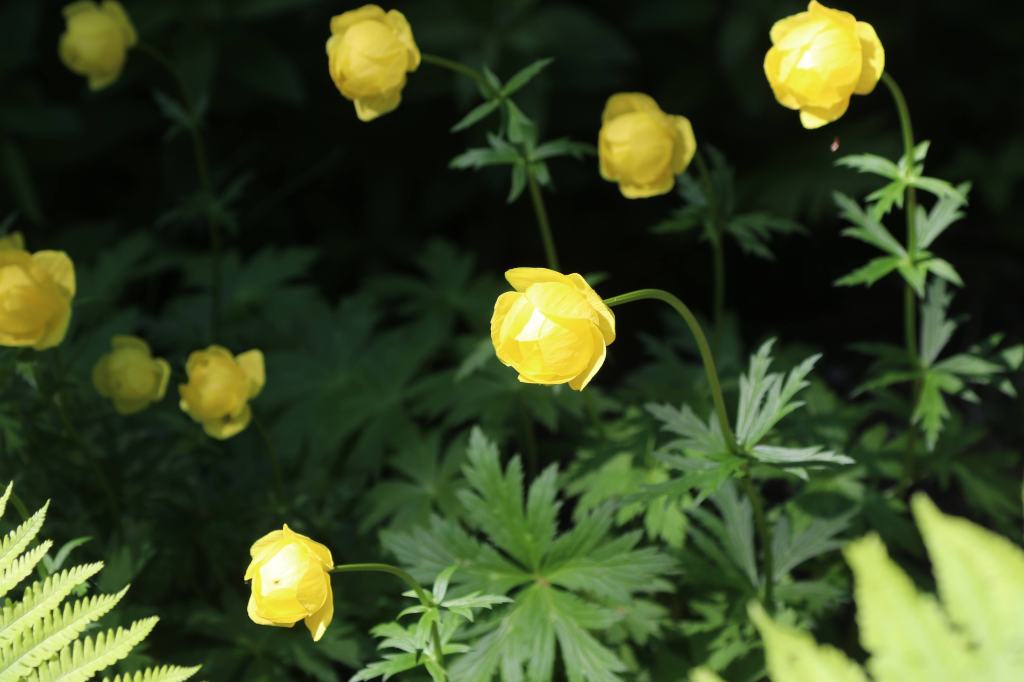
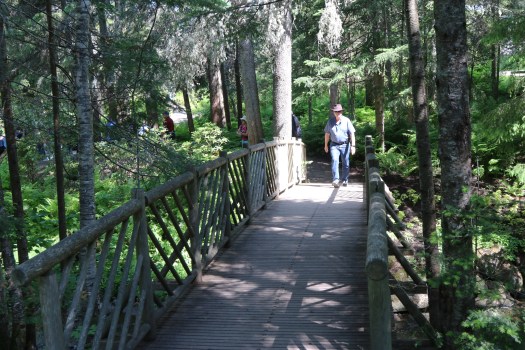
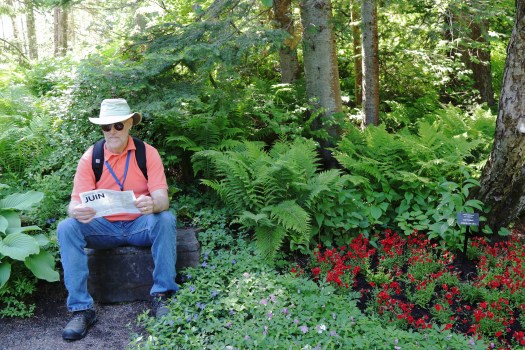
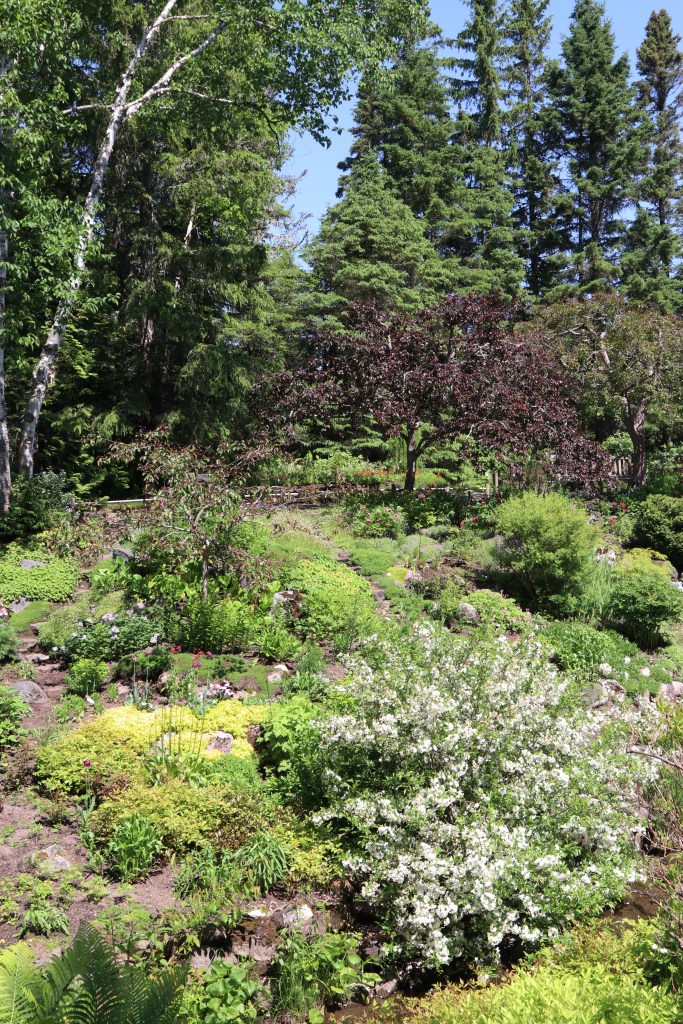
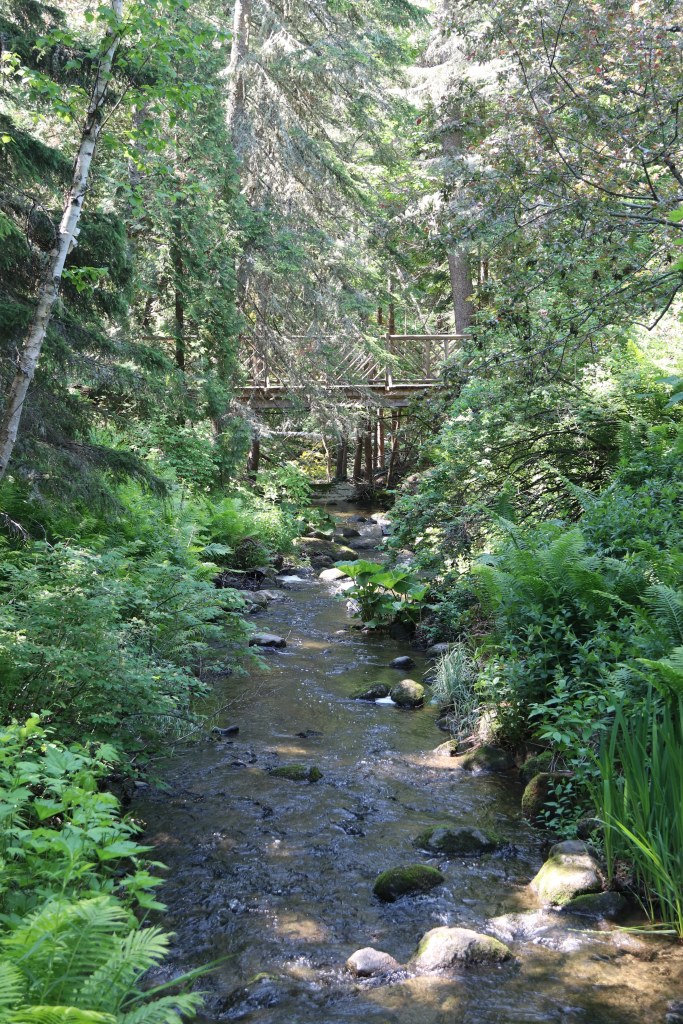
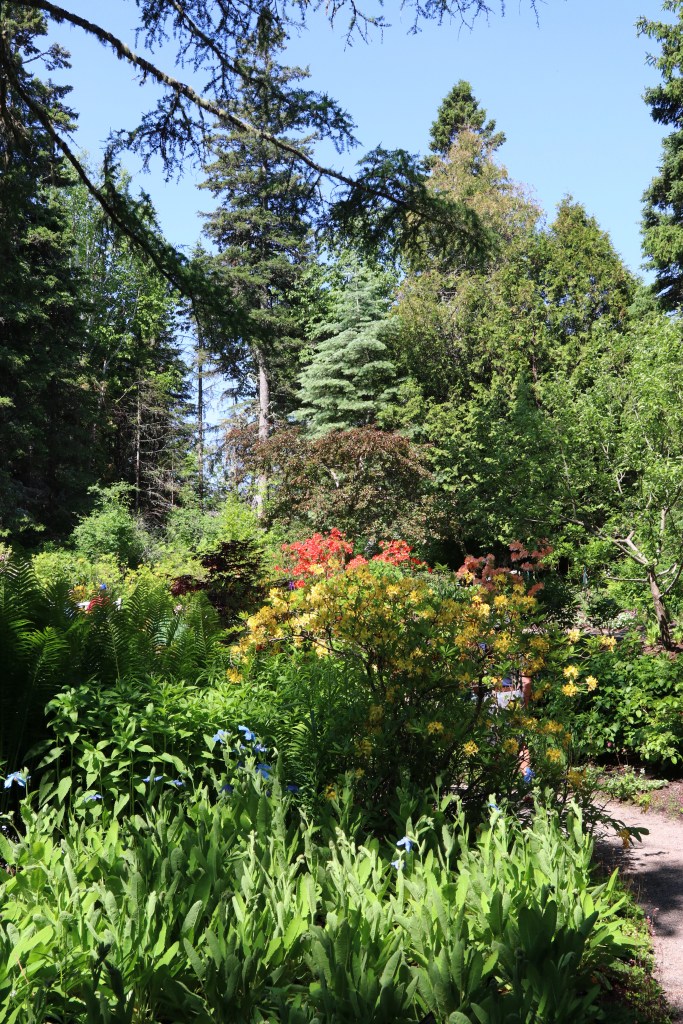
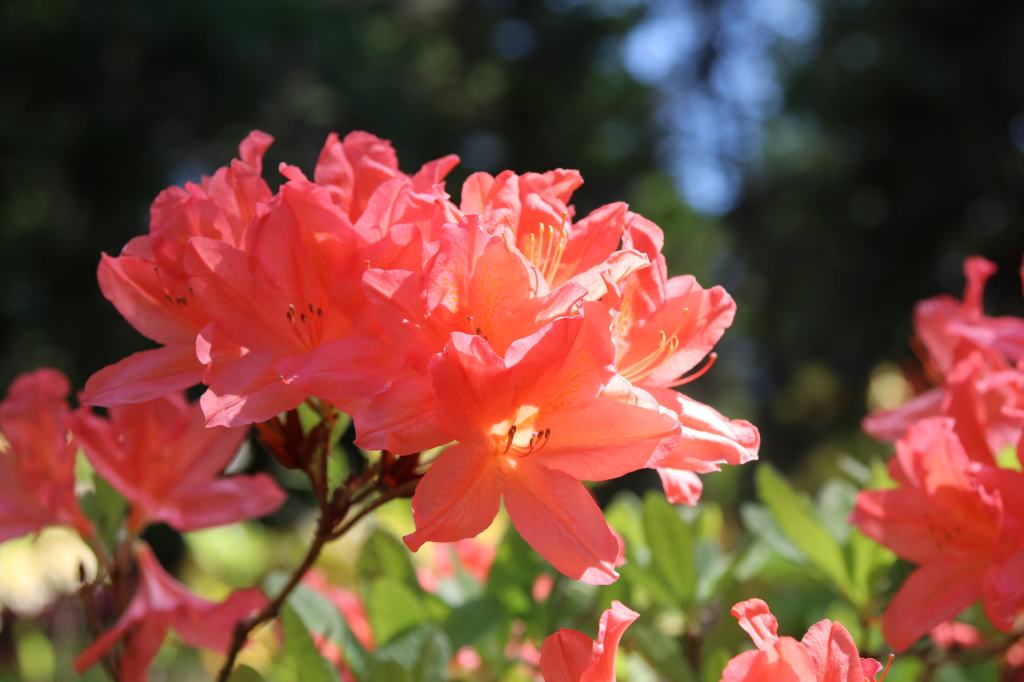
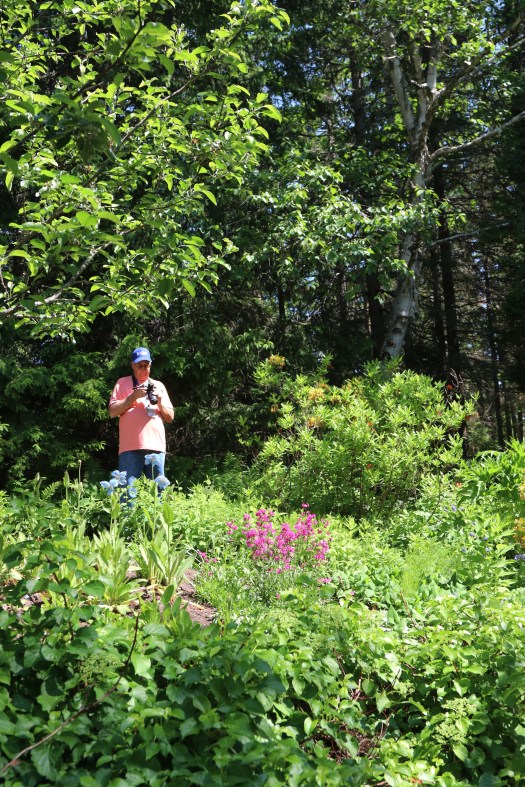
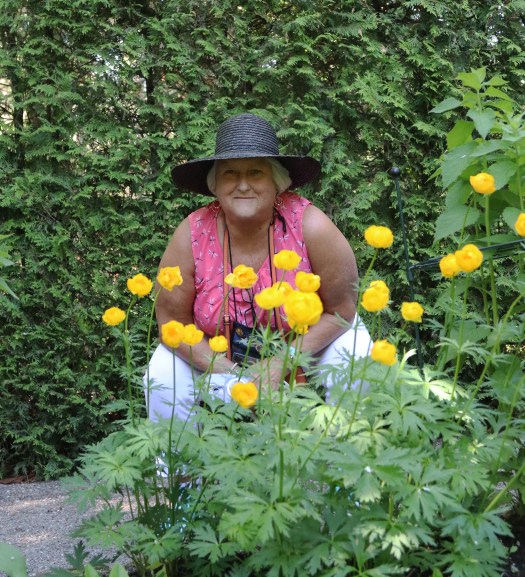
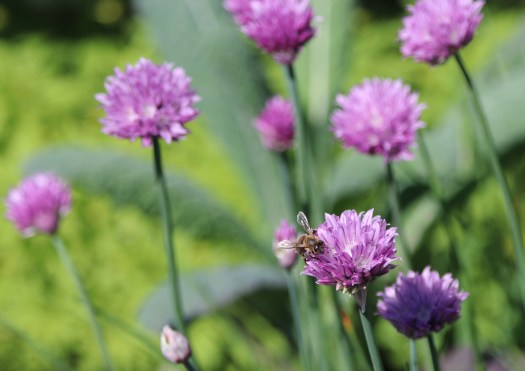
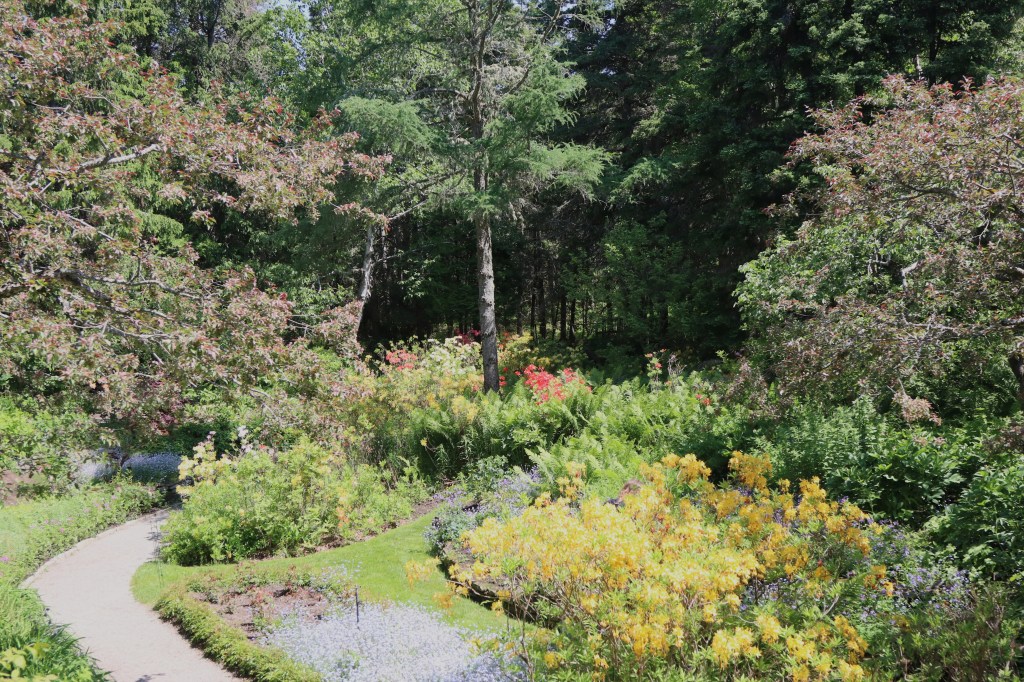
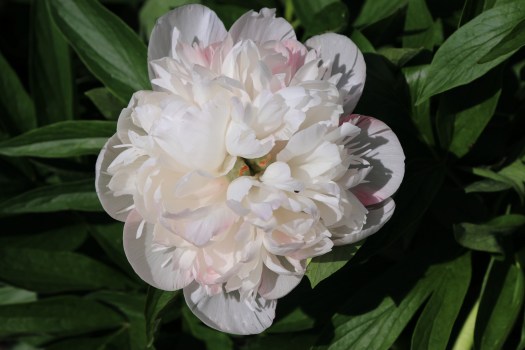
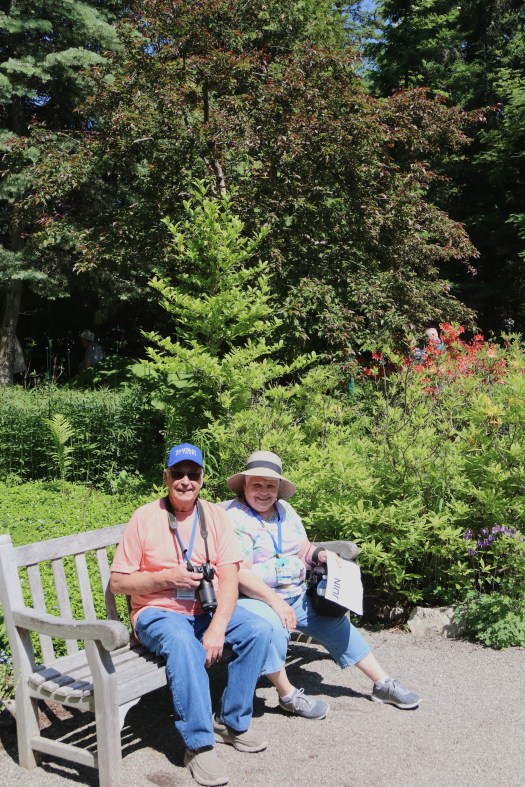
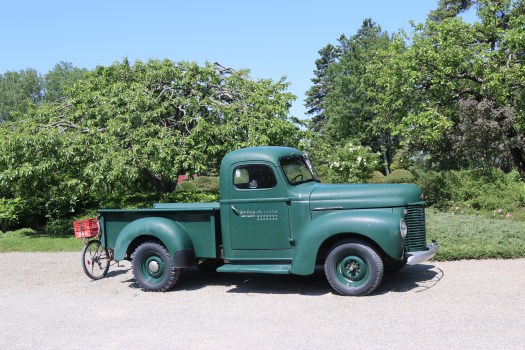
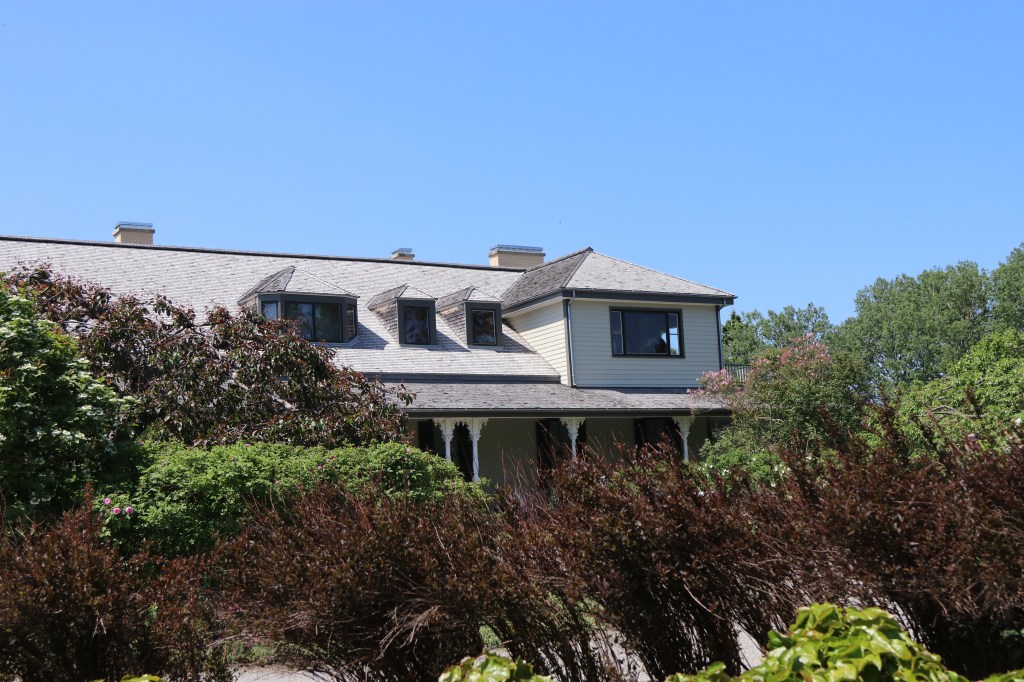
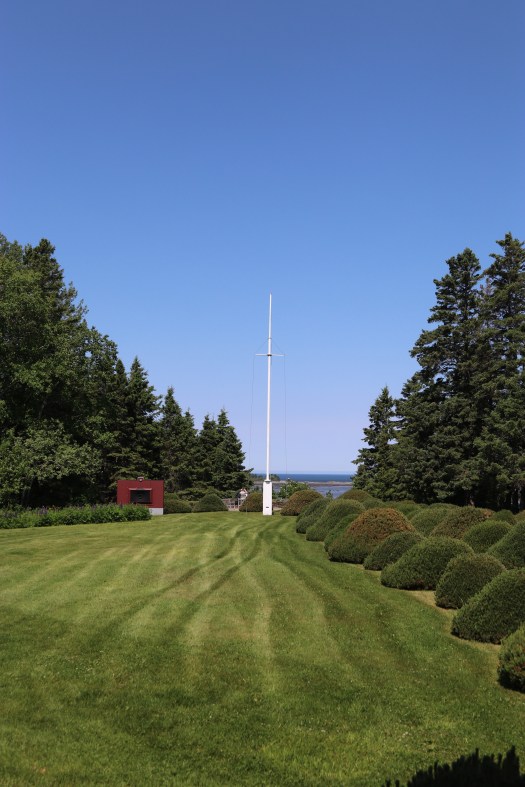
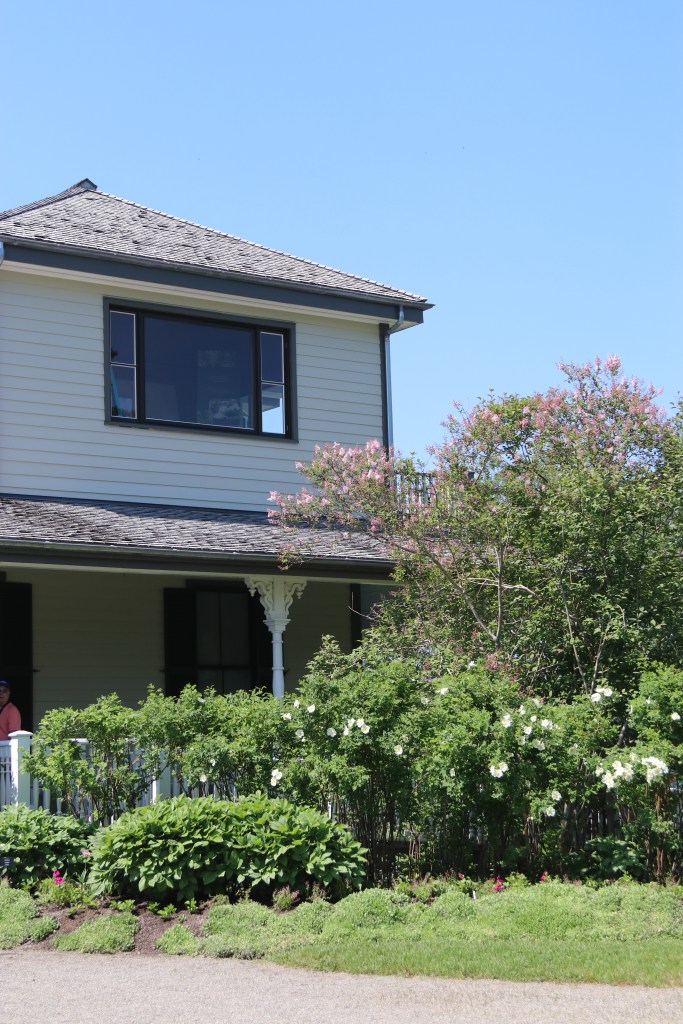
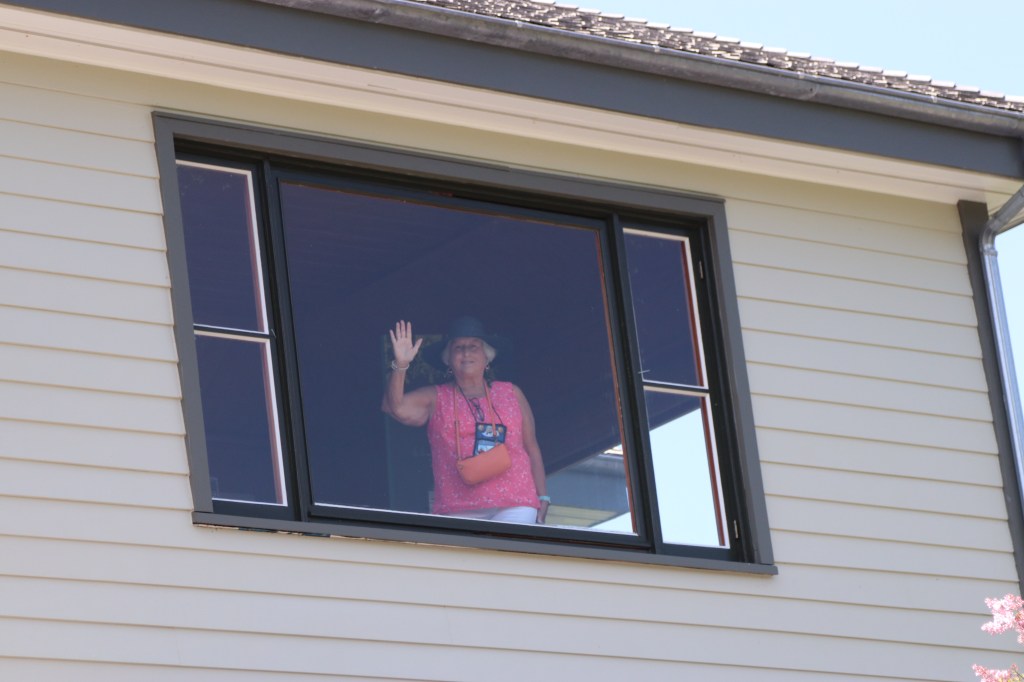
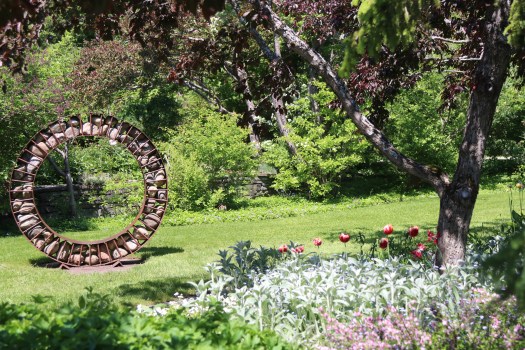
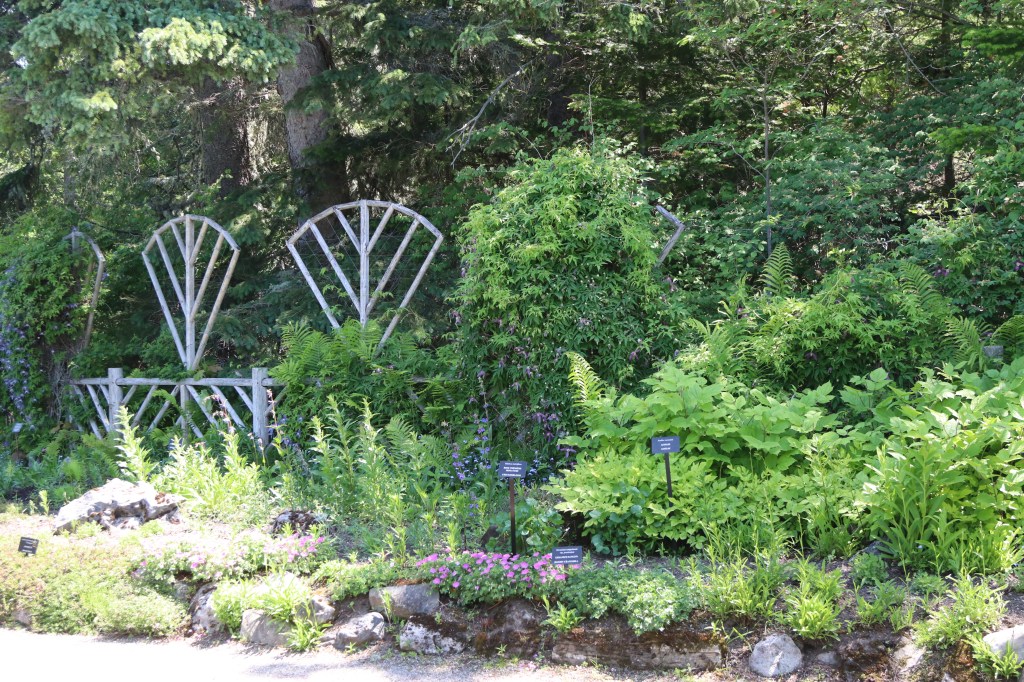
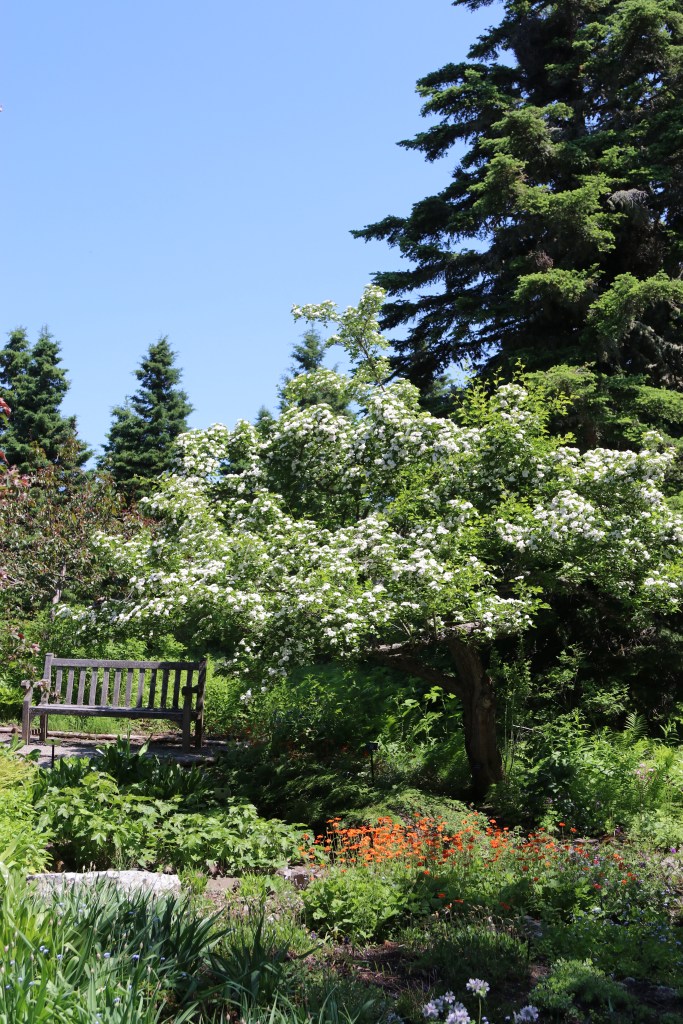
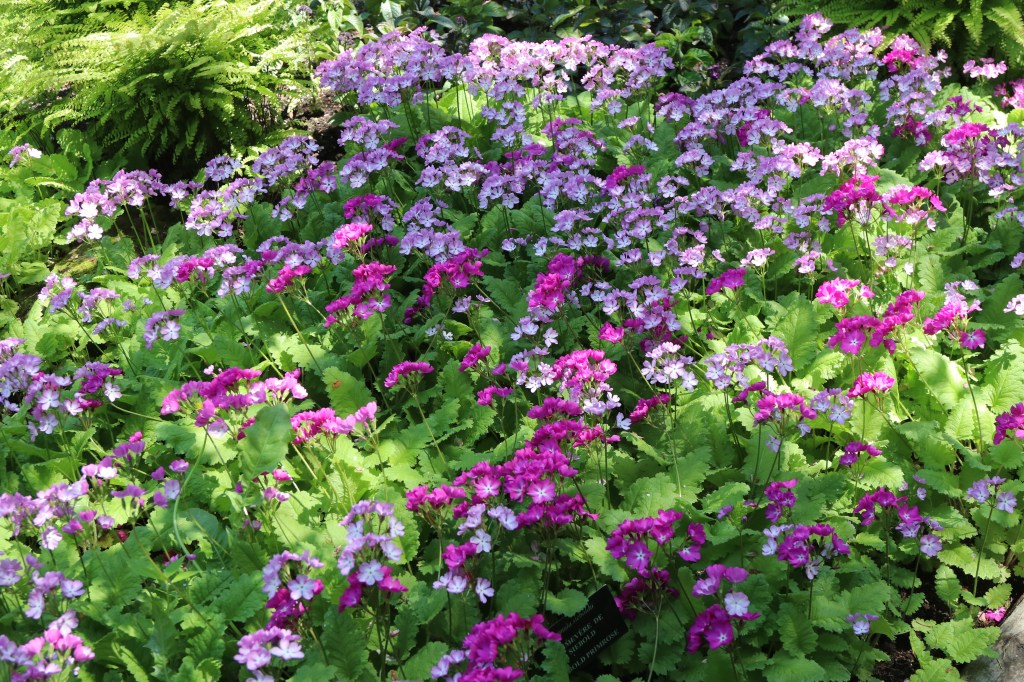
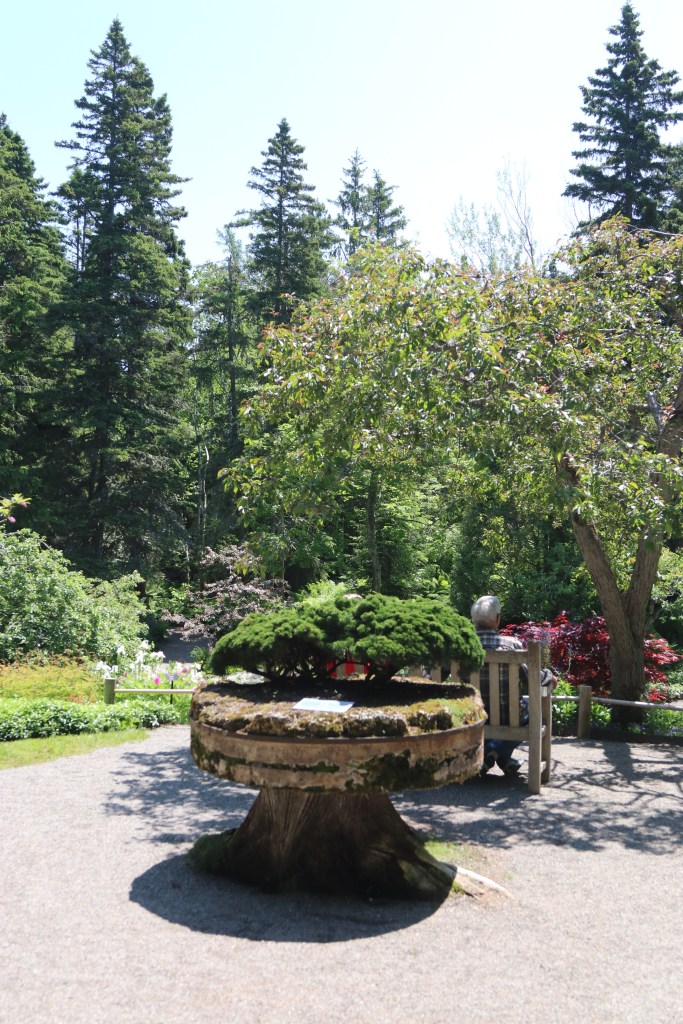
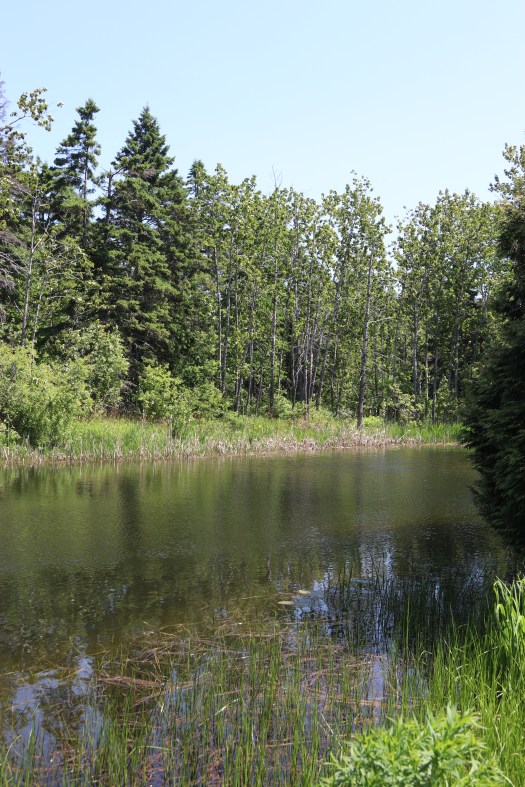
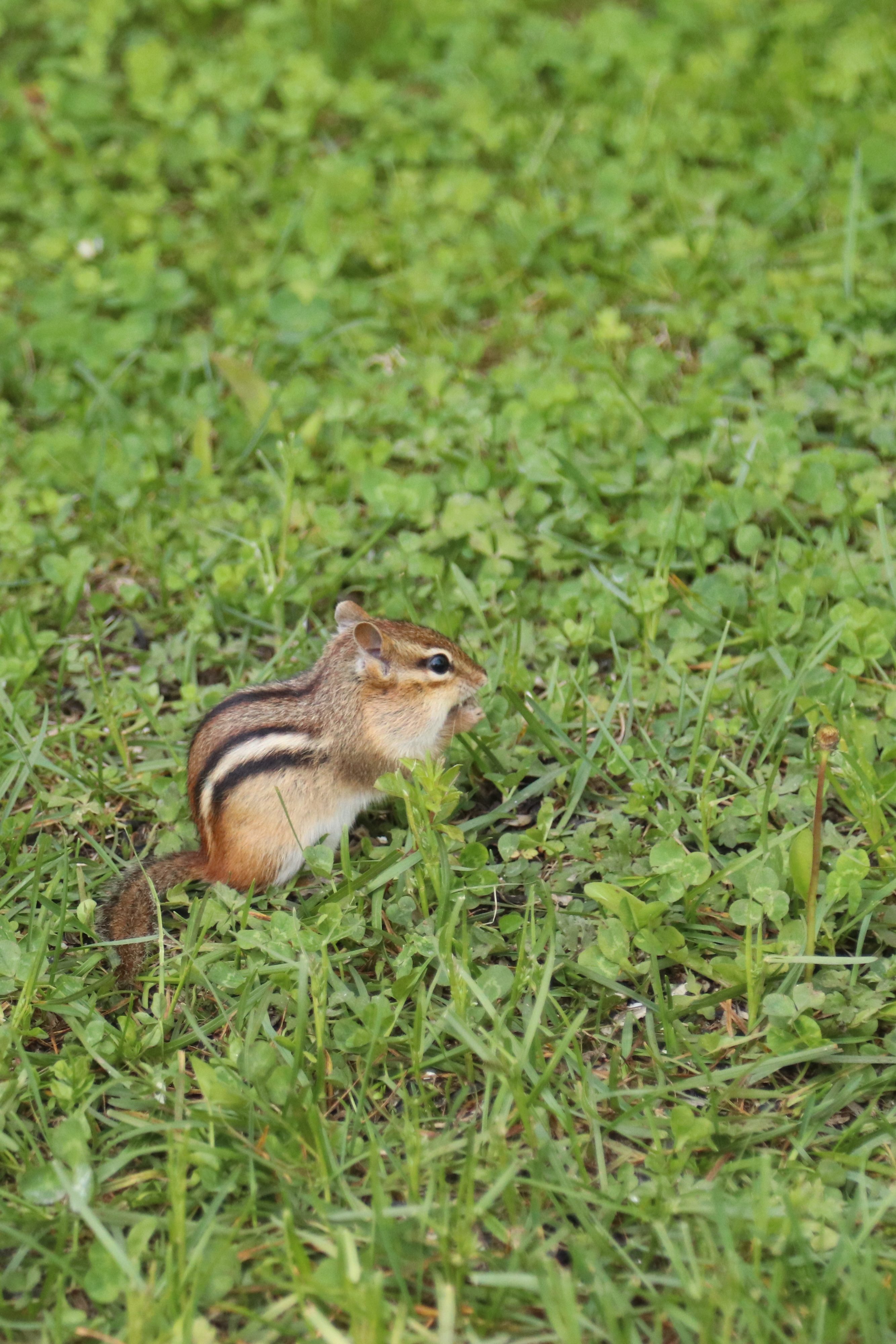
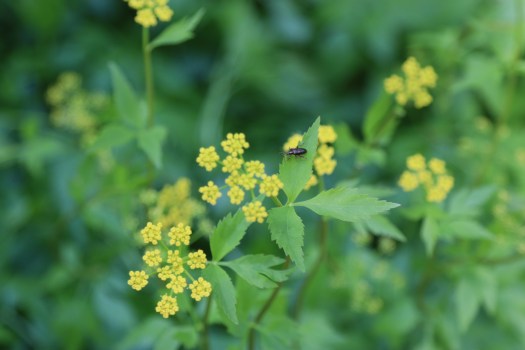
Images at the entrance of the variety which can be found on the grounds. I always have to have a picture of Wendy taking a picture. She was trying to capture a beautiful butterfly.And here’s Jerry walking back to try and find Wendy….I like semi-macro photography, especially of flowers.There’s a beautiful little stream running through the property. Since it’s mid June not everything had bloomed yet. It’s fairly far north. Chris trying to figure out where to go next. Rhododendrons!Johnny checking his camera settings. Rae crouching amongst the flowers.Here’s a little bee looking for pollen. There are lilacs everywhere in QuebecThere was some interesting art as well.One of the few peonies that had bloomed. Most had huge buds but no flowers. Johnny and Caroline enjoying the day.This truck still runs.The lodgeThe Long Walk pathView from the back of the lodge towards the St. LawrenceThe inside of the lodge had an exhibit on clothing styles of Elsie’s time. Rae waving to me from the second floor of the lodgeAs close to the water as we could get. The Long Walk without people…More interesting art.Bonsai!There was also a pond area and plantings around it dedicated to supporting bird life. This little guy was eating up fallen bird seed.
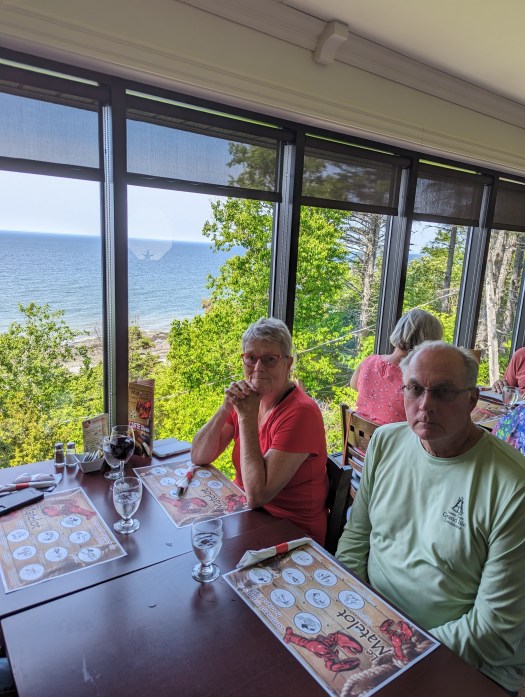
As we tromped around the gardens, many decided we’d like to eat dinner together at a seafood restaurant near the campground called Le Matelot. However, they said they couldn’t accommodate our party for dinner (we asked for 14 seats). So, people made reservations for smaller groups for lunch, after the garden tour. There were plenty of seats available, but I think there was some struggle for them to understand our non-French conversation. I ended up going with Charlie, Rae, Richard and Dana.
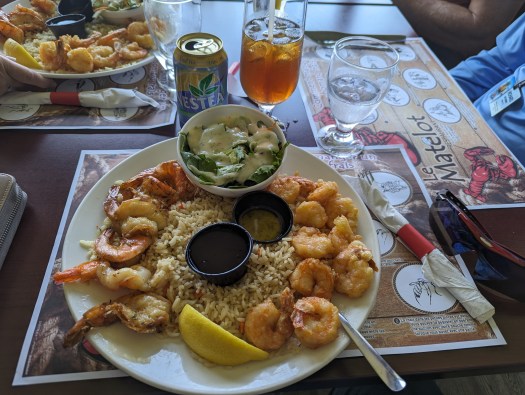
Our view. Not bad. Randy, Mary, and Chris were right next to us. I had butterfly shrimp and mandarin shrimp (crevette in French). Outside the restaurant they had a chair shaped into a lobster (homard in French).
After our late lunch, I went to Mont Joli for fuel. We were due to travel the next day from Camping Annies to Gaspe. While we had a beautiful day in Metis sur Mer, the next morning would alter things dramatically…
Our second day was spent again on a bus tour, but this time a bit further from the City. It was raining in the morning, but cleared up by afternoon and we had a marvelous day. Our very first stop was some 50+ km from the campground. Roger had the driver (a new one whose name I didn’t catch) take us on some scenic routes; most of the way is along the river, so it was quite stunning.
He pointed out typical Quebecois houses. Most have a covered front porch (no snow falling on your head at the door at least), very sloped roofs to help snow slide off, and dormers; they had large families so would use attic space for more rooms.
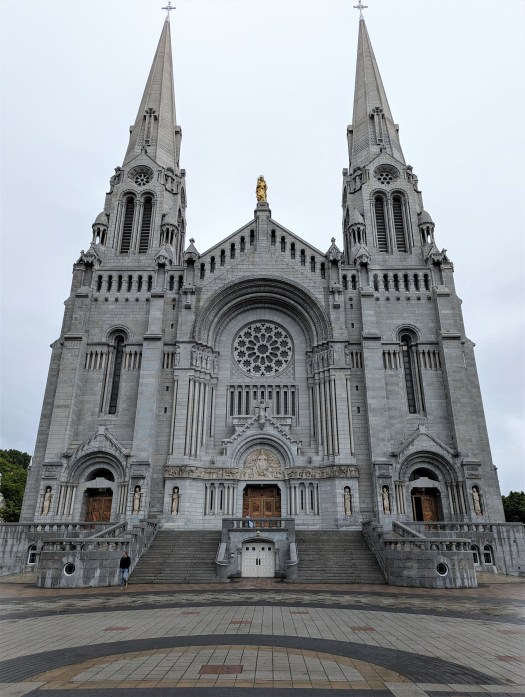
After 40 minutes of travel, we arrived to our destination. The Basilica of St. Anne de Beupre.
The current Basilica was built in 1926 after a fire destroyed the first basilica. However, a church dedicated to St. Anne has stood on this site since 1658. St. Anne is the patron saint of sailors. Roger explained a bad storm on the river nearly killed some fisherman; they prayed to Anne and survived and vowed to build a chapel in her honor. This church became known for it’s miracle cures; it is said that there were storage rooms full of walkers, canes, and wheelchairs no longer needed by the supplicant. Many to this day make a pilgrimage to venerate the mother of the Virgin Mary (and the grandmother of Jesus as Roger kept pointing out).
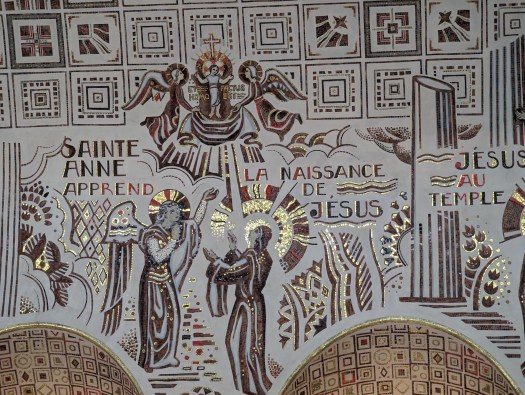
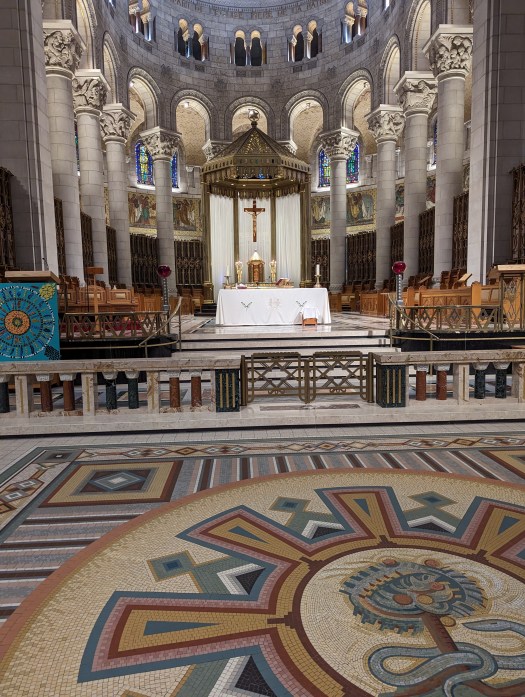
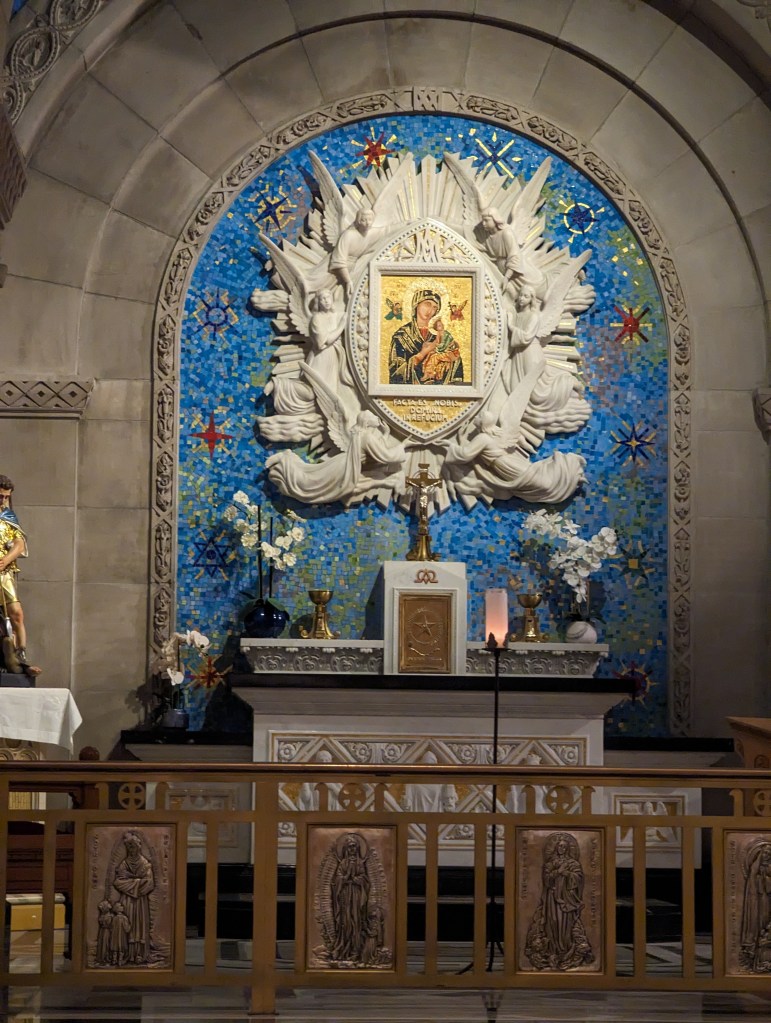
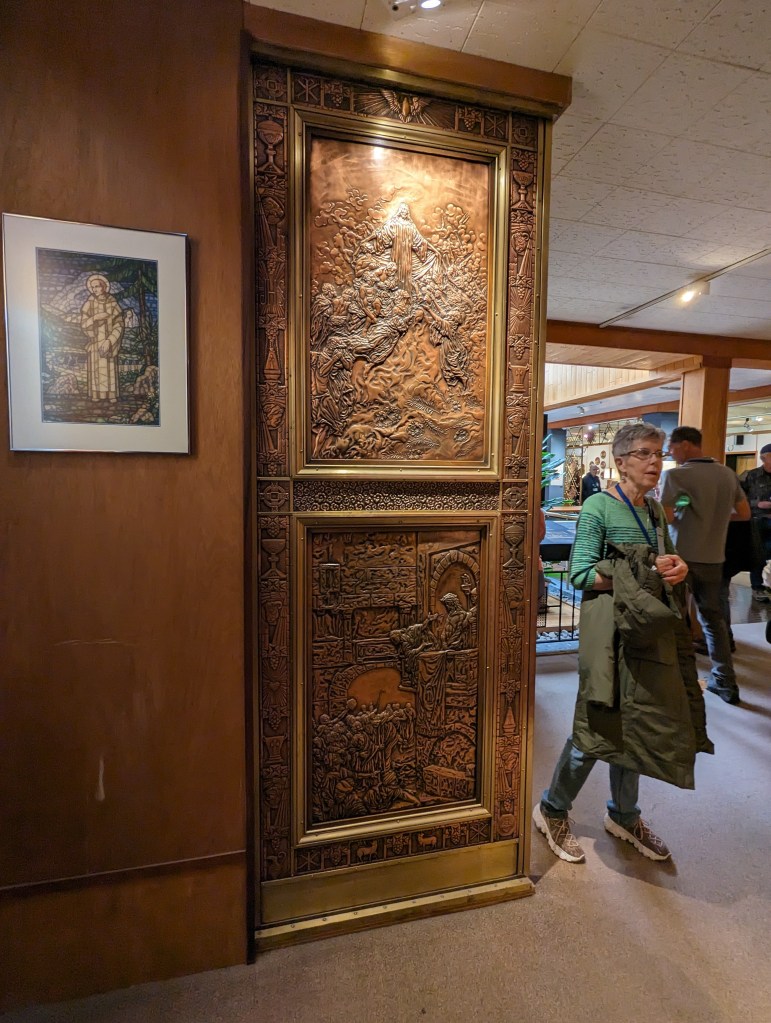
The Basilica has 2 levels. Both are covered in mosaics. The main nave is on the upper level, and it is spectacular. the outer doors leading into the sanctuary are of embossed copper. After our visit to the basilica, we went to the art studio of the man, Albert Gilles, who created the pieces. More on this later.
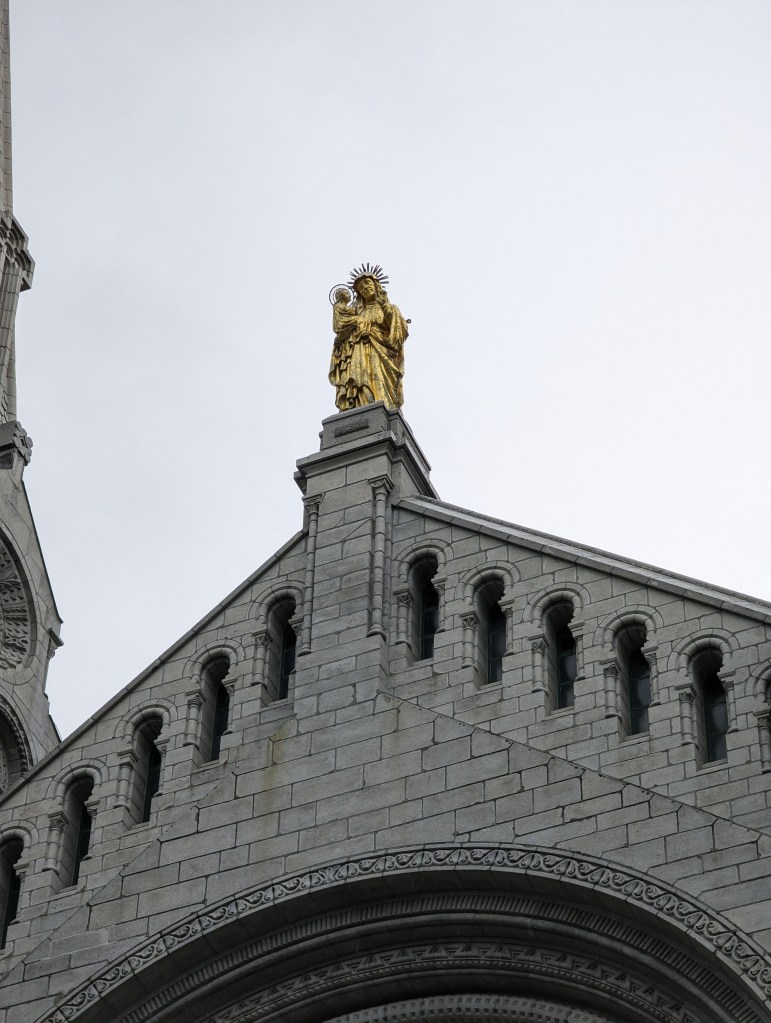
The front of the Basilica has a fountainDetail of the roof statueOne of the 3 entrances with carvings above it.The copper has been lacquered so it won’t oxidize.The doors are quite thick.
Then, you enter the vestibule and even here I had trouble not taking a million pictures.
This is just the vestibule from the entrance. So amazing.Detail of the mosaic.It is breathtaking to think of the work involved.
However, the sanctuary itself was magnificent. It was awe inspiring.
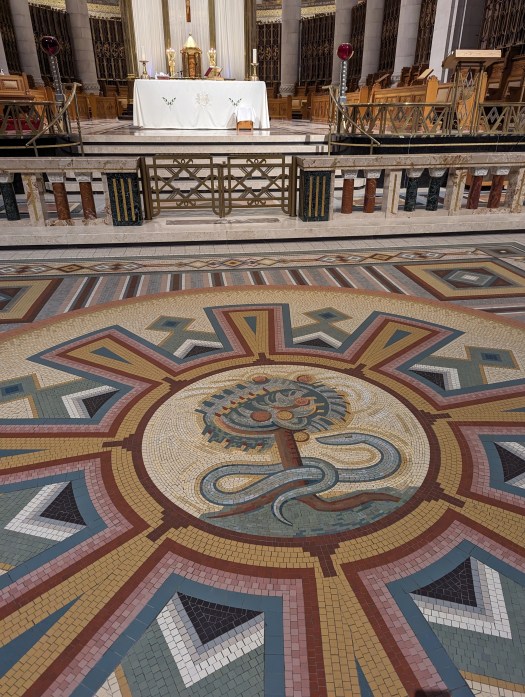
The floors are even mosaics. There are scenes that depict the Seven Deadly Sins through the nave.
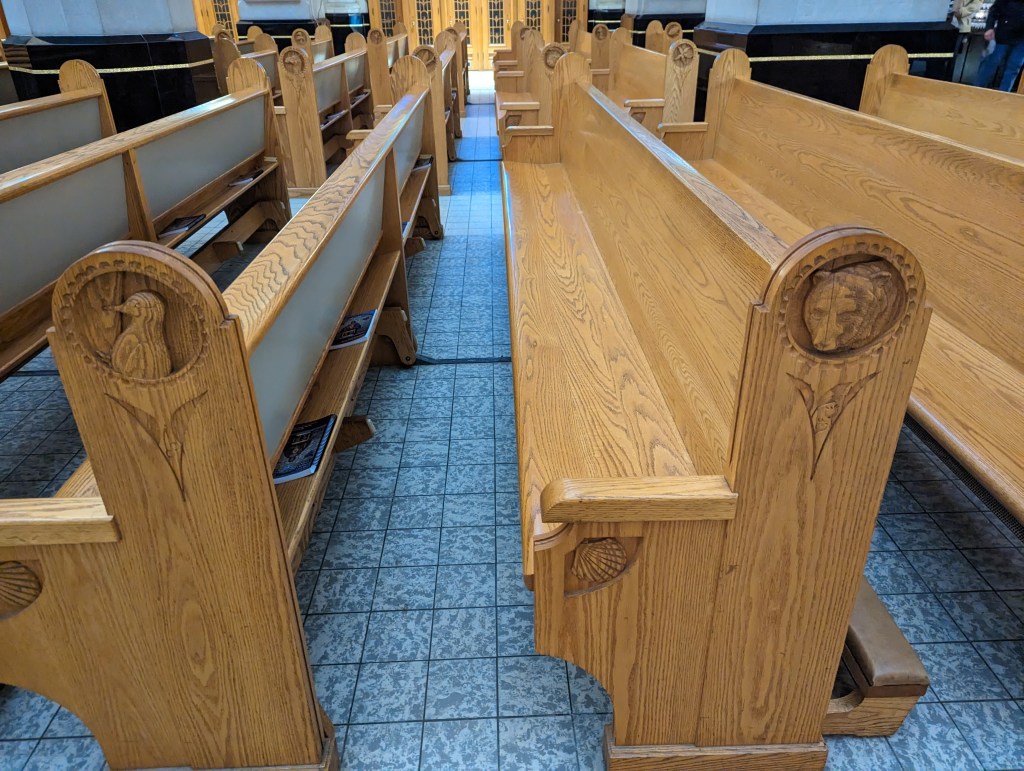
Each wooden pew at both ends has had an animal representing a species in North America hand carved into it. I could have spent hours looking at them, but here are a few.
Two of the pews in the very front feature animals that represent Canada and the United States. Roger stumped everyone when he asked what the official animal of Canada was, with people wrongly guessing moose, bears, etc. I think when someone tossed out “loon” Roger was a bit offended. But they are on Loonies. Then I remembered a video I saw years ago of a beaver welcoming people to Canada; the beaver is correct!
I loved looking at the ceiling detail.
Gold leaf was everywhere!
The altar area had some kind of polished stone columns supporting a railing and surrounding it.
As well as a mosaic of the serpent and apple tree
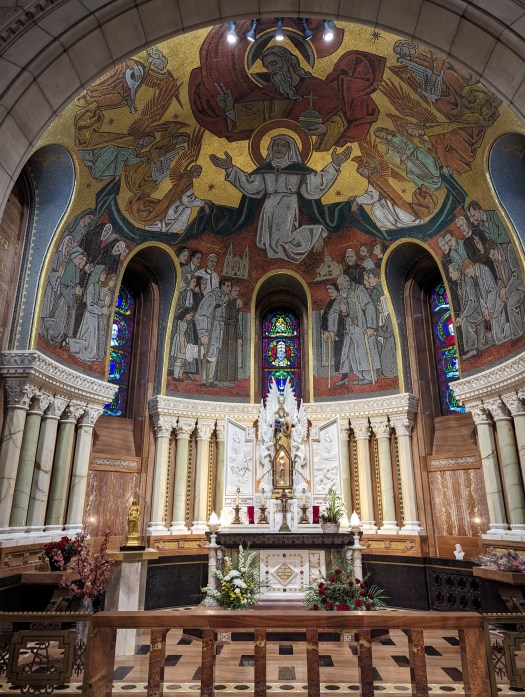
Details of the sides and ceilingMultiple beautiful stained glass as well.
It seemed as though everywhere you turned there was something beautiful.
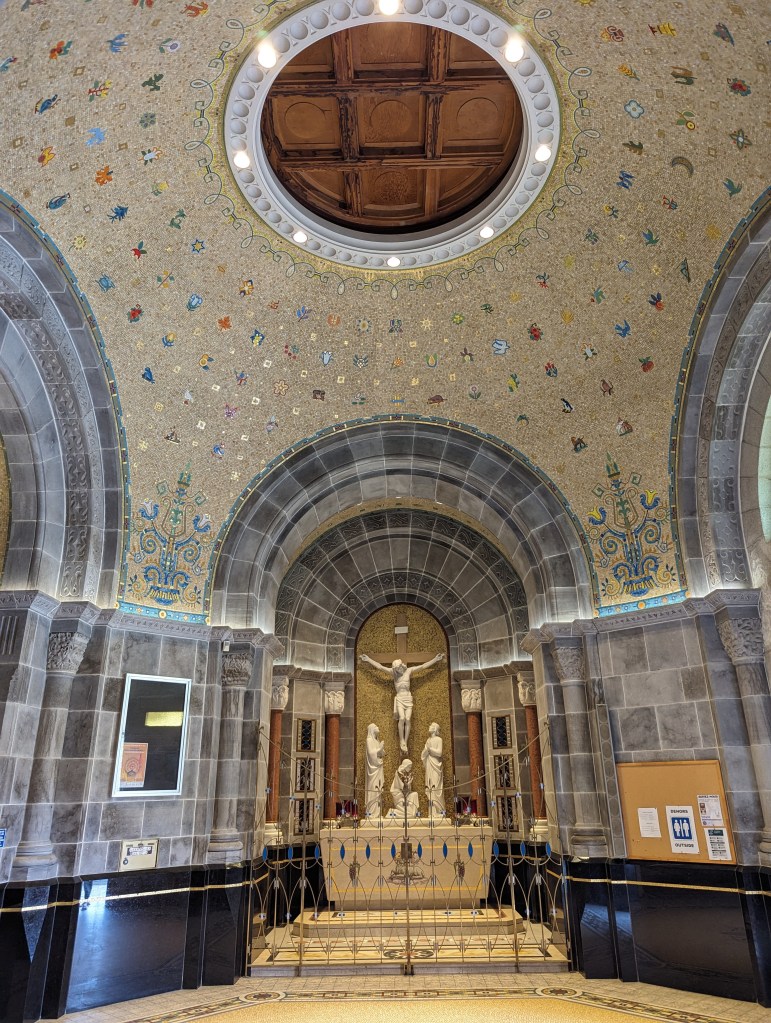
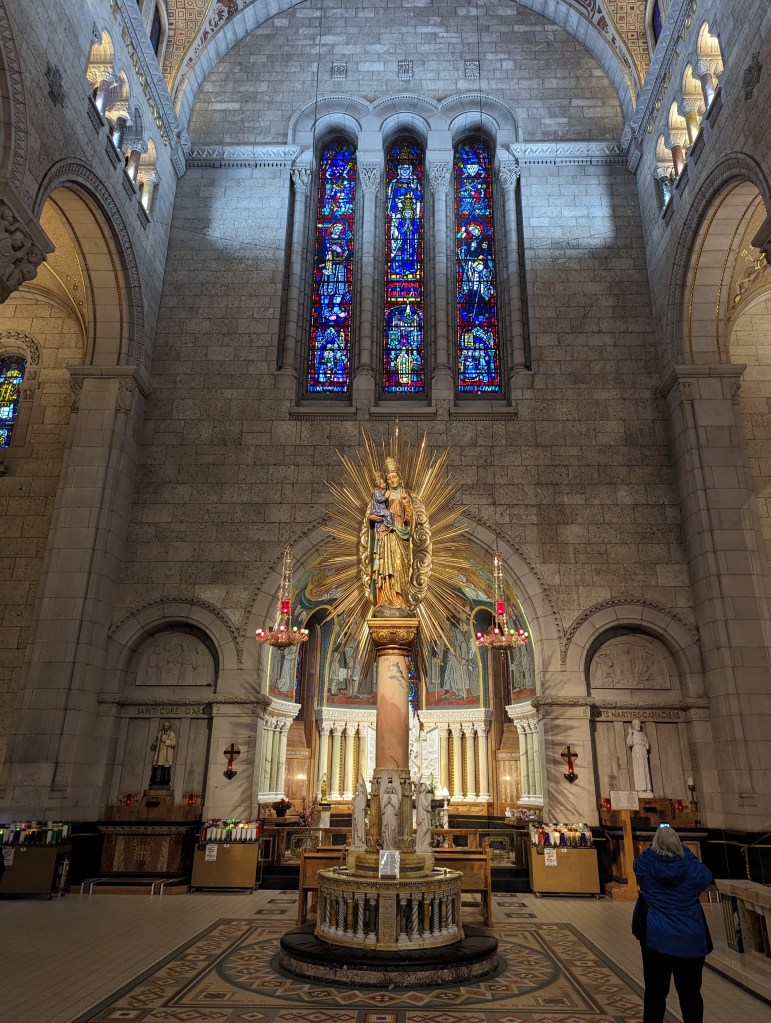
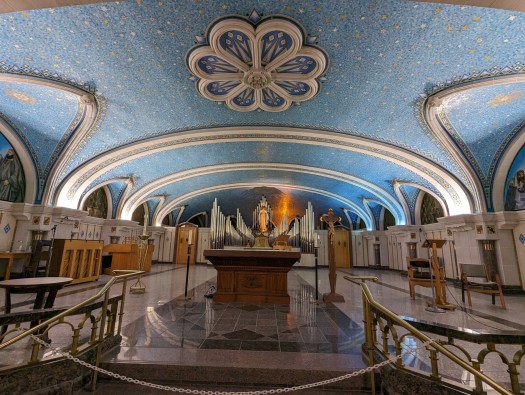
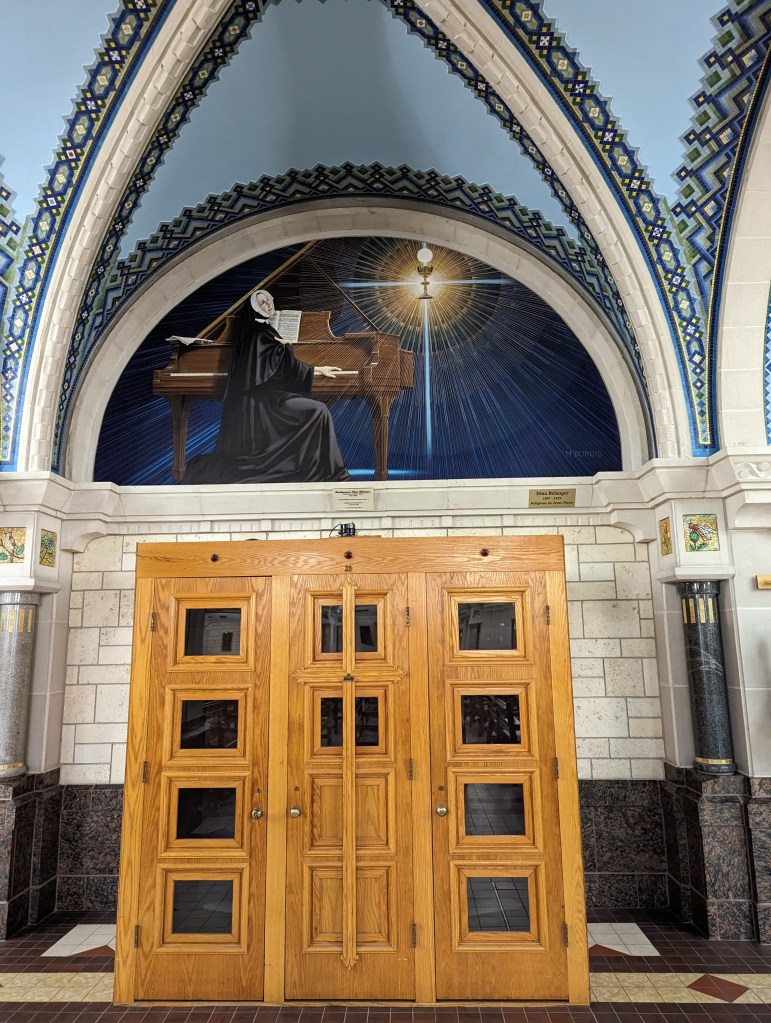
Now, the pictures above are all from the upper santuary. There’s another one below it. This one is dedicated to St. Anne’s daughter, the Virgin Mary. We were told that it features a lot of blue and white colors due to it being for Mary. Again, it’s all mosaic work. And every column had a mosaic of an animal or plant. Again, I wish I could have photographed all of them, but you have to have a limit or this post would be much longer than it already is.
And the final amazing piece at the Basilica was also in the lower sanctuary, to the left side of the altar. It is a replica of the Pieta, made in the same marble that Michelangelo used. The Pieta came to New York for the 1964-64 World’s Fair at the Vatican Pavilion. There was concern it would be lost or damaged, so a replica was made and then later given to St. Anne’s. Some of the people on the trip saw the real thing at the World’s Fair.
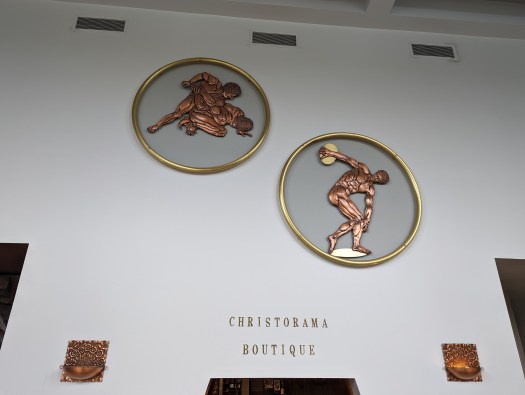
Remember those copper doors at the entrance to the basilica? They were embossed by an amazing artisan named Albert Gilles. Born in 1895 in France, his aunt interested him in copper work. He emigrated to Canada and lived in the U.S. for some time before settling near Quebec City. He died in 1979, but his wife and daughters carry on his work. They have a studio near the basilica, and we were given a tour and shown how they do their work. It was very fascinating. They are the only people in the world still embossing copper by hand.
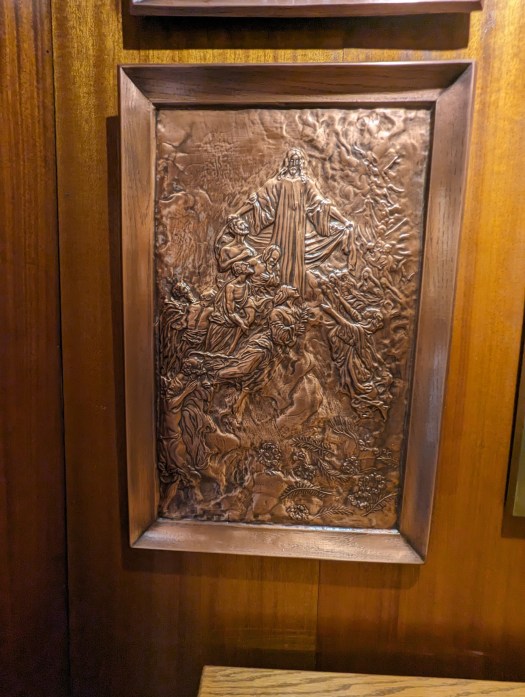
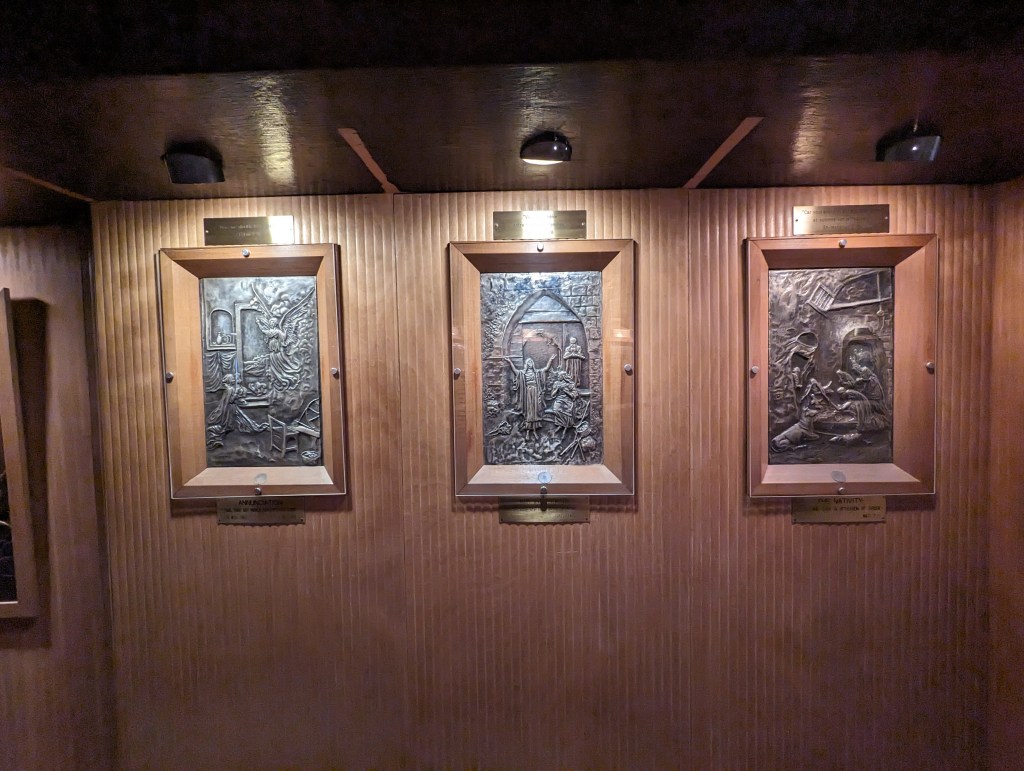
In the back they have a “Christorama”. It is a series of 50 panels of embossed copper that Gilles completed over 15 years’ time that depict the crucifixion and resurrection of Jesus. They are all behind glass with lighting above that gave weird light flares on camera, but they are breathtaking in person.
Copy of one of the panels (it wasn’t under glass…)
Back on the bus, we headed to the Manoir de Montmorency. This manor was built in 1781 and was inhabited by the Duke of Kent from 1791-94. He was the father of Queen Victoria. It is situated on the cliff above the famous Chute (waterfall) Montmorency, named by Champlain in 1608 for a duc of Montmorency in France (who was later the viceroy of New France). We ate a delicious lunch at the Manoir and had the opportunity to look at the falls from above.
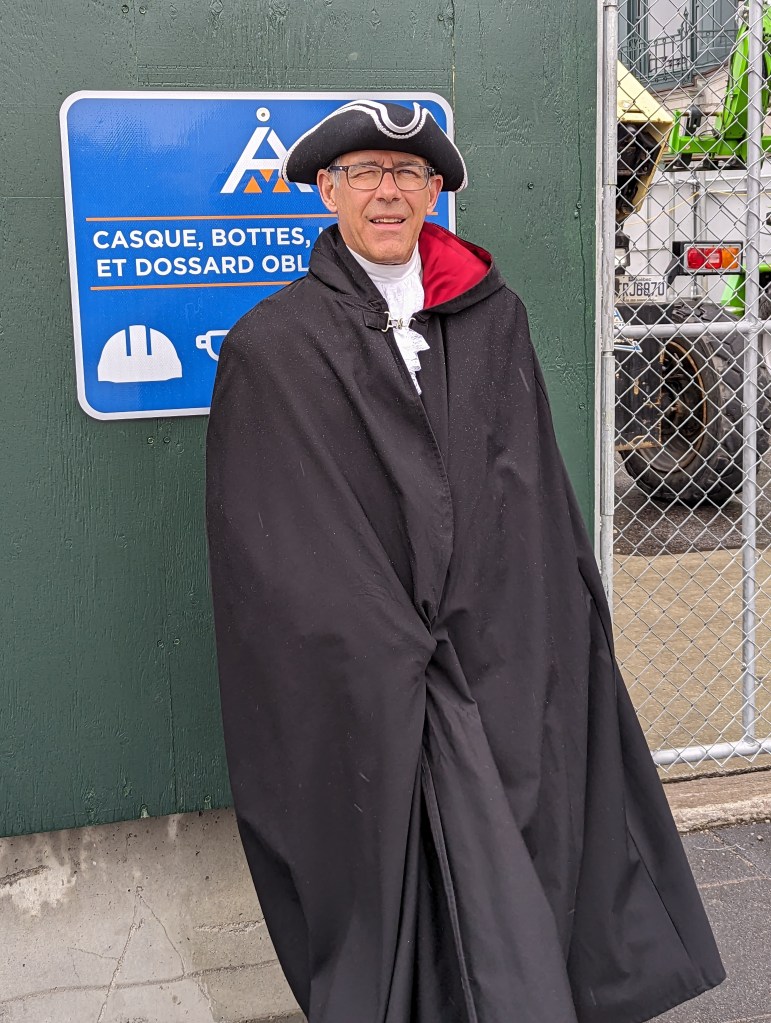
There was even a woman in costume walking around. She said she was the daughter of the Duke.
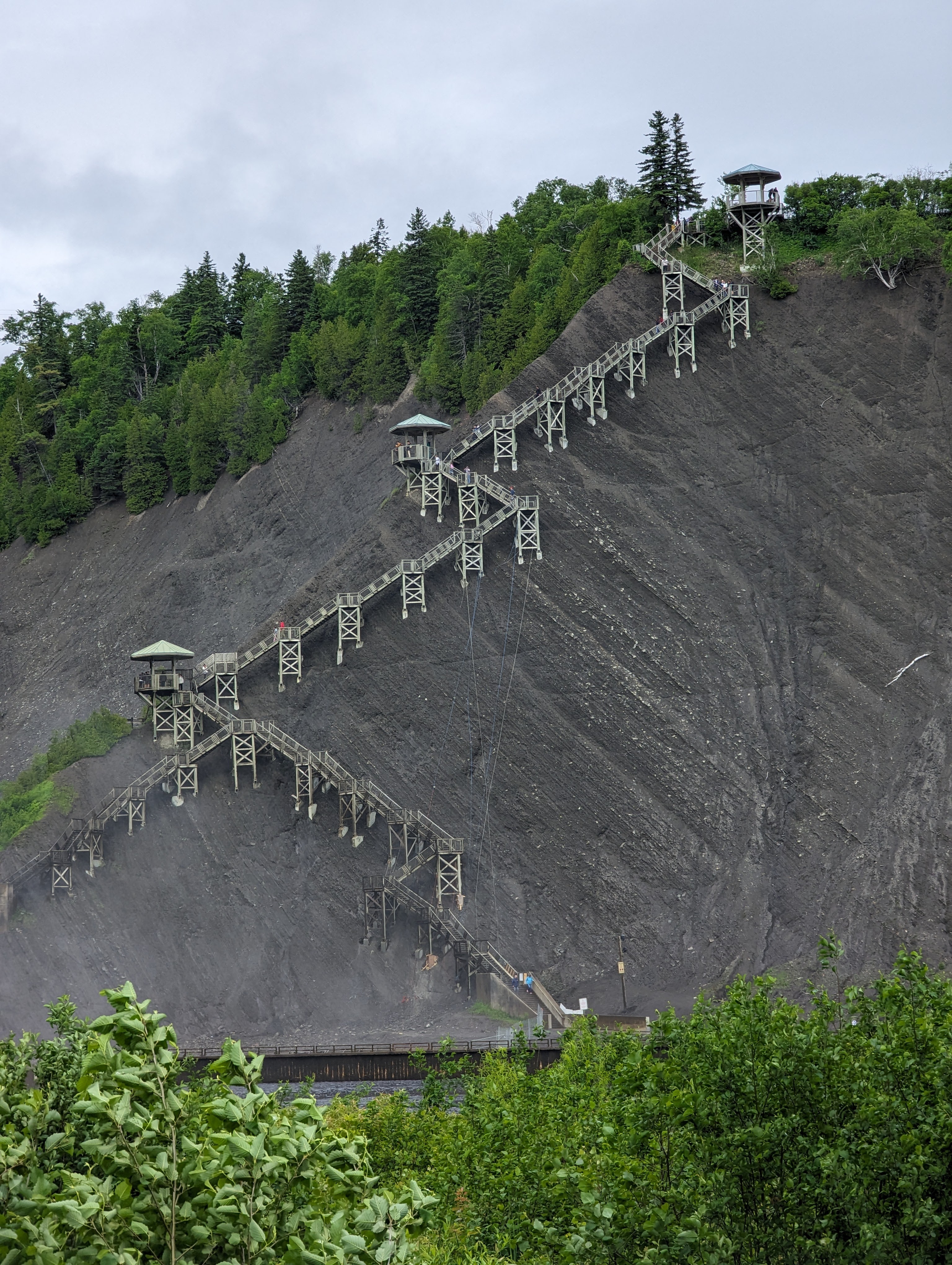
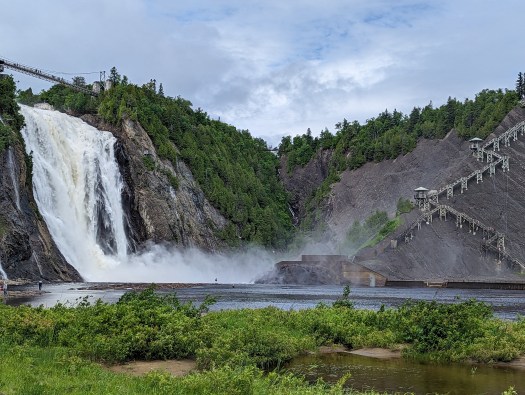
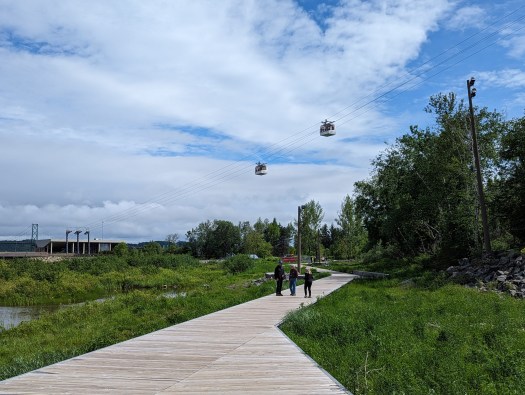
After we were finished at the Manoir we drove down to the bottom of the falls. We took a group picture (I don’t have a copy at this point) and wandered on a boardwalk near the base. There is a staircase to a ziplining opportunity as well as a gondola that you can ride from the bottom to the top.
From a distanceMuch closerTo the left of the falls at the top you can see where the zipliners landClimb to the top to zip from here to the fallsBoardwalk and gondola
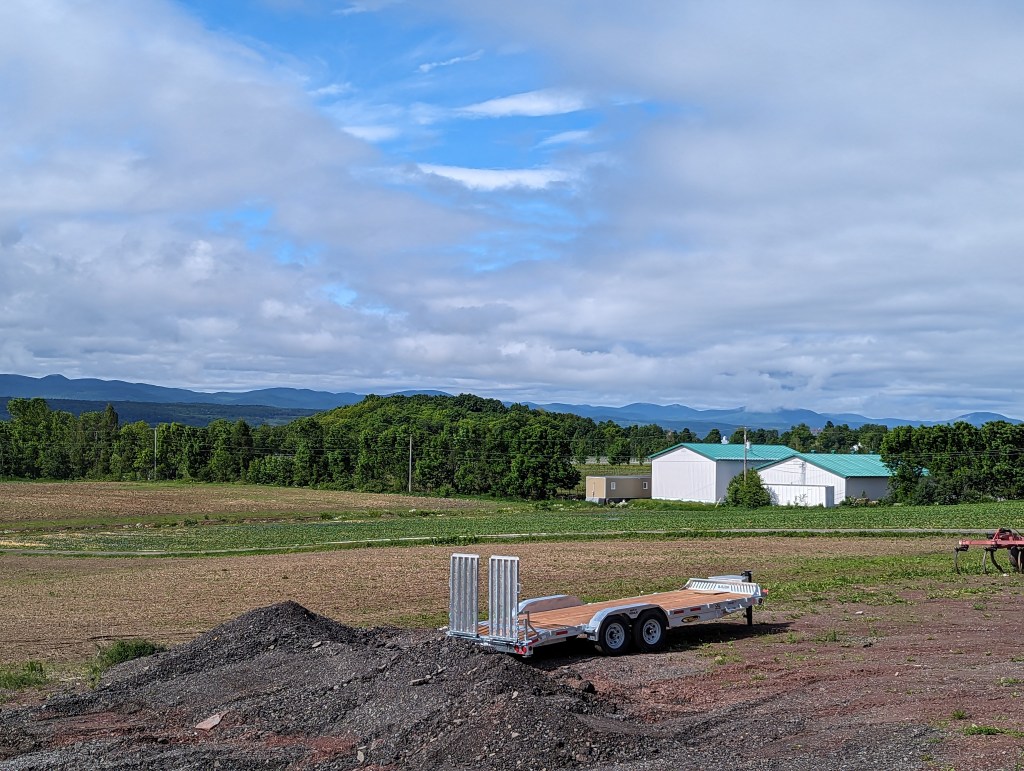
To end the day, we were driven across the St. Lawrence to the Ile d’Orleans, an island in the river about 5 km east of downtown Quebec City. It’s 21 miles long and 5 miles at it’s widest point. It was where James Wolfe and his British troops observed the French defenses of the city before attacking at the Plains of Abraham. It has very fertile soil and has long been utilized for agriculture. We went to a farm market there and had the opportunity to buy some delicious fresh veggies and fruits (strawberries are grown all over here) as well as canned and bottled treats.
The farmhouse was across the streetPart of the farm with mountains across the river in the distanceOn the bridge, almost to the island, this RV/pontoon boad was stranded at low tide near the shore. There were people hanging on on it. We all though it was hilarious.
My final pics are of the city in the distance as we crossed back to the mainland. It was quite a long but wonderful day!
Quebec City KOA, our next destination, was 240 km give or take from our campground. I remember thinking there was far more traffic than I would have expected between the two. While there is a major road that we took, the A20, it was never light traffic. I had no issues, but unfortunately John and Sherry, from Tuscon (and friends from my Alaska trip) had a trailer wheel bearing go bad; they pulled over when they noticed some smoke! Harry and Linda, our tailgunners, stopped and helped John fix it enough he could get to the campground. Many of us had stopped some 40 miles ahead of them at a rest area; Jerry was preparing to drop his trailer and go back when we heard they were finally able to get moving again. But it reinforces to me why I go with groups of people. Someone is always around ready to help. Jerry has torqued all my lugnuts and my hitch bolts at least once already.
The KOA in Quebec City was much more to my liking; I could park my truck in front of the fifth wheel without too much maneuvering around. It was also near a large IGA store which I ran to the day we pulled in. It was a bit weird not knowing the brands they carry and not recognizing foods since all the descriptions were in French, but I did ok.
The next morning was our first of two full day bus tours. This time the bus left at 8 sharp and our guide was a lovely gentleman who introduced himself as “Roger the great”. He clearly has a great love for his city and was full of knowledge about what we were seeing. The only sour note is that the weather was not so cooperative; it was raining and that would be the theme for both days. Wind, wind, wind, rain, rain, rain. We just brought our rain coats and powered on.
Quebec City (hard K sound for the Qu, not cwa-bec) is on the north side of the St. Lawrence river, while our campground is on the southside in a place called St. Nicolas, very near Lévis. Quebec City was founded in 1608 by Samuel Champlain. He took the Algonquin word for the area, Kébec, which means “narrows” because the St. Lawrence River narrows down to just 3/4 mile wide here. Quebec City is also where the river becomes tidal. The St. Lawrence is the main discharge river for the Great Lakes; it is all freshwater until around Quebec City where the water starts to increasingly become “brackish” or salty, and there start to be noticeable tides.
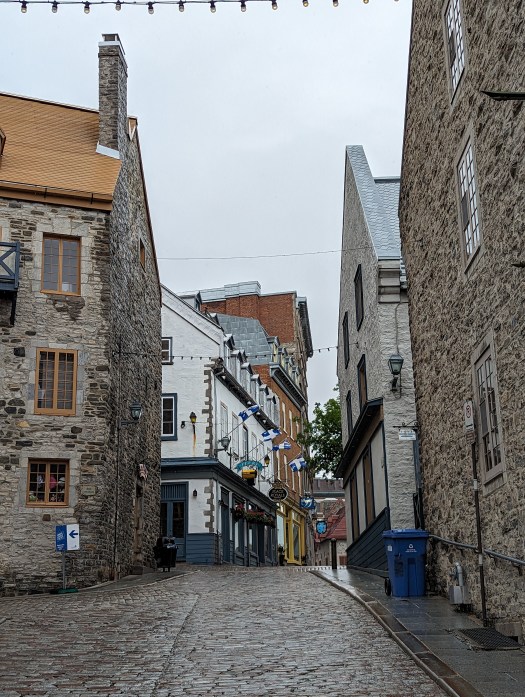
After we crossed the bridge and drove along a lovely riverside road for some time we came to Lower Town. Picture a city built on a cliff. There is an Upper Town and a Lower Town. Imagine you are a settler trying to survive this harsh land; they build walls to surround it. Quebec City is the only fortified city with its walls and gates still remaining north of Mexico. It was designated a UNESCO World Heritage site in 1985.
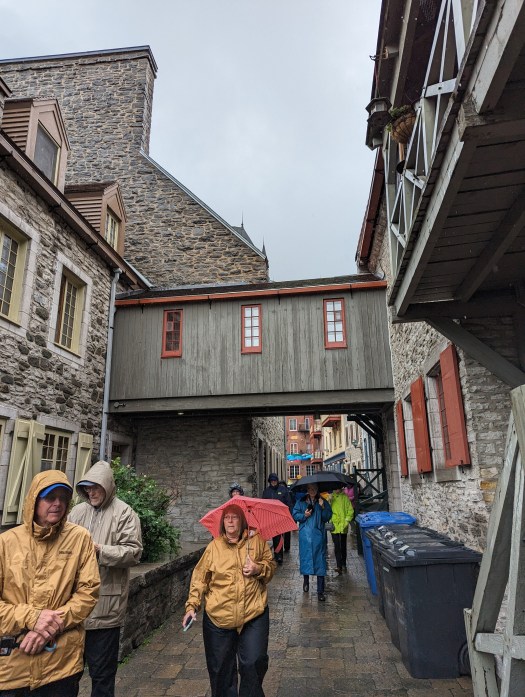
We set out with Richard to walk the cobblestone streets in the rain. As it happened, there was some sort of marathon/running race happening at the same time, so we cheered on the runners as we kept encountering them on our explorations.
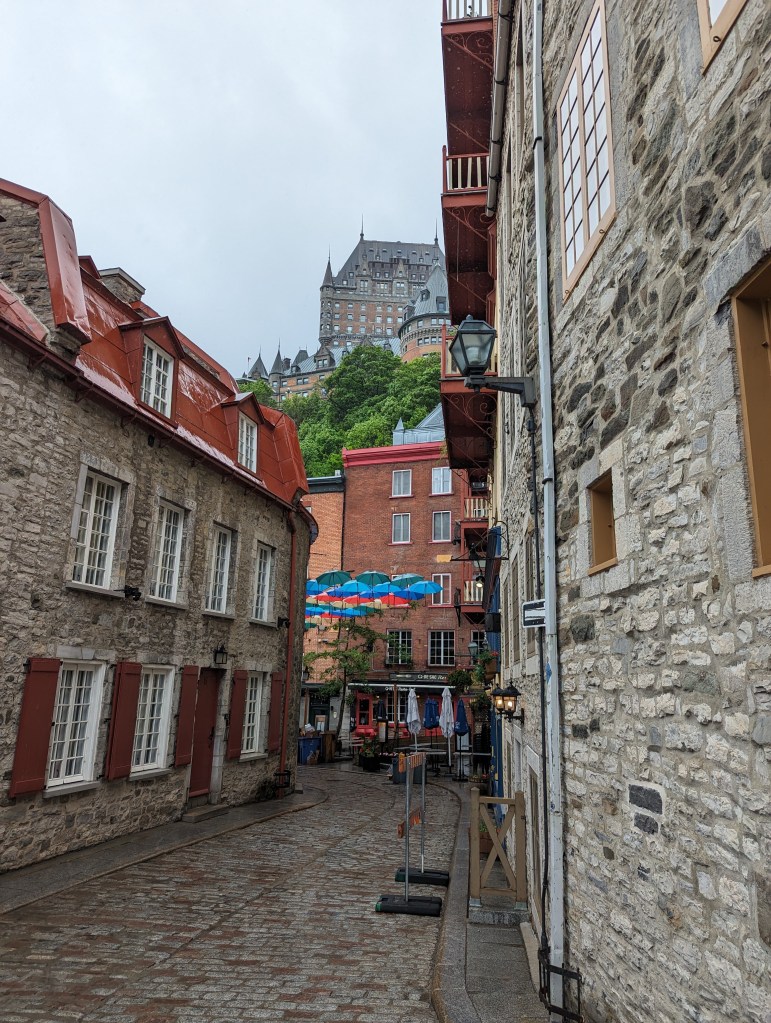
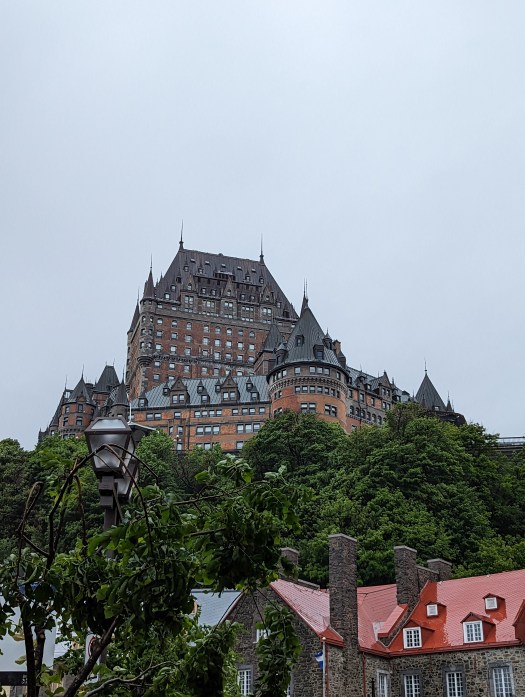
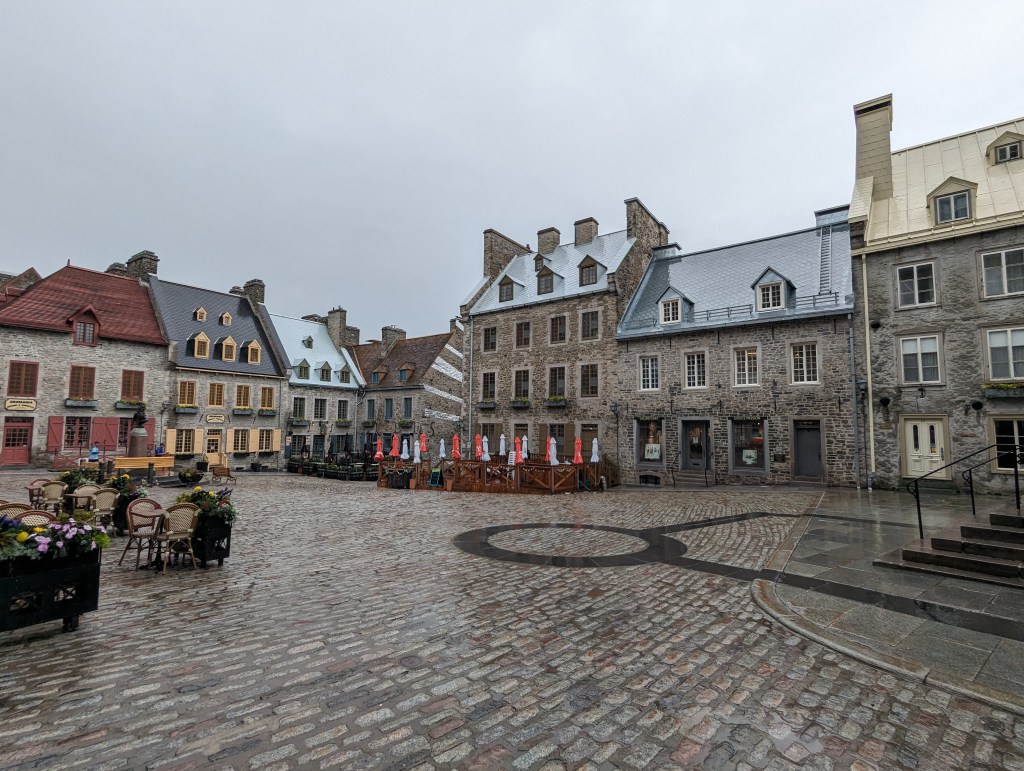
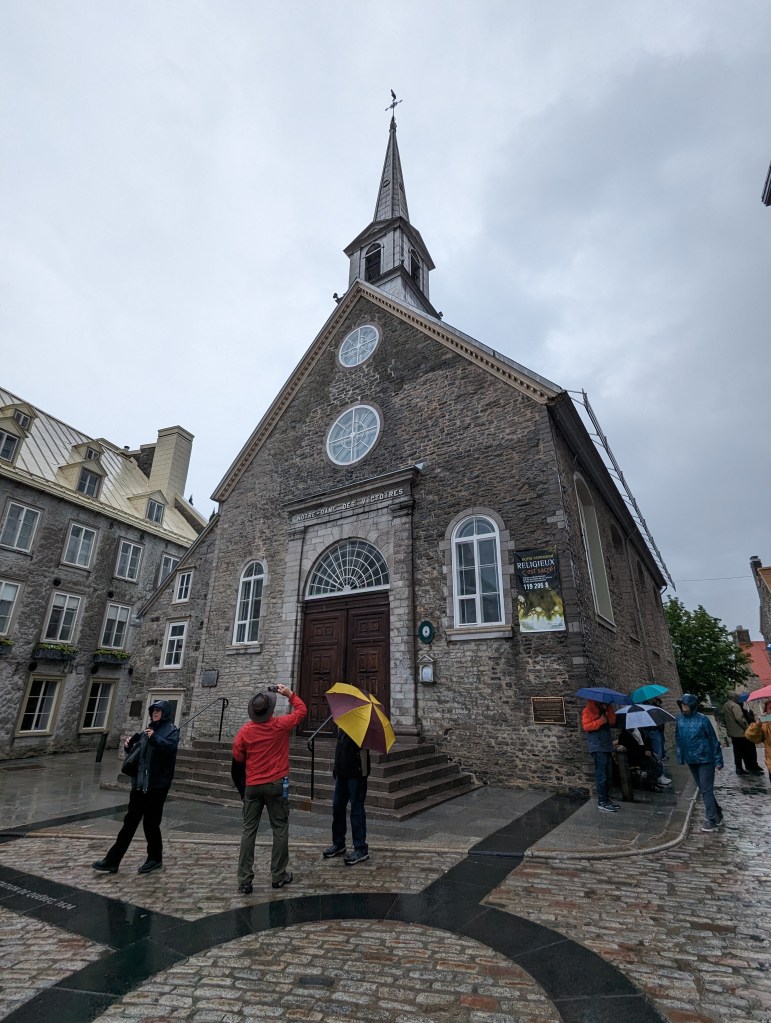
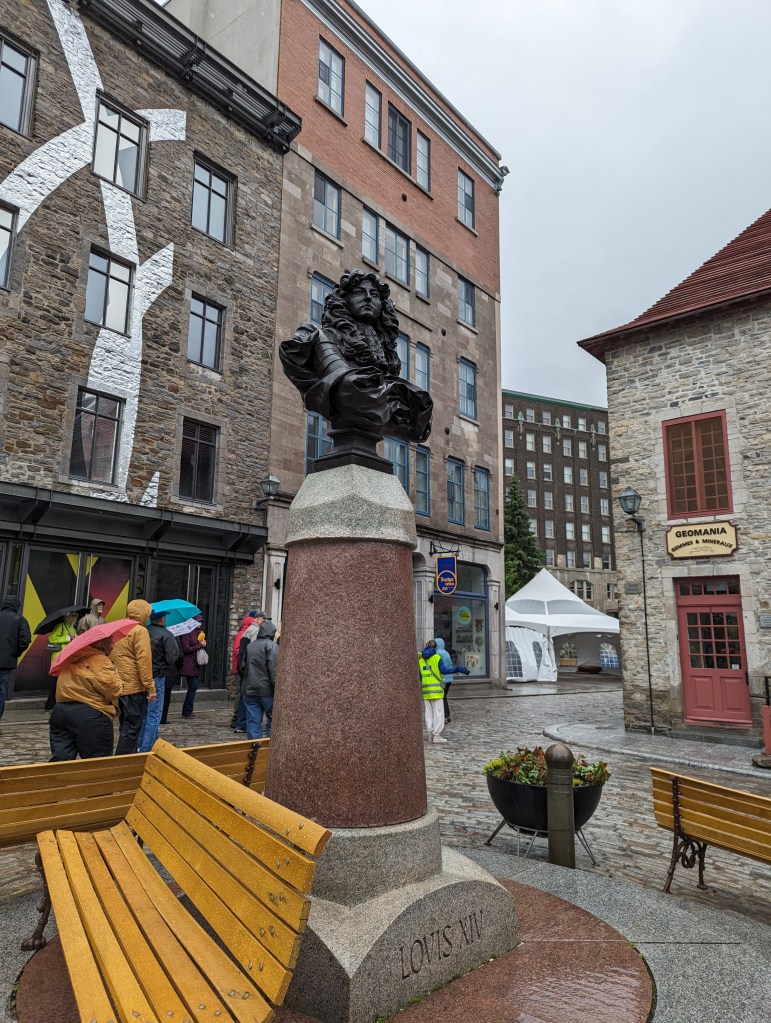
Old Quebec has kept much of it’s European heritage evidentThe wind would undulate these umbrellasI thought it was a really cute ideaThe Chateau Frontenac looms over Lower TownWe walked through this tunnel to another street. Randy had to duck. Came out into the Place Royale; the runners were going down the far street.Notre Dame des VictoiresLouis XIV
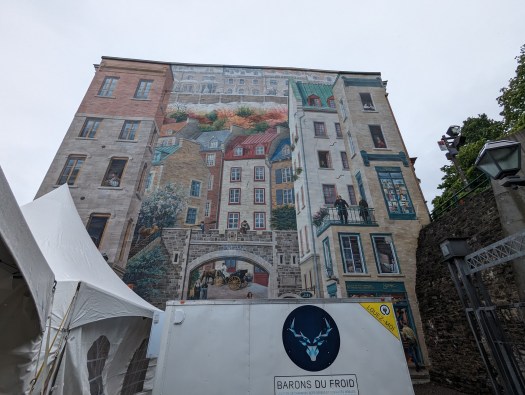
Roger asked us who the biggest enemy of the people of Quebec City was. I thought maybe Montreal, if there was some sort of rivalry between the cities, or perhaps it might be the English speaking parts of Canada as Quebec is very aggressive about preserving the French language and culture (as no English on the signs….). But the real answer: winter. It’s very cold, very snowy. And the houses have to be built to withstand the cold and hold up under the snow. North facing walls won’t have windows, for example. So they paint murals on them. Here’s a great example:
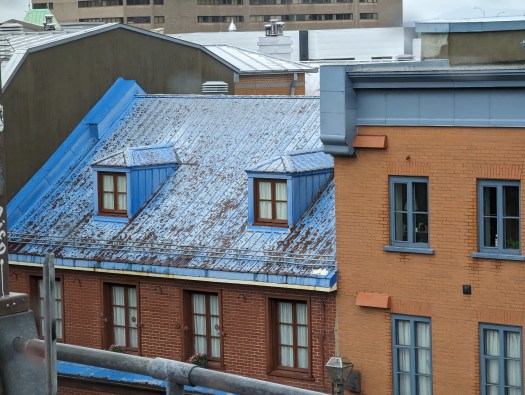
We wandered a few blocks through Lower Town then reloaded on the bus. Our driver, Yves, took us to Upper Town, though it was challenging with road closures due to the race. One thing Roger pointed out was the roofs of buildings. Remember, winter is their greatest enemy. Shingled roofs don’t last very long. So, many will have tin roofs that they have to paint to keep from rusting. However, Quebec is one of the largest producers of copper in the world. So a great solution to the roof issue is to use copper. There were tons of buildings with the green patina roofs that marked a copper roof that’s been in place for years. And some with the brown copper of a relatively new roof. I liked the tin ones too as they were often quite colorful.
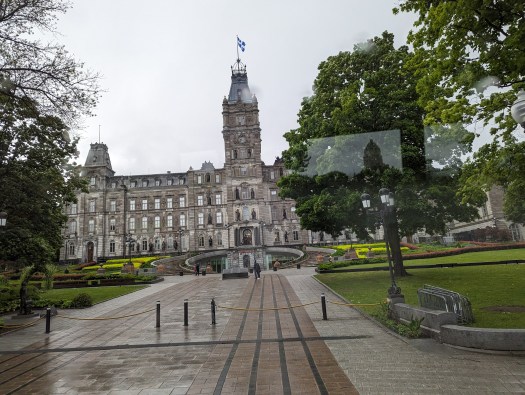
This tin roof needs repaintingParliament (Quebec City is the capital of the province)
We also drove around the Plains of Abraham, which is part of the Battlefields Parks in QC. It’s named after the man who owned the land originally. During the French and Indian War, the French of course were in control of Quebec City. On the night of September 13, 1759, 4,400 British troops under the command of General James Wolfe climbed the cliffs during the night, undetected, and surprised the French army, who thought the cliffs were impassable. It was over in 15 minutes, though Wolfe was killed (as well as the French commander, the Marquis de Montcalm). Today the Plains are a city park with historical markers and wide open green spaces. We did not get off the bus save for one site, a statue dedicated to Joan of Arc.
Whimsical topiary seen from the bus ride
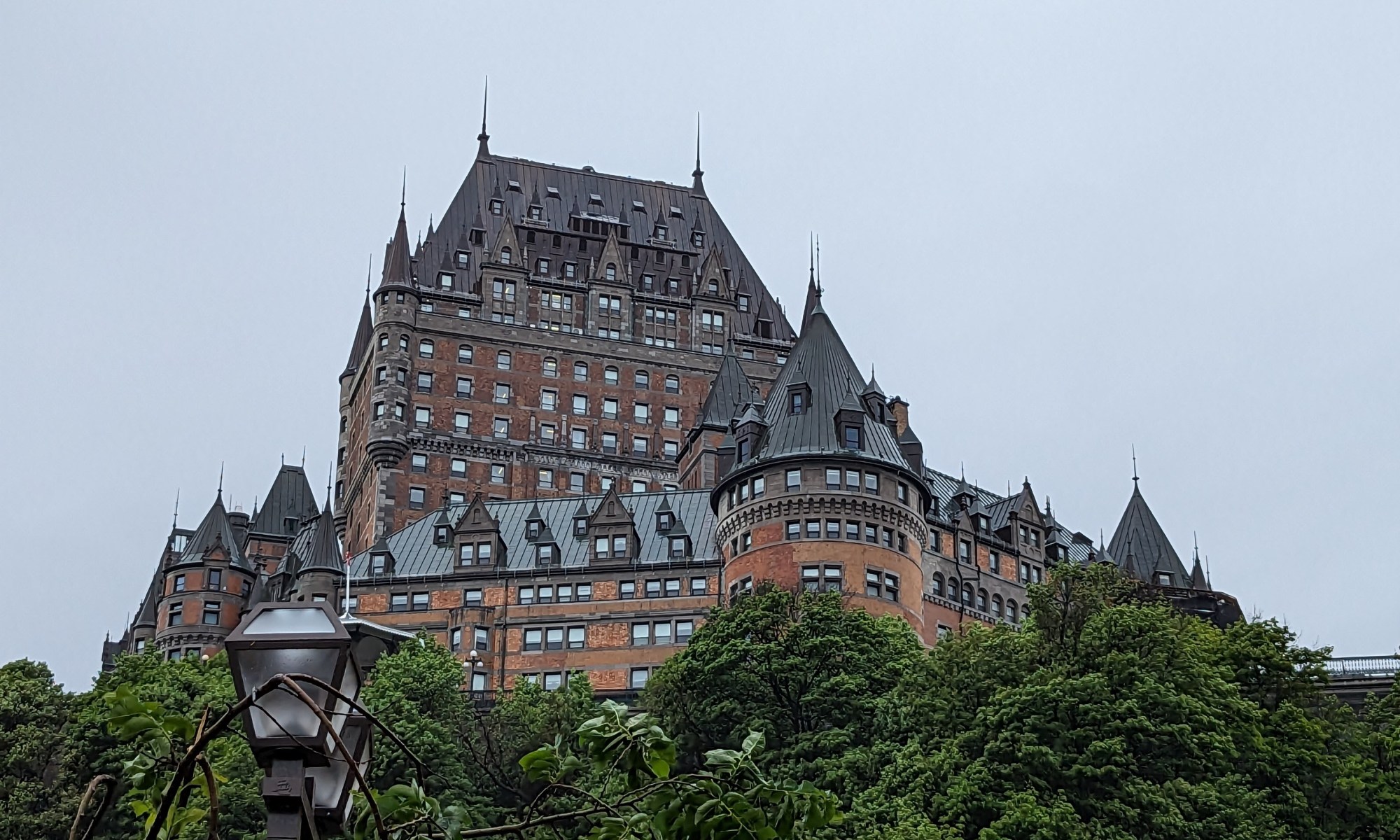
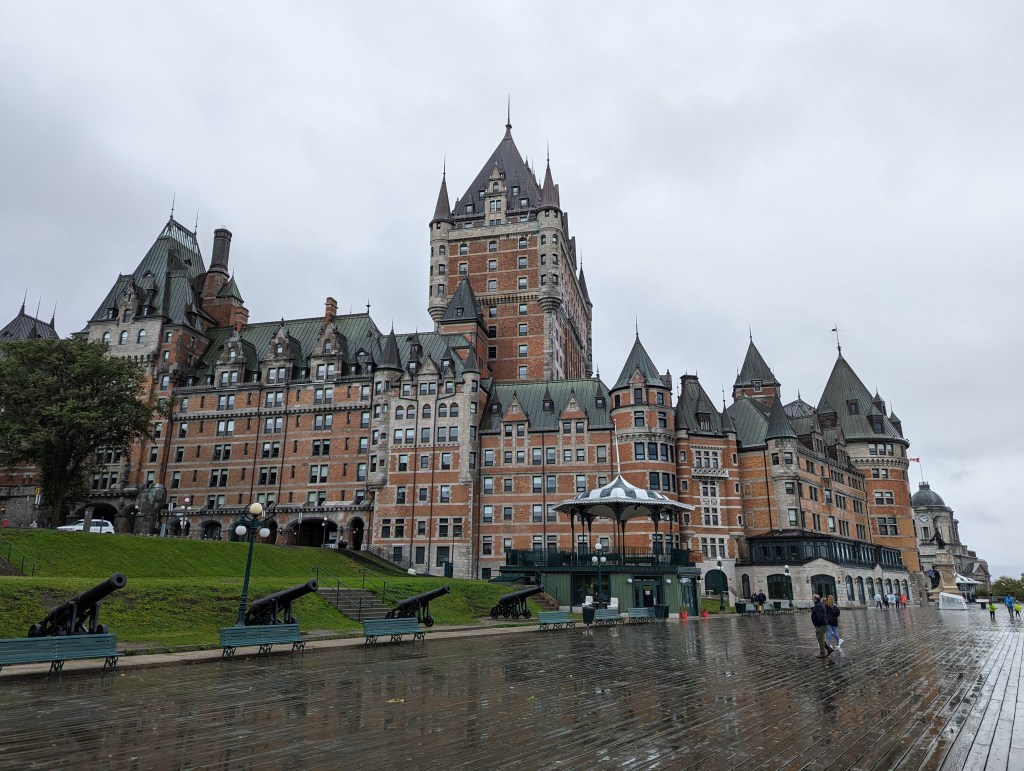
At lunchtime, we were driven up the Chateau Frontenac. This is a hotel, one of the grand hotels built by the Canadian Pacific Railway to encourage tourism (and use of the railways) in 1892. During World War II, this is where allies such as Churchill, Roosevelt, and Mackenzie King (Canadian PM) met to discuss strategies during the first and second Quebec conferences. Our lunch there was delicious and we had a great view of the rain over the St. Lawrence. Afterwards I wandered outside though the winds were gusting into the 30 mph range. It was challenging just to hold my camera still.
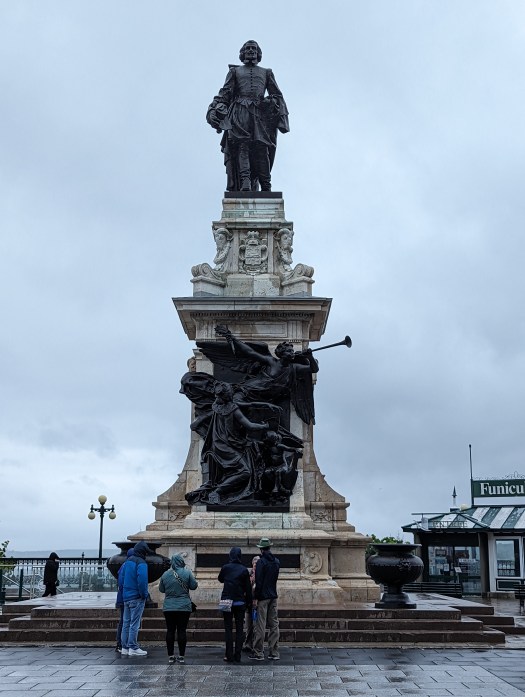
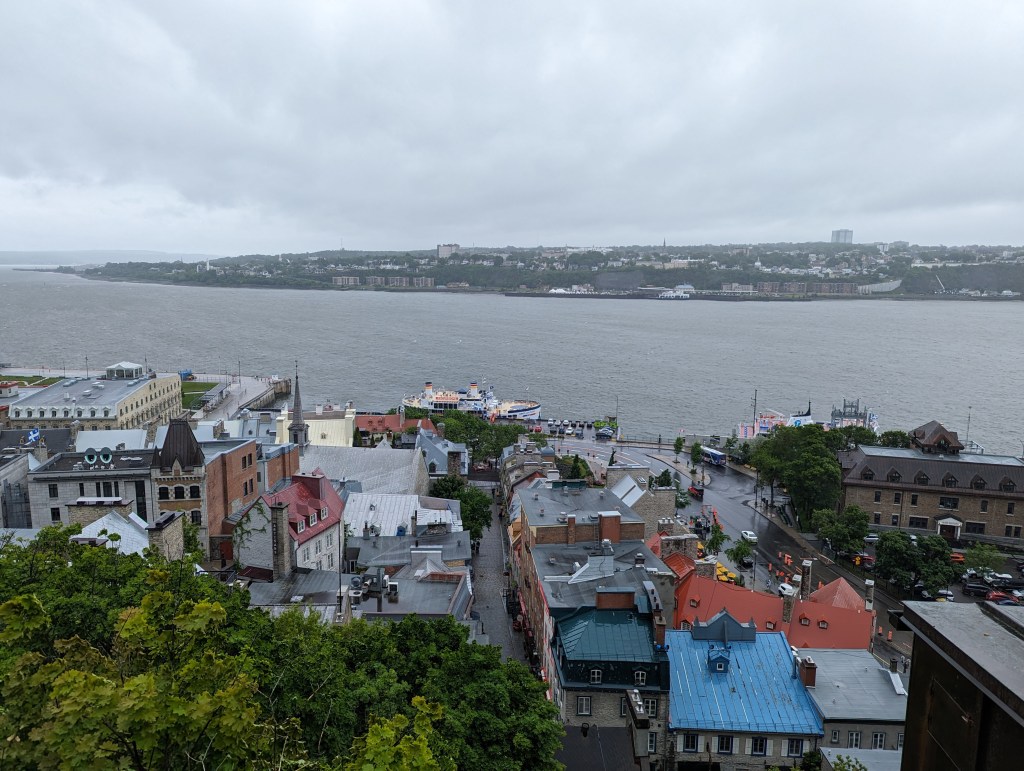
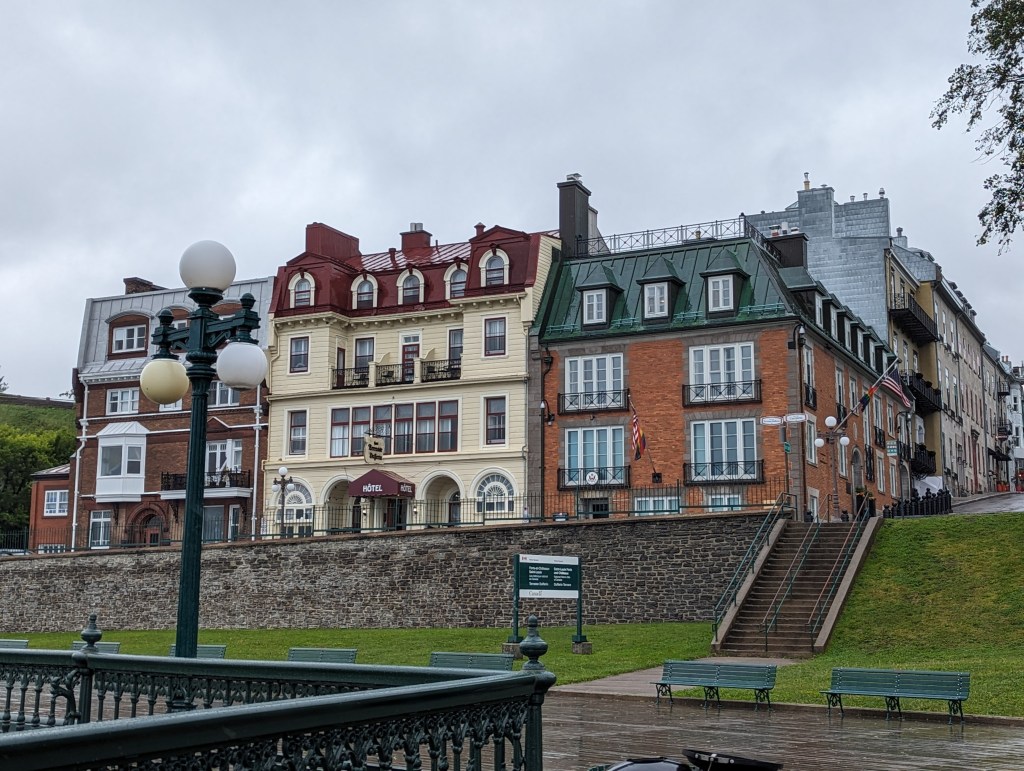
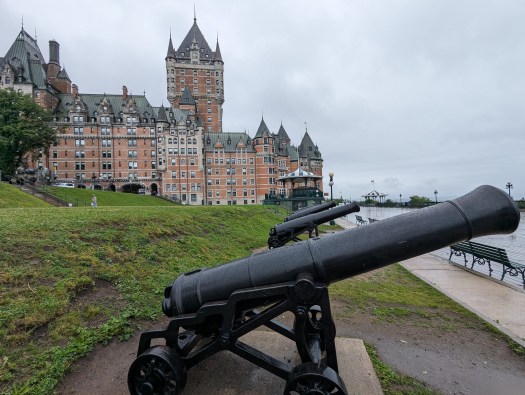
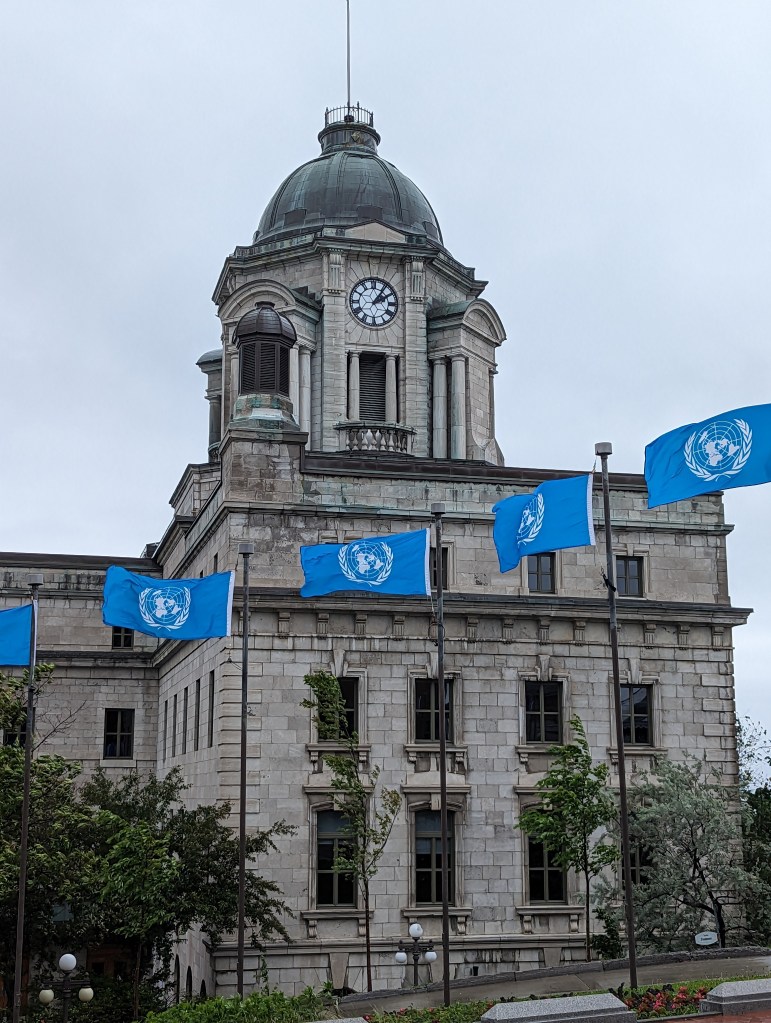
Statue of Champlain, the founder of Quebec CityStart of Dufferin Terrace, which is in front of the Frontenac and overlooks the river/Lower TownView of the river and Lower town. Notice some copper and tin roofsBuildings at far end of TerraceThe Chateau and a few of the myriad canons on display.Louis St. Laurent building, which has always been part of the Postal ServiceThere were several people dressed in costume, though I’m not totally sure whyOne of my favorite shots because you can see the umbrella installation that we also saw from the ground
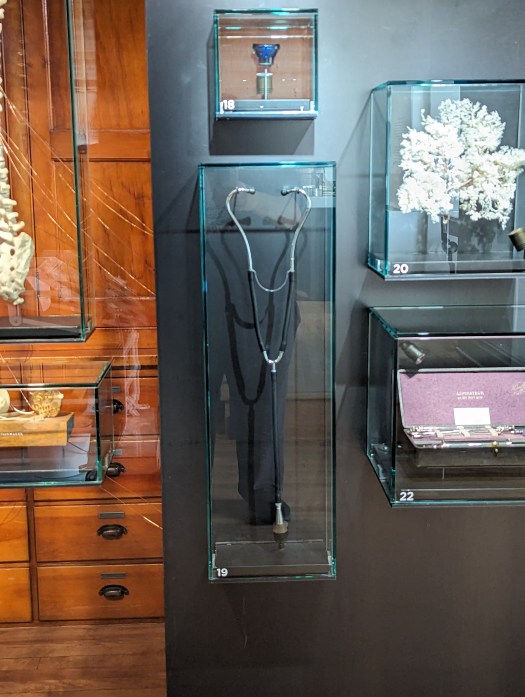
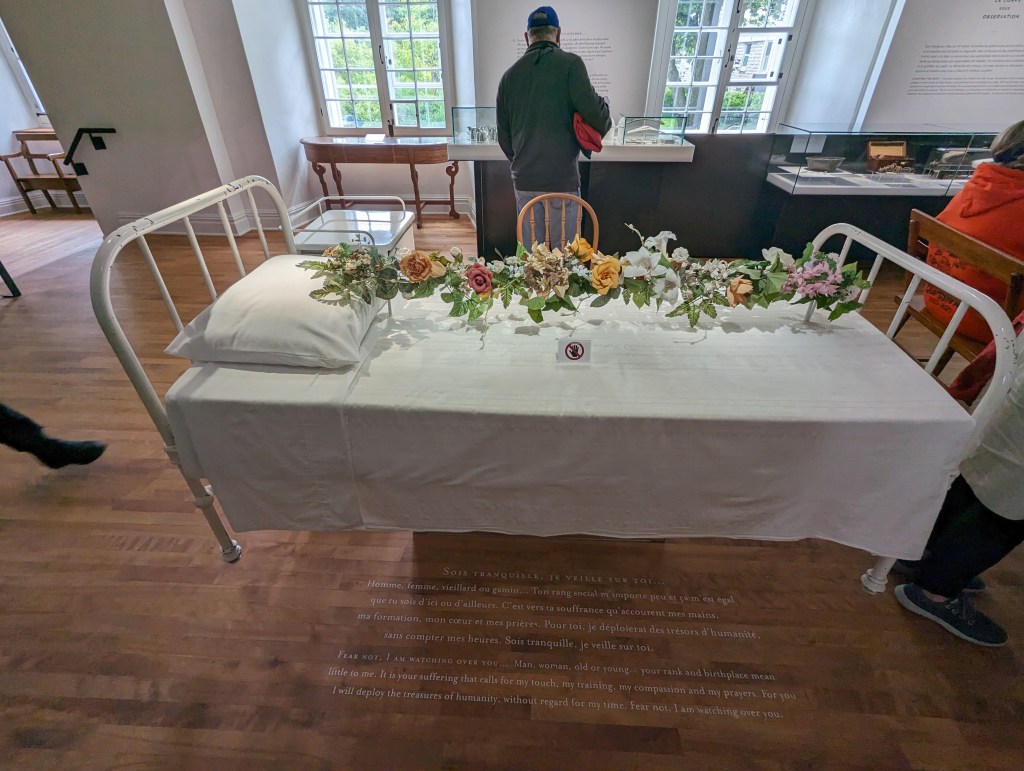
After lunch, we were taken to the first hospital established north of Mexico in North America, the Hotel-Dieu de Québec. It was built and run by Augustinian nuns in 1644. The original building is now a museum, which we walked through, but it is next door to the modern teaching hospital, associated with Laval University School of Medicine. I was pretty excited about this tour, given my profession.
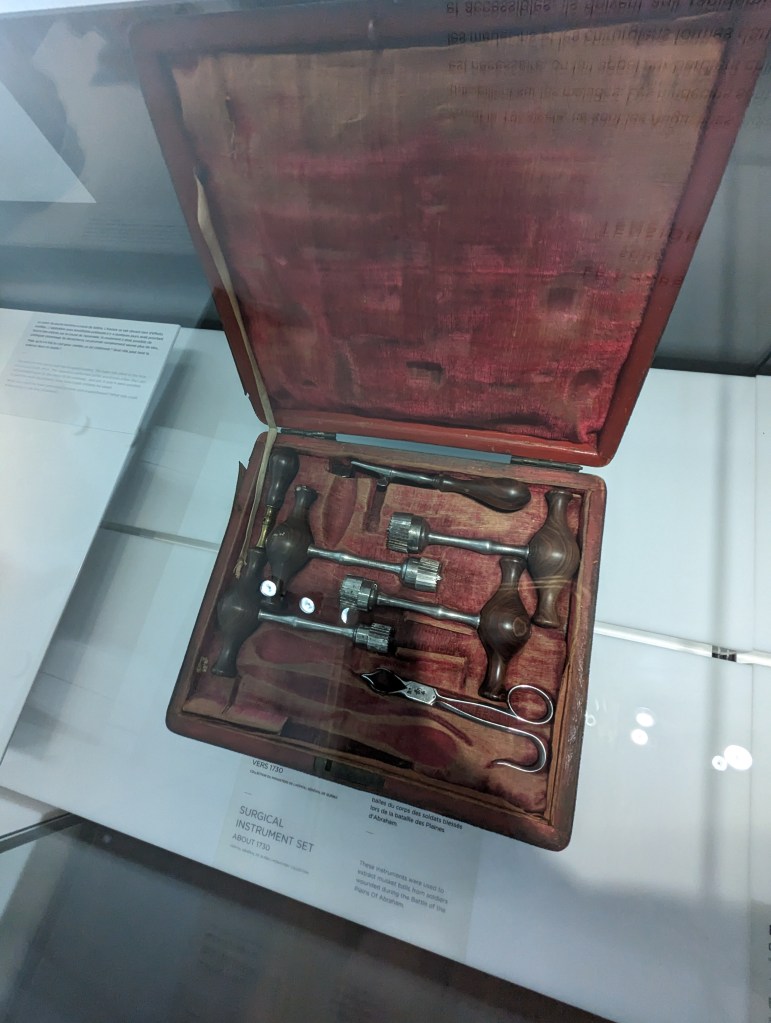
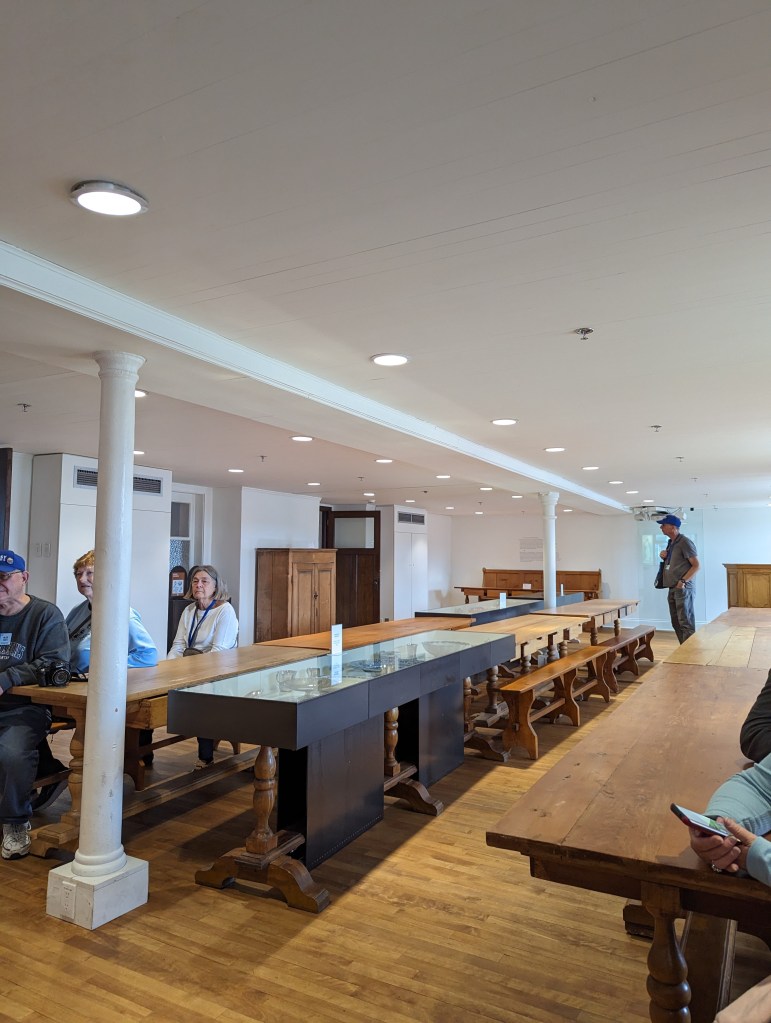
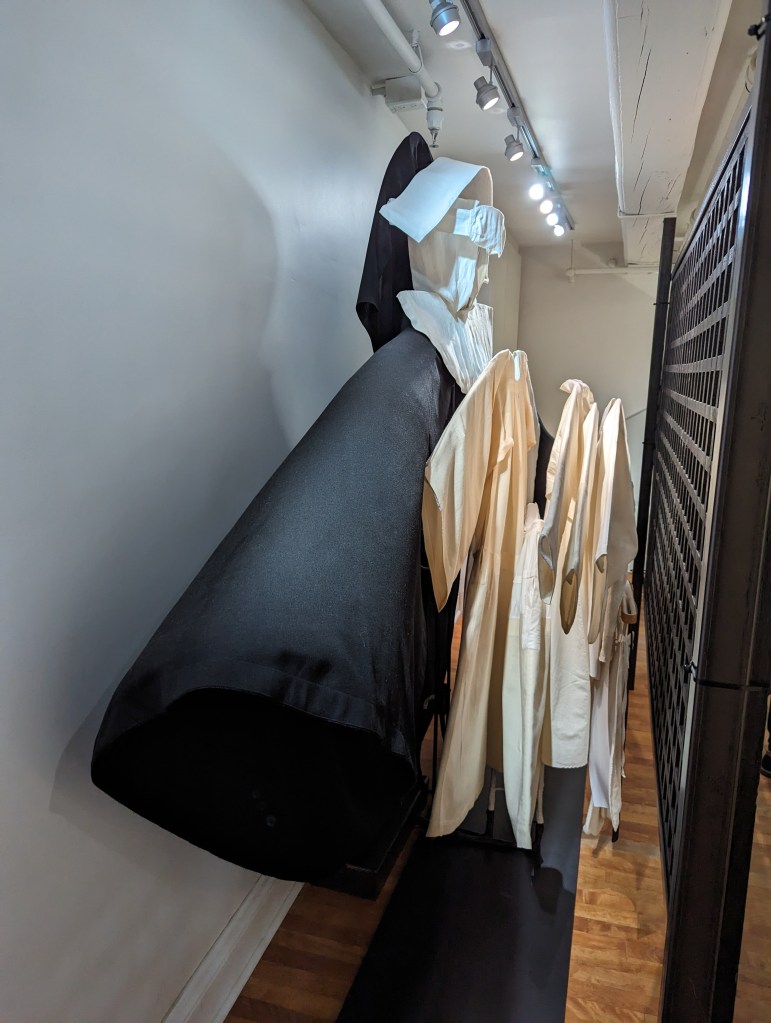
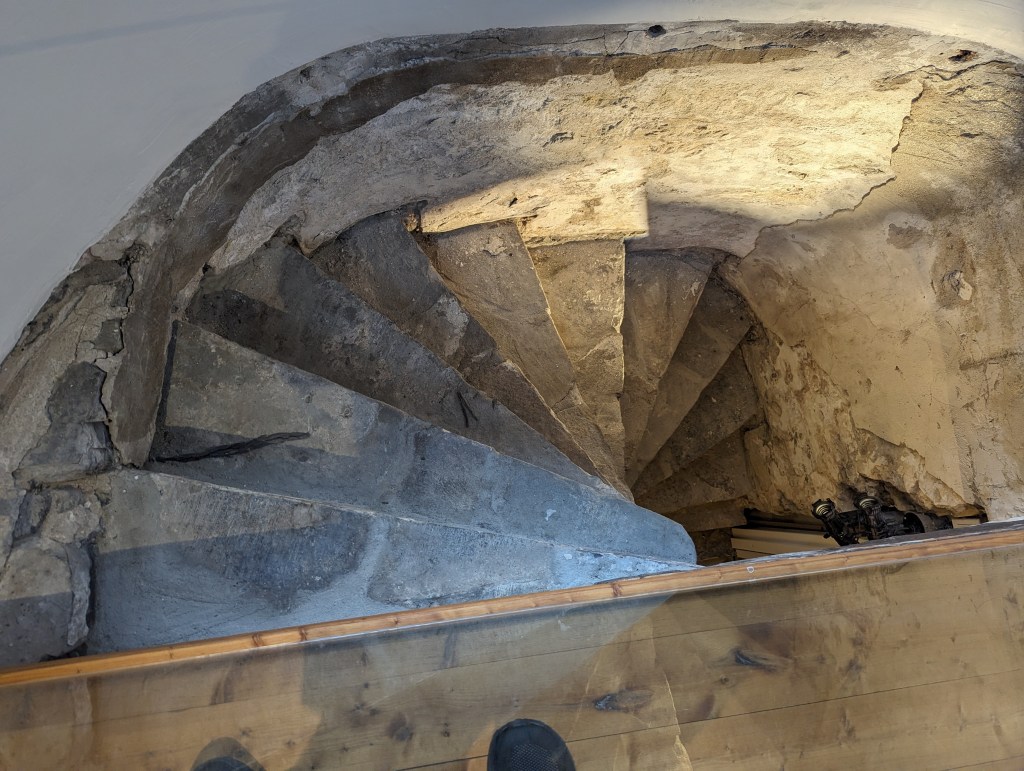
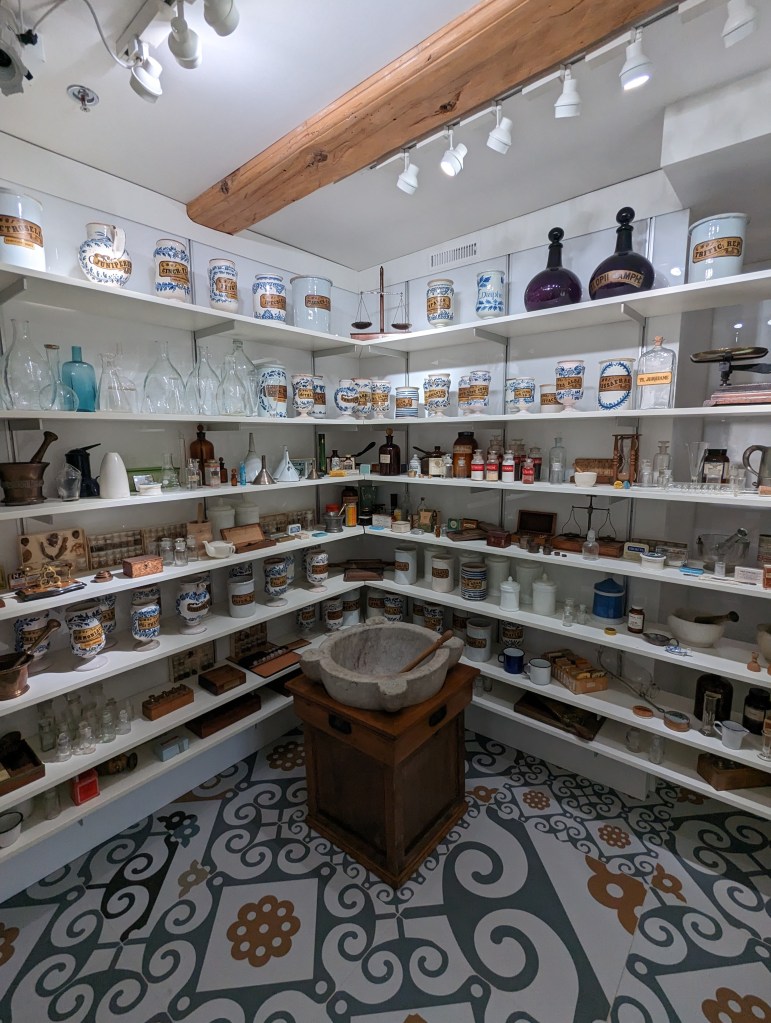
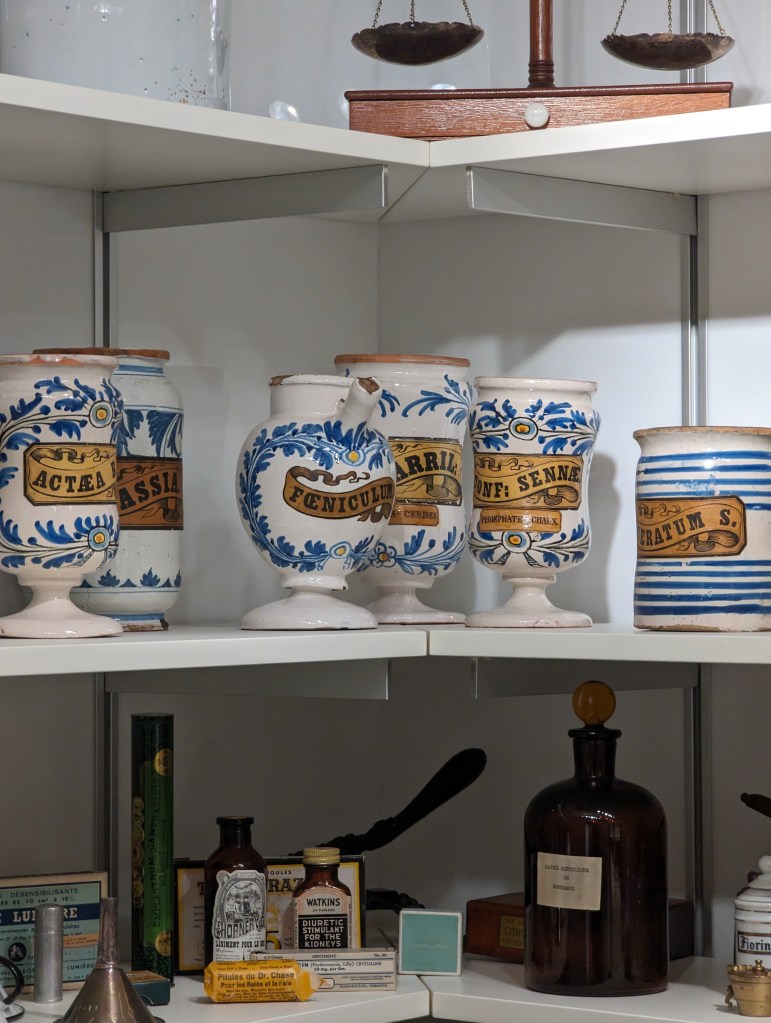
Stethoscope!syringeshospital bedvarious instrumentsDining room where nuns would listen to stories about saints and Biblical readingsAll the pieces of the habit they woreThey would go up and down these steep stairs!Apothecary room. They had to grow all their medicinal herbs/plantsDetails of some of the containers
It was a long day, but we learned a lot about Quebec City. It’s a very beautiful place and well worth a visit if you are thinking about unique places to go see.
This was an action-packed day. And it set the tone for the next few days as well. We were on the bus at 8:30 and off we went. We had an awesome driver, Christian, who is originally from Argentina. I started speaking Spanish to him, and he really enjoyed talking to me through the day. He’s lived in Montreal for 20 years and speaks Spanish, French, English, Portuguese, Mandarin, Italian and I think at least one more language. I was in awe.
We also had a great guide, Christina. She was very knowledgeable about the city and was able to convey a ton of information in a very enjoyable format. I wish I had guides like her everywhere I go…
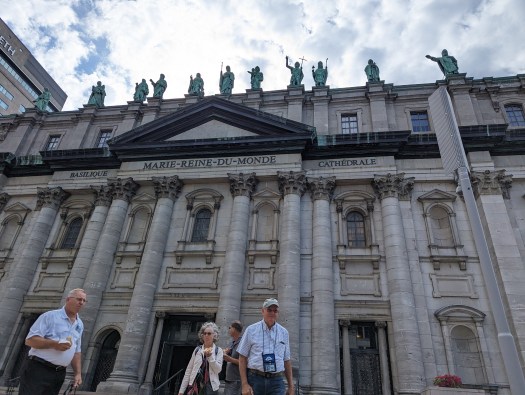
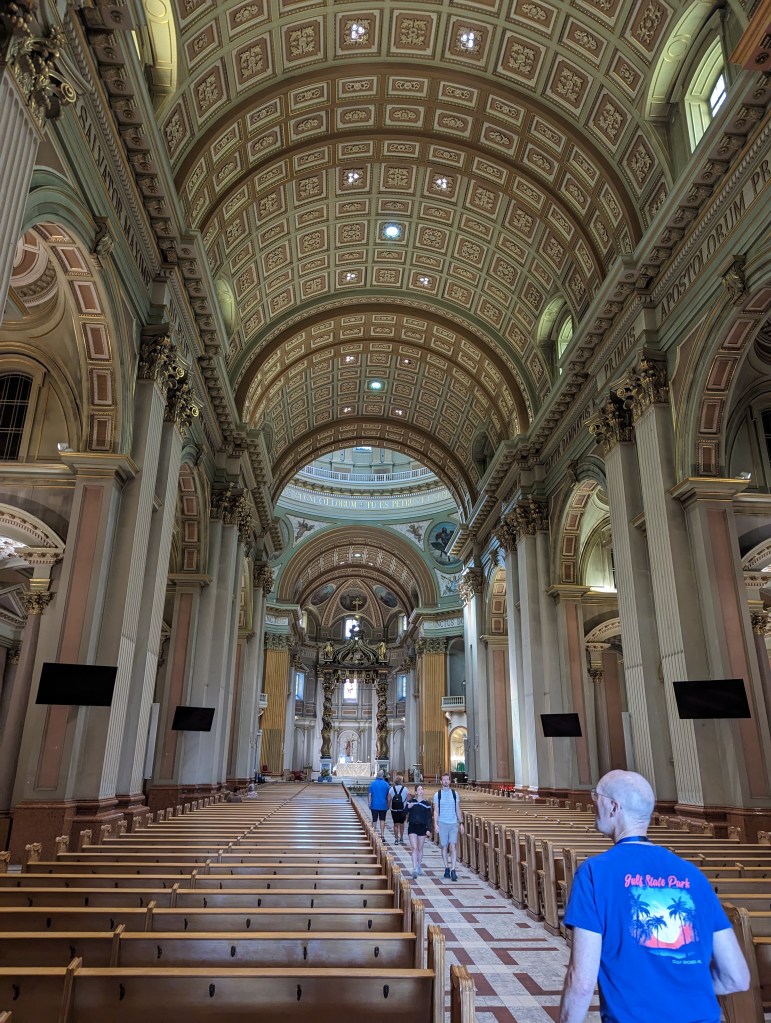
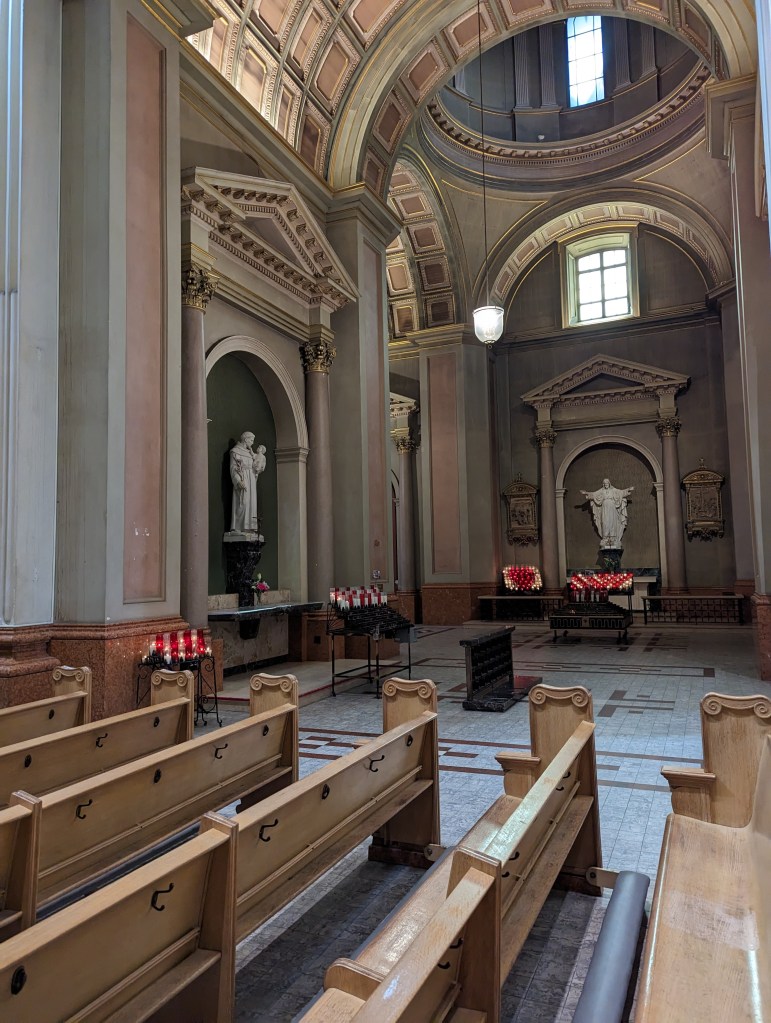
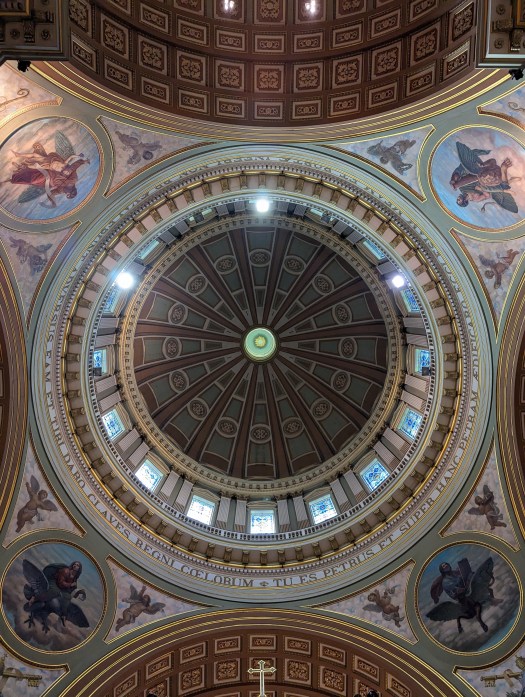
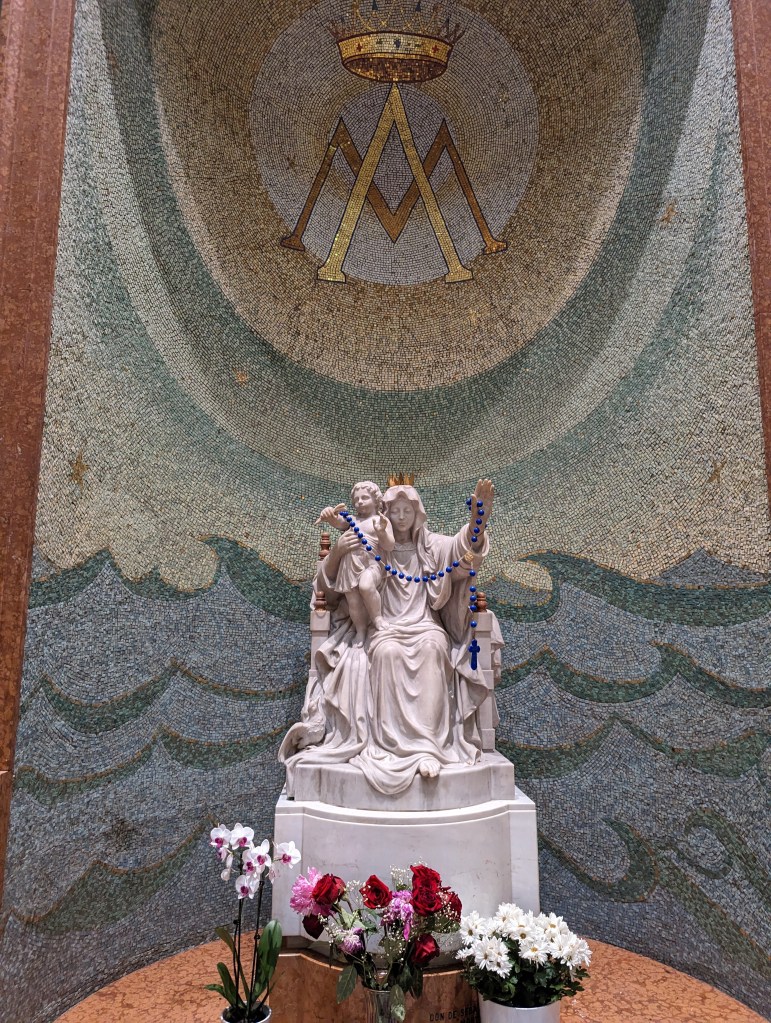
We started the day at the Cathedral of Marie Reine du Monde (Mary, queen of the world). It is a replica of St. Peter’s Basilica but on a smaller scale. It was very impressive, but I had no idea at the time that it would pale in comparison to later sites.
Outside the Cathedral. After we came back out we were given bagels; Christina claims Montreal bagels are known to be the best in the world. It was good. Entering the sactuary. Wow.There are lots of niches on the sidesDetail of the right side near altarDome. I mean, just amazing. The altar was breathtaking
The cathedral is located in a downtown area. Lot’s of skyscrapers. And the world-famous Fairmount Queen Elizabeth hotel is right next door.
Oh, the indignity!
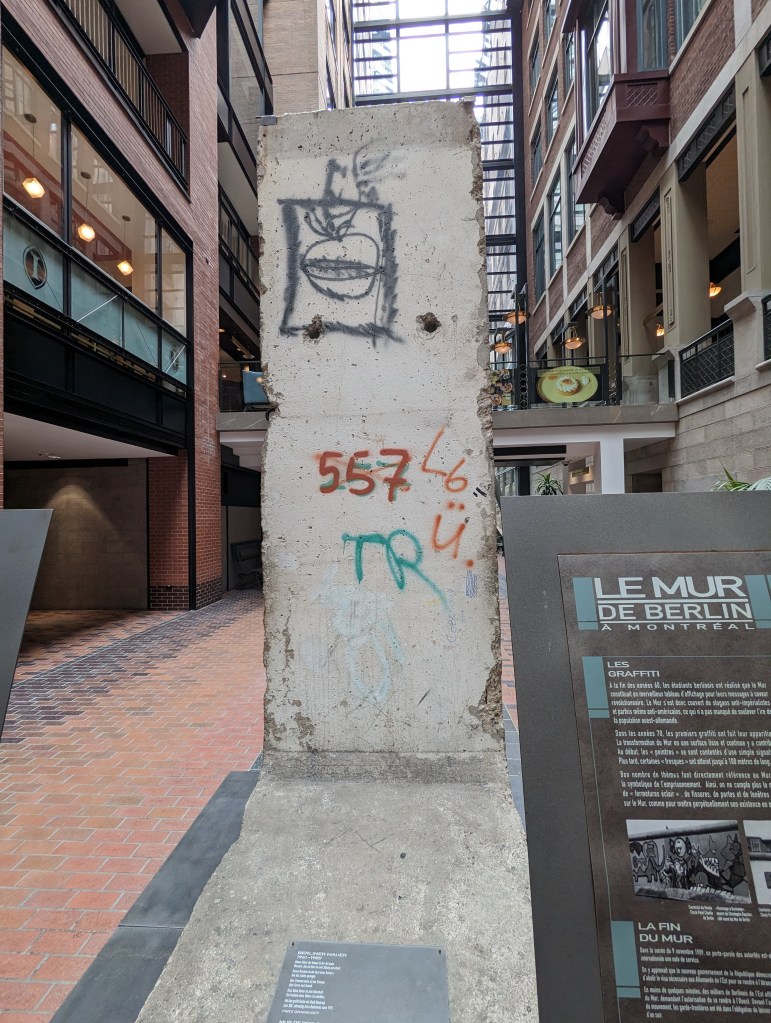
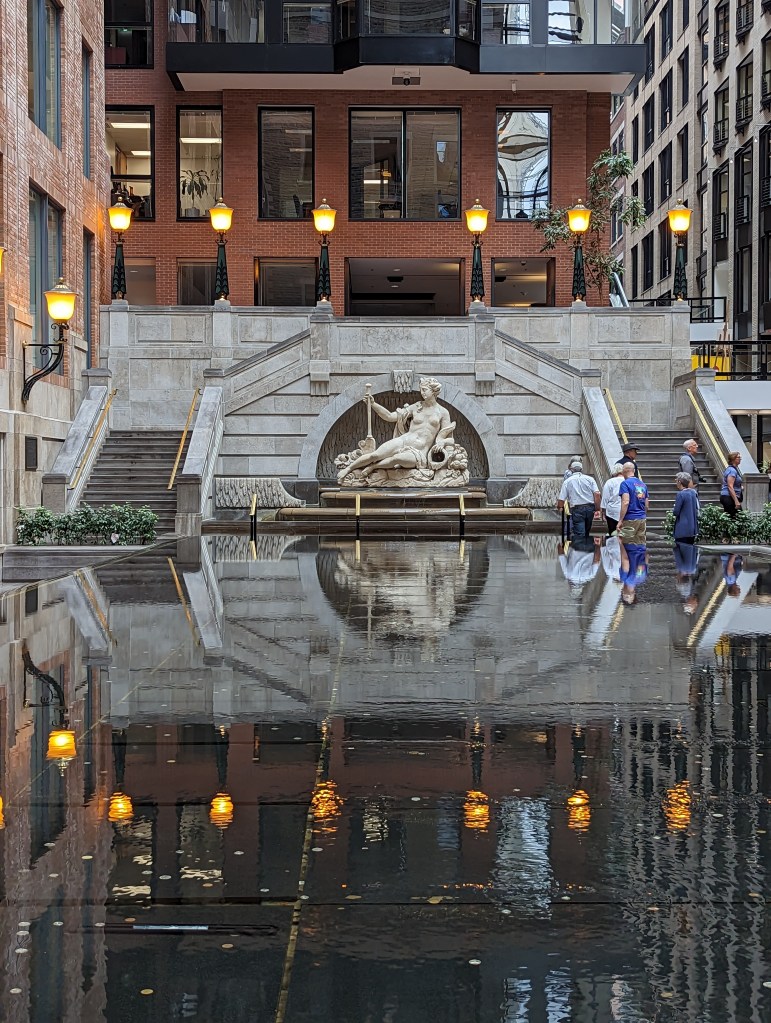
After reloading on the bus, we were taken to the World Trade Center of Montreal. This has an entrance to the underground city, which obviously allows people to shop in the winter without having to deal with snow and ice. There are offices all throughout the Center, and it has a ton of glass allowing sunlight in to help battle the winter blues. There were also some interesting artifacts.
All the windows of the floors are offices. No housing here. Piece of the Berlin Wall. This was the side facing the West, which you know because people could approach it and leave graffiti. The Eastern Side of the same piece of wall. Couldn’t approach here without being shot. Reflecting pool in the World Trade CenterCloser viewInteresting chandelier
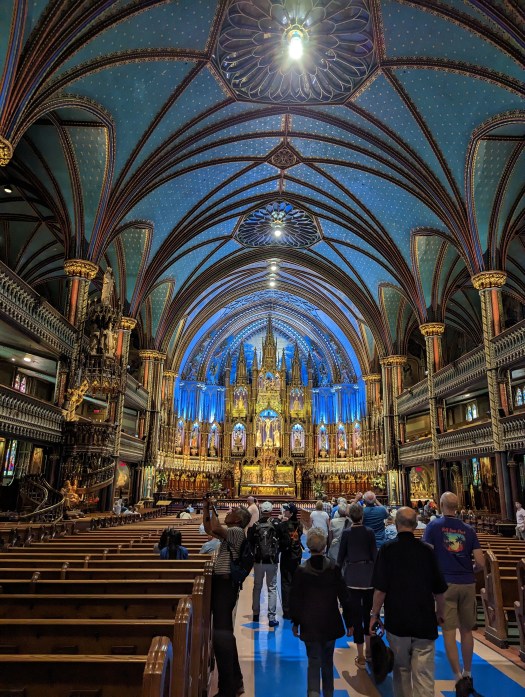
Exiting the World Trade Center, we walked a few blocks to the highlight of the day, at least for me. The Notre Dame Basilica of Montreal.
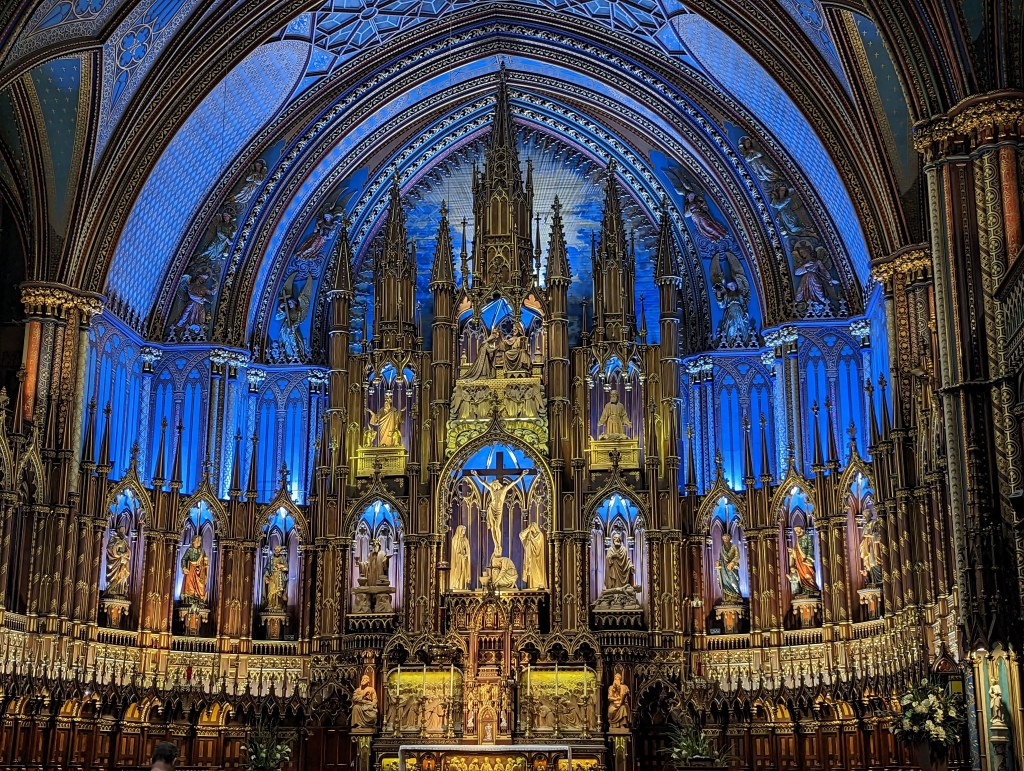
I believe since it’s dedicated to the Virgine Mary (Notre Dame means Our Lady) that the colors are then blues. Could be wrong about that though.
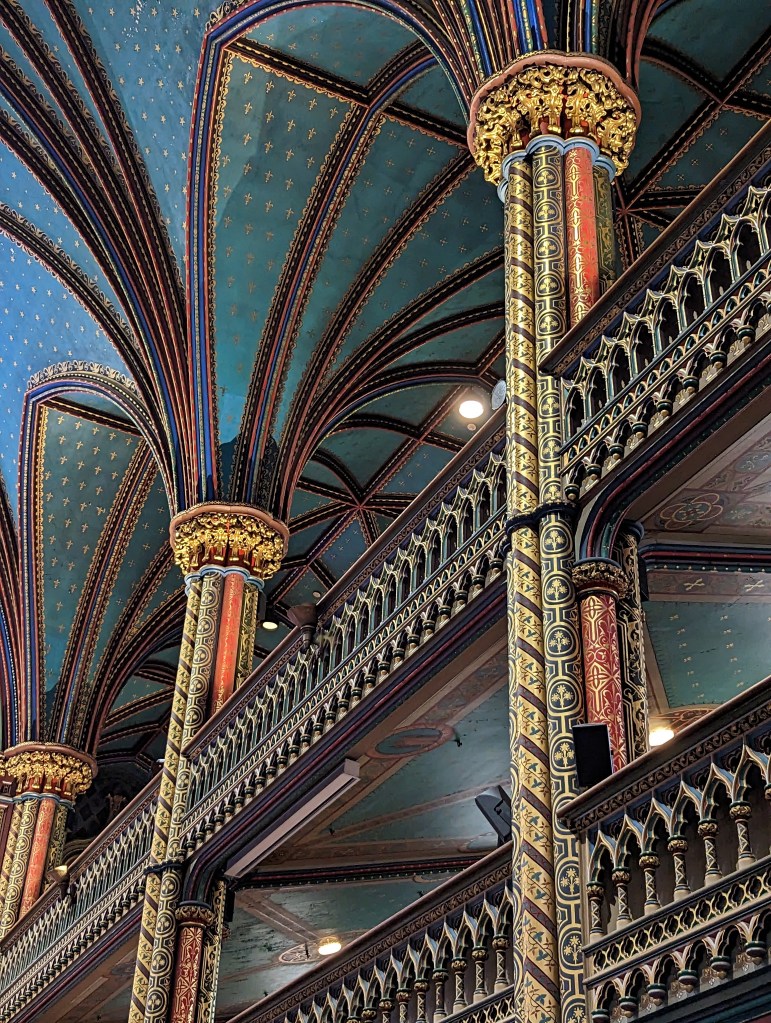
Detail of the balconies/ceilingAbove the altar
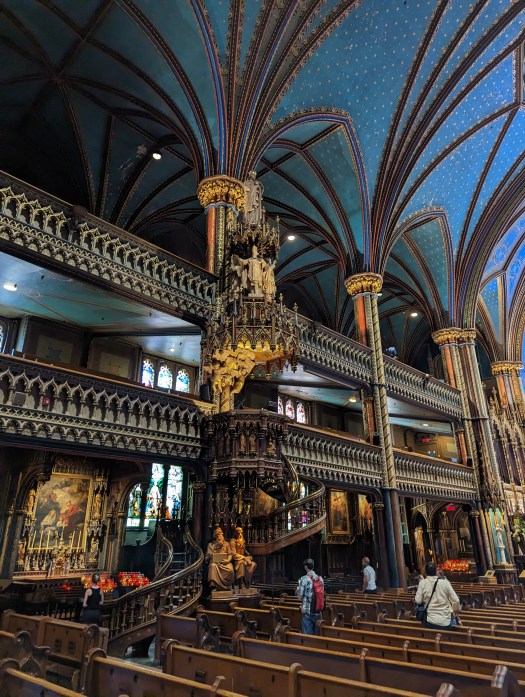
There are 2 balconies and the total seating is 3500. This is where Celine Dion got married. The organ has 7,000 pipes!!!
This is the pulpit, halfway down the sanctuary. It was located here as when it was built there was no microphones and the priest had to be in the middle to be heard. This pulpit was carved from a single mahogany tree trunk!! The 2 figures at the bottom are carved from yellow pine.
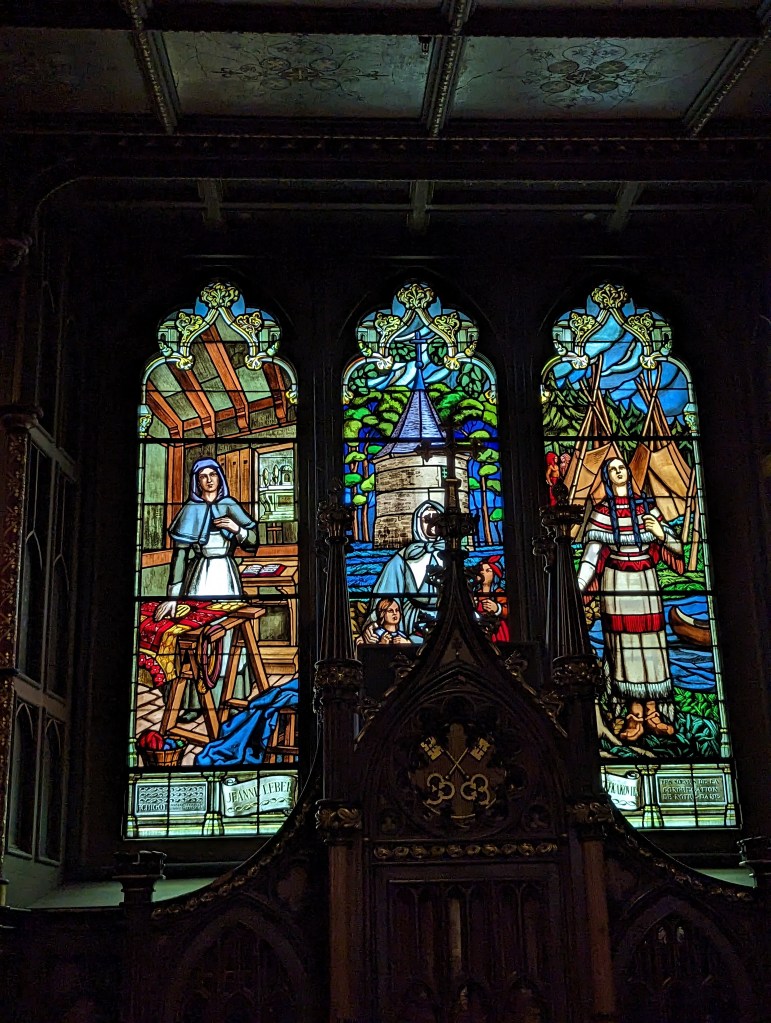
The stained glass windows, like the one seen above, are unique to this basilica in that instead of depicting biblical scenes they instead show important moments in the early days of the church in Montreal. The city was founded to bring Christianity to the indigenous peoples.
Most people don’t want to get married in a massive sanctuary that holds 3500 people, so there’s a smaller chapel behind the altar which is shown above. This is where the vast majority of weddings and other events are held.
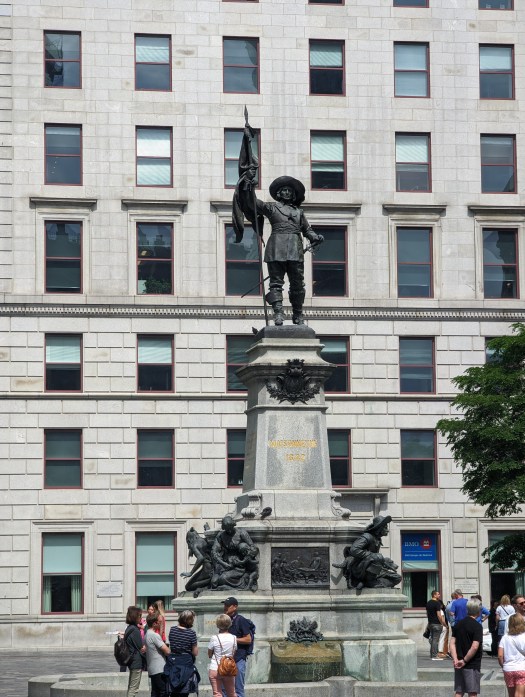
Once you exit the Basilica there is a sqare across from it that has a statue of the man who helped found Montreal. His name was Paul de Chomedey, Sieur de Maisonneuve.
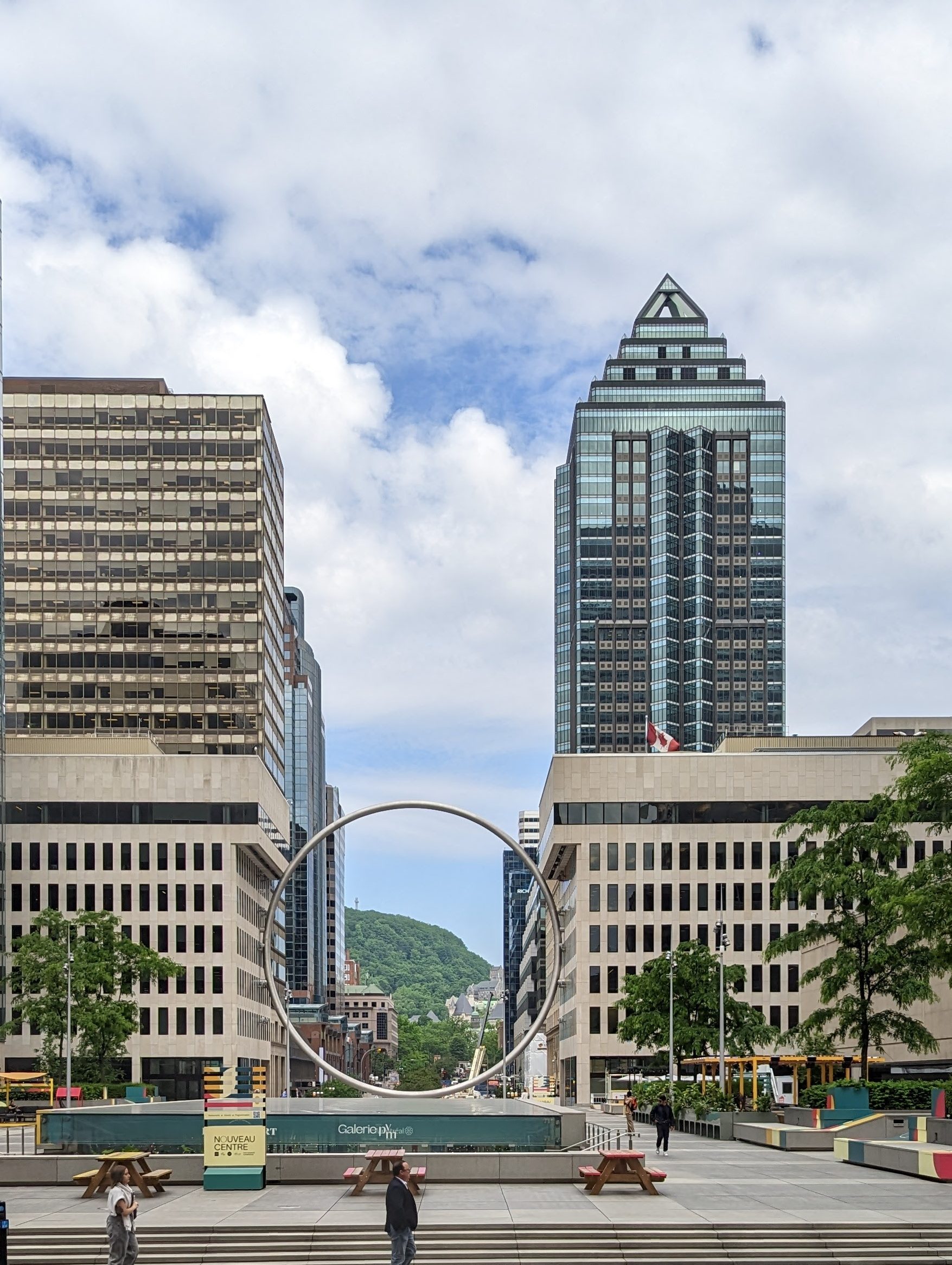
Montreal is on the banks of the St. Lawrence River, but there is a “mountain” in the middle of the city, Mount Royal (and if you pronounce it the French way you see where the name Montreal came from). Soon after Maisonneuve arrived with settlers from Quebec City, there was a flood. He prayed to the Virgin Mary to spare them and promised to carry a cross to the top of the mountain if they survived. They did, as so the cross on Mount Royal stands to this day. No building can be built taller than the top of the cross by law here. You can see the cross from downtown through a new art installation which is basically a giant metal circle (that Christina says cost $5million).
Can you see the cross on top of the mountain in the distance?
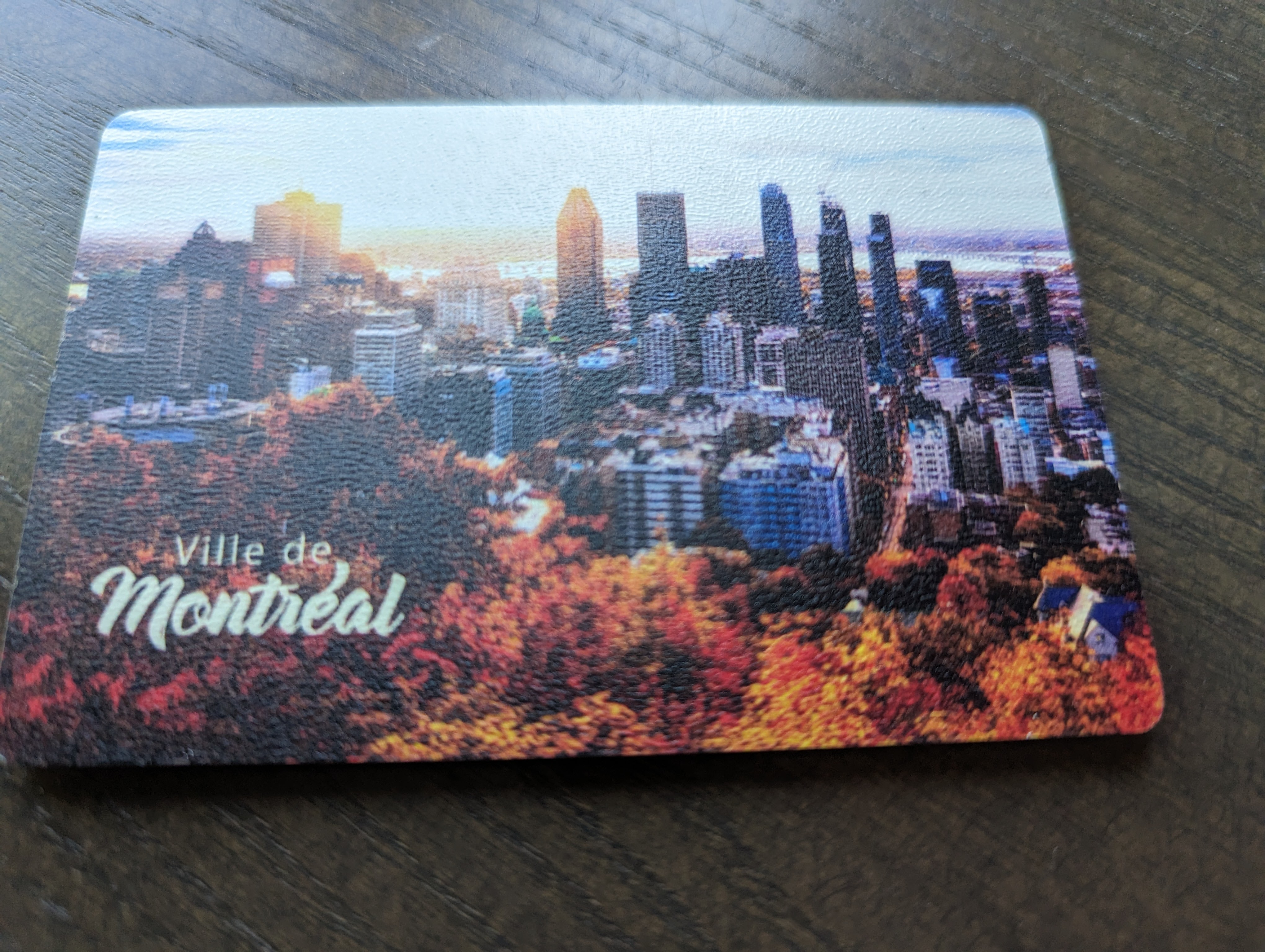
After we got back on the bus we were taken to Old Montreal, an area of shops and restaurants. It was quite charming. We spent some time browsing around and I bought a magnet to add to my collection.
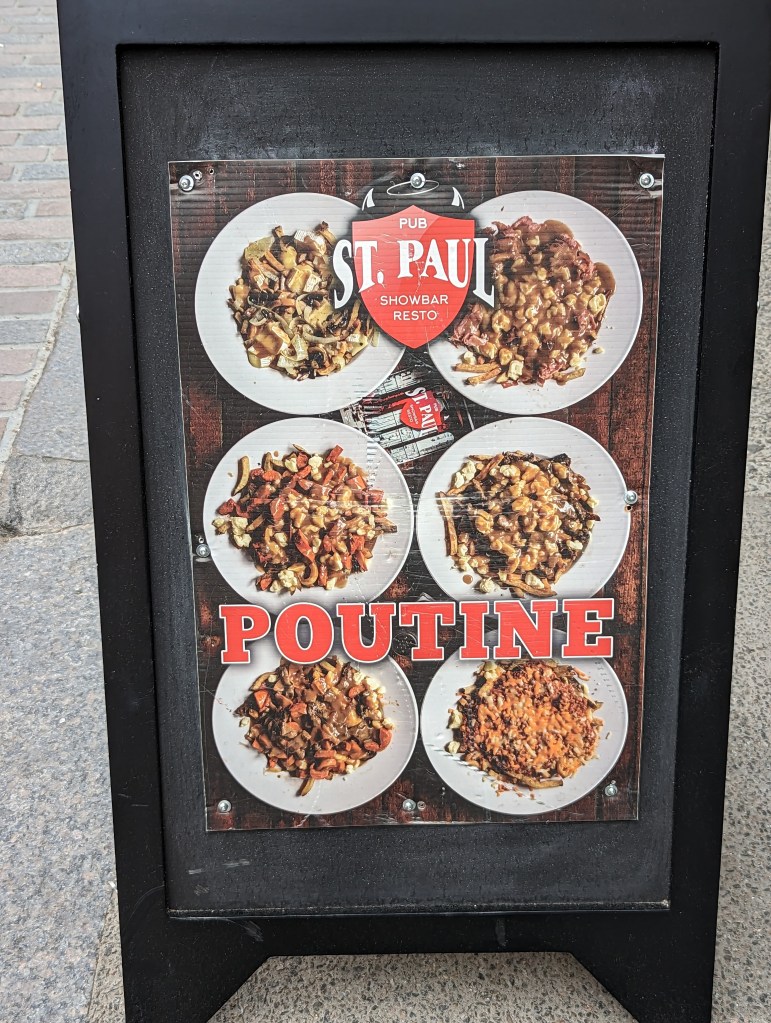
Race week was evidentPoutine is all the rage
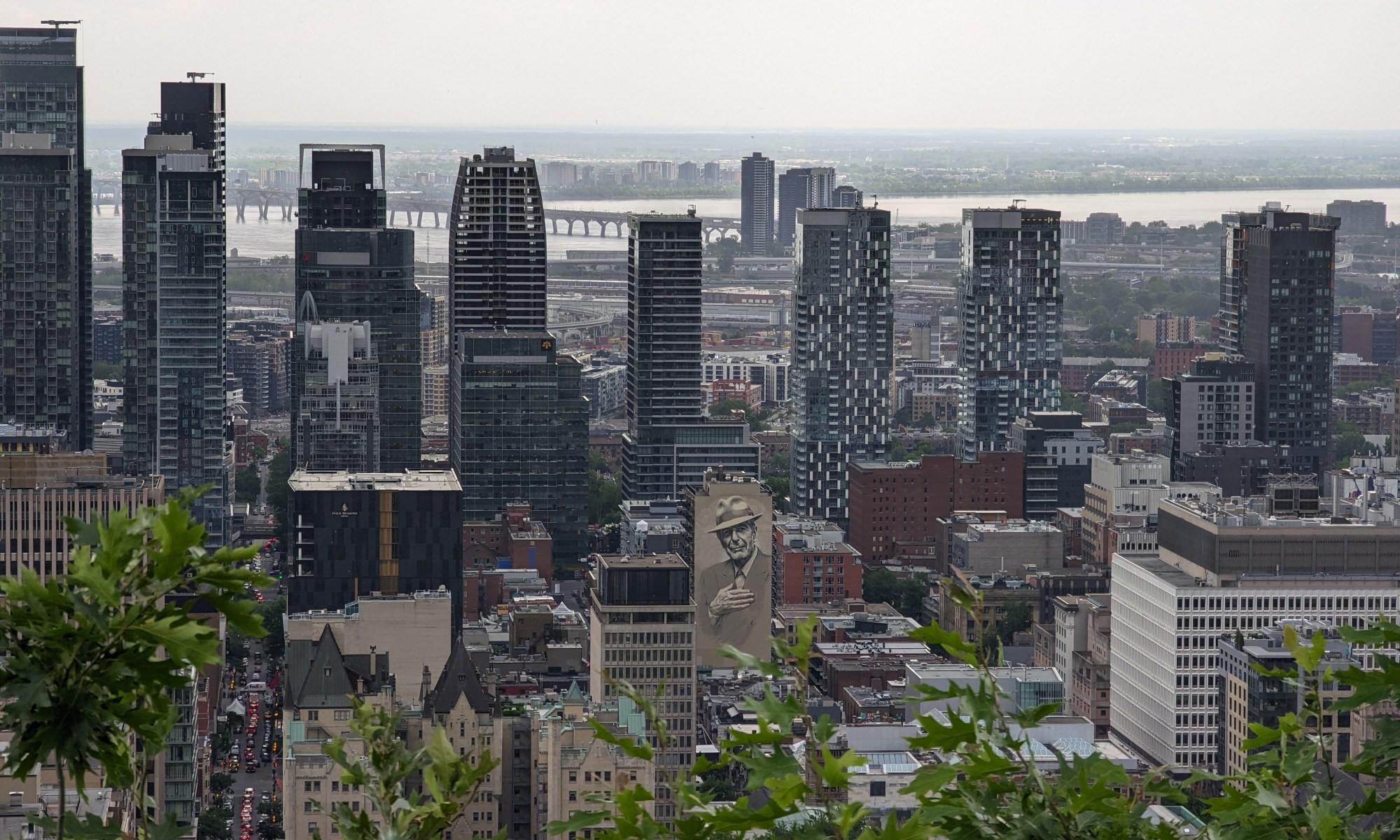
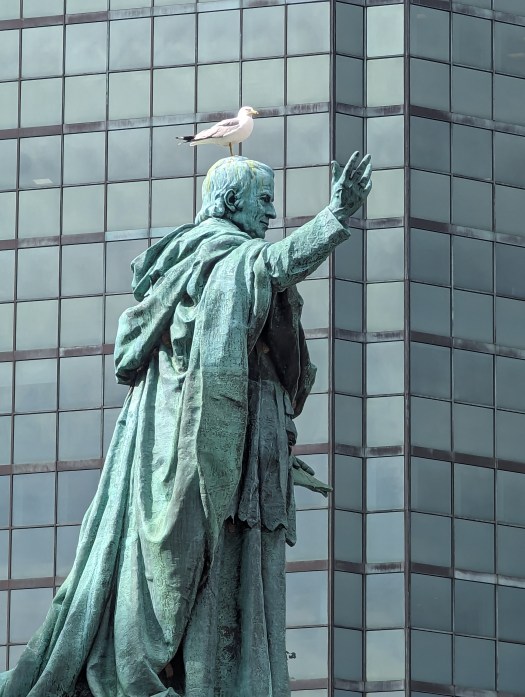
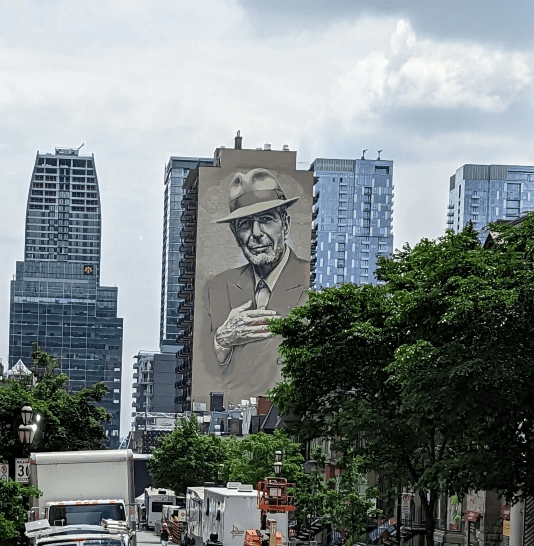
Back on the bus to drive up to Mount Royal for a picnic lunch, we passed a building with a giant mural of Leonard Cohen, who among other songs wrote “Hallelujah”. He was a son of Montreal.
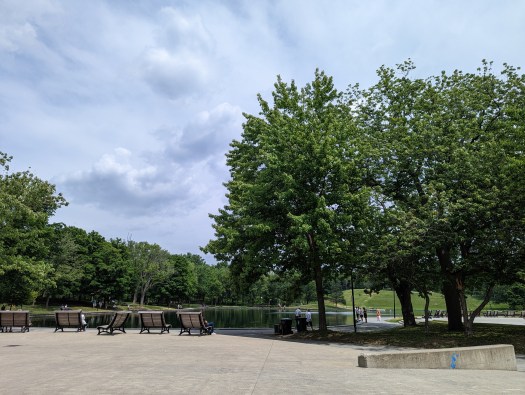
I enjoyed lunch: turkey on some French style hard crust bread with a tort for desert with fresh berries piled on it. We were at a little pond in the park.
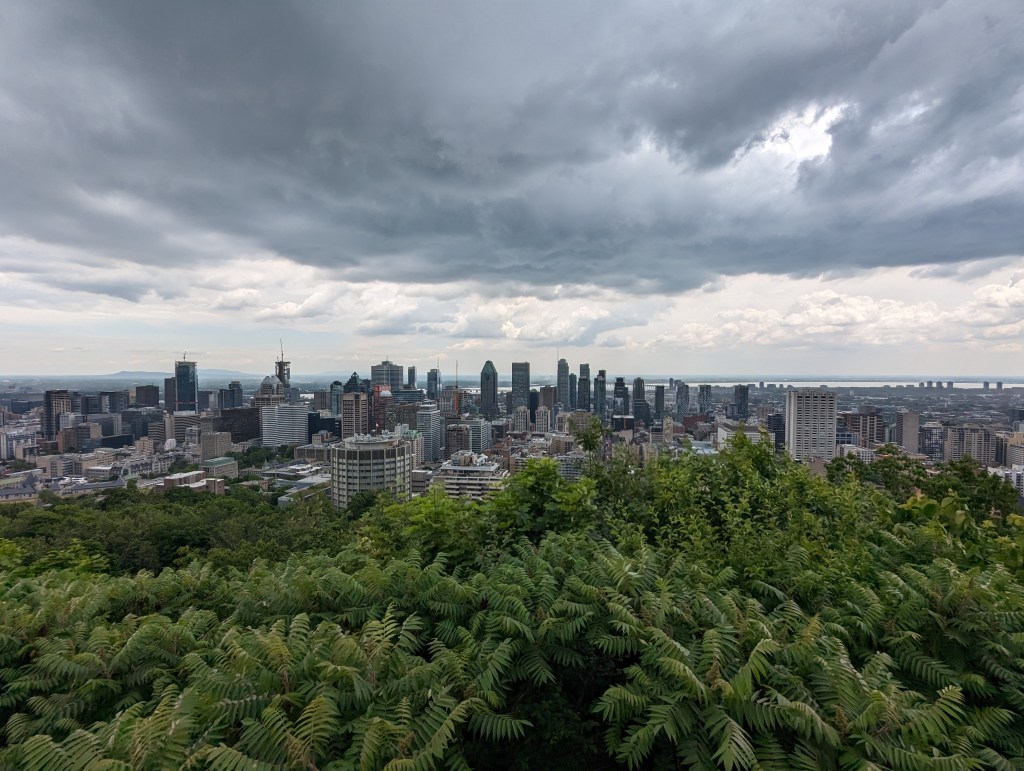
Then we went further up the mountain and hiked up to a lookout point that shows the city below. Unfortunately, a storm was moving in and we got a little wet.
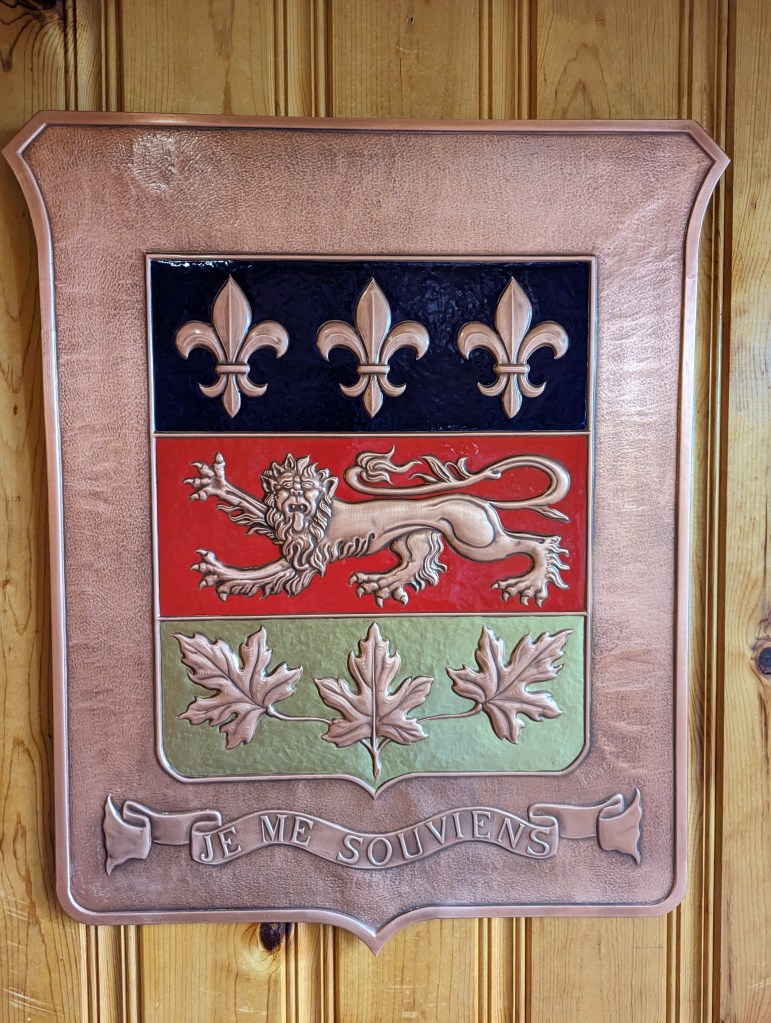
You can even see Cohen building up here!Flag of Quebec is on left, the blue with fleur de lis. Flag of Montreal on right features 4 images of groups of people who founded city in the quadrants: the French fleur de lis, the English Rose, Scottish thistle and Irish shamrock. The middle white pine tree represents the indigenous peoples.
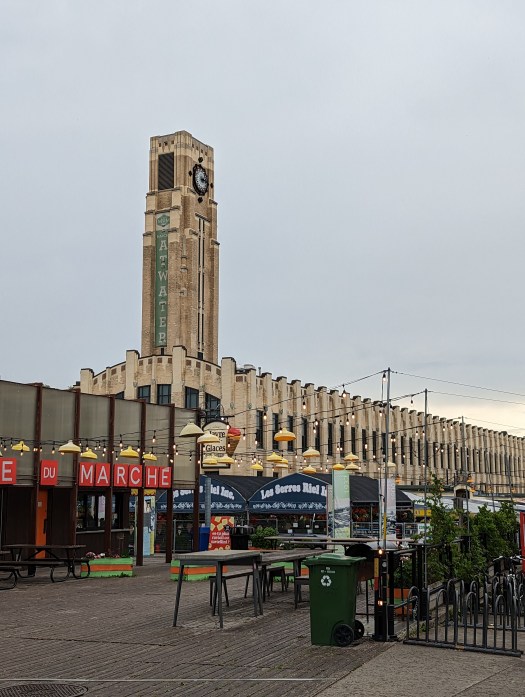
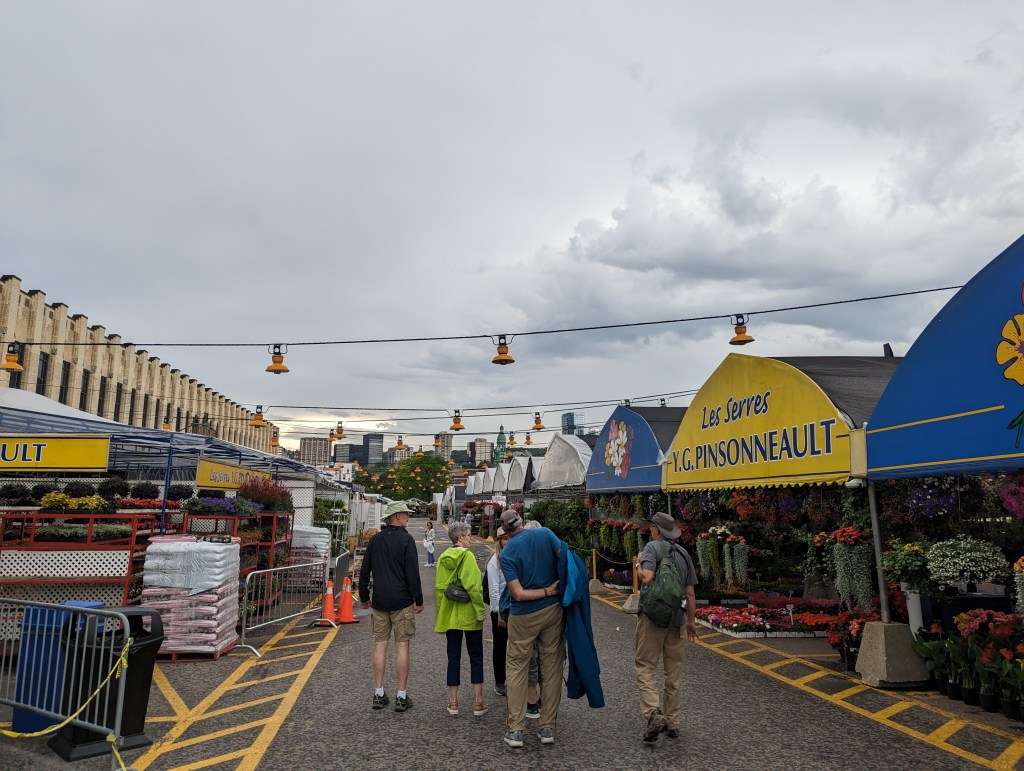
Our final destination of the day was a place called the Atwater market. It’s a shopping venue with indoor and outdoor spaces; outside currently there are a ton of flower and vegetable plants available to buy, but Christina told us by July 1st they’d all be gone. She said Christmas season is quite magical to wander this area as well. And in the fall the flower vendors are replaced by thousands of pumpkins!
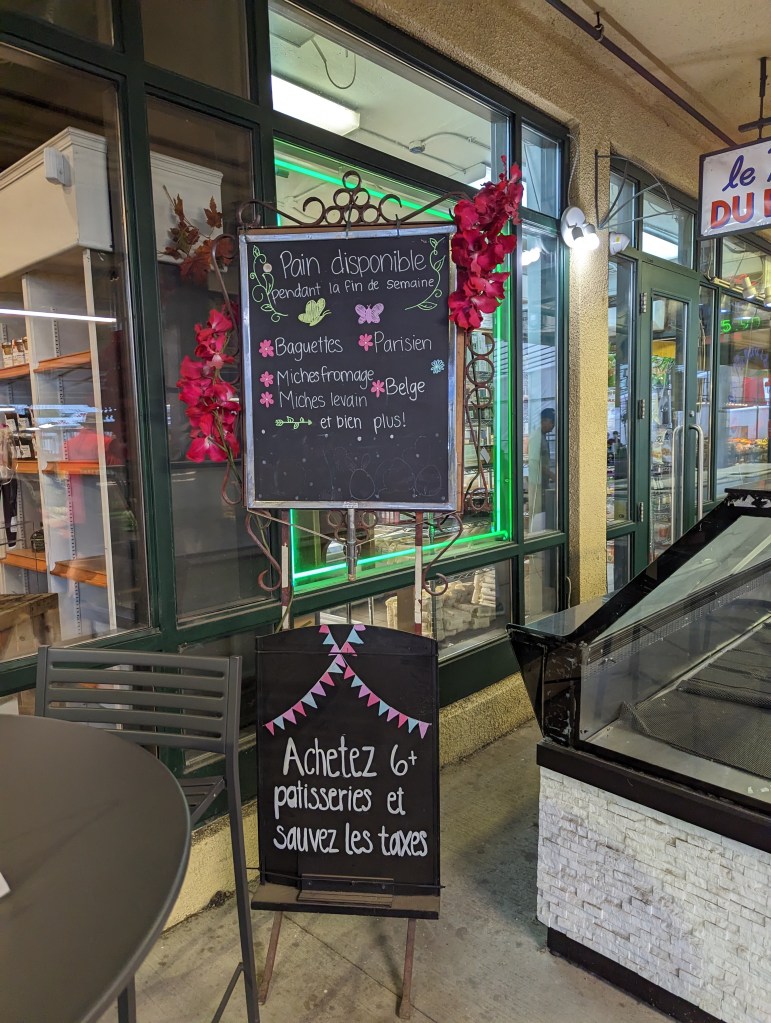
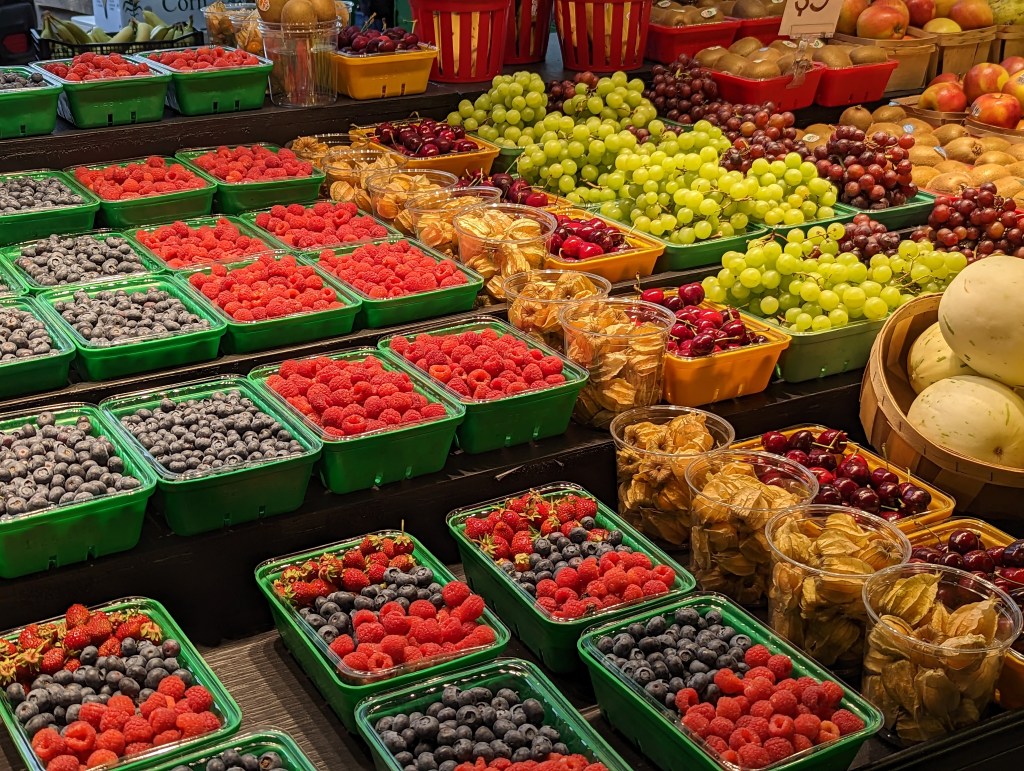
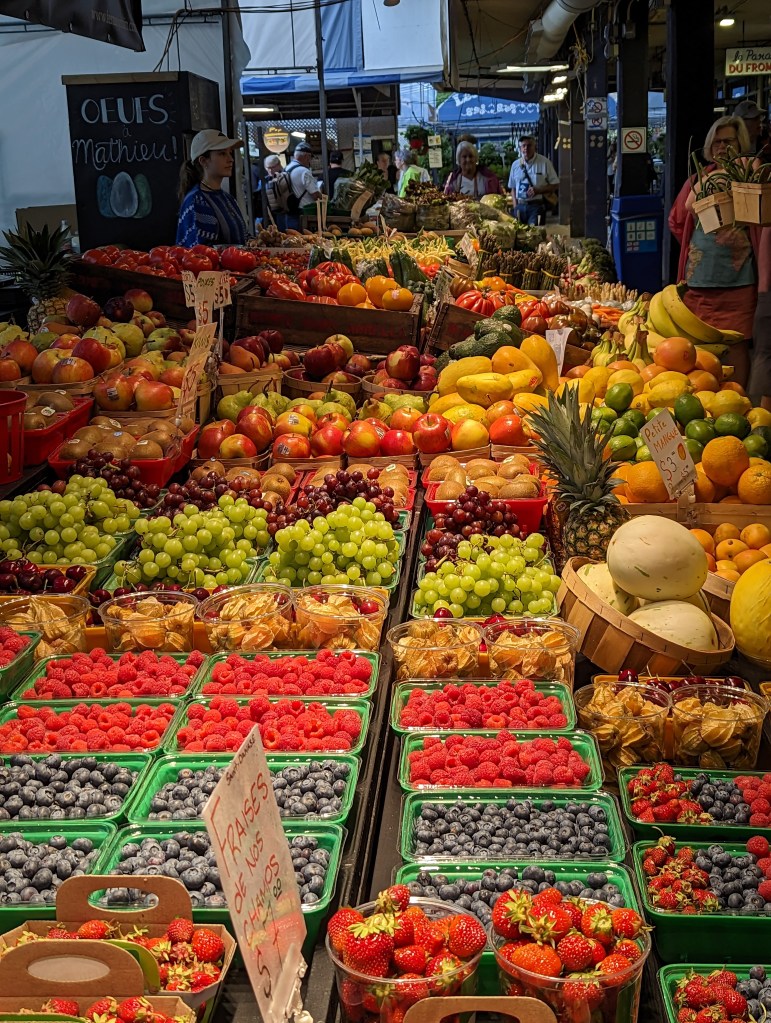
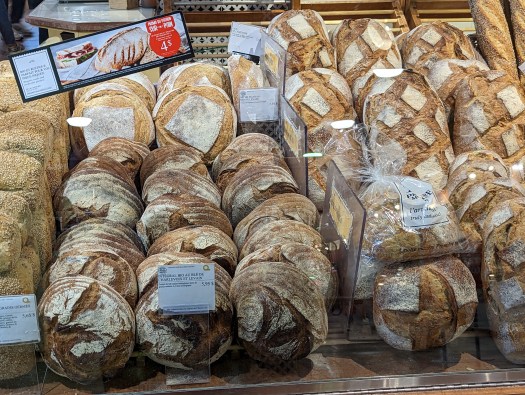
It was still raining a bit but it didn’t stop usOne of the myriad flower vendorsLots of little shopsFresh fruit and veggies sold under canopiesEverything looked deliciousBread available at a bakery inside
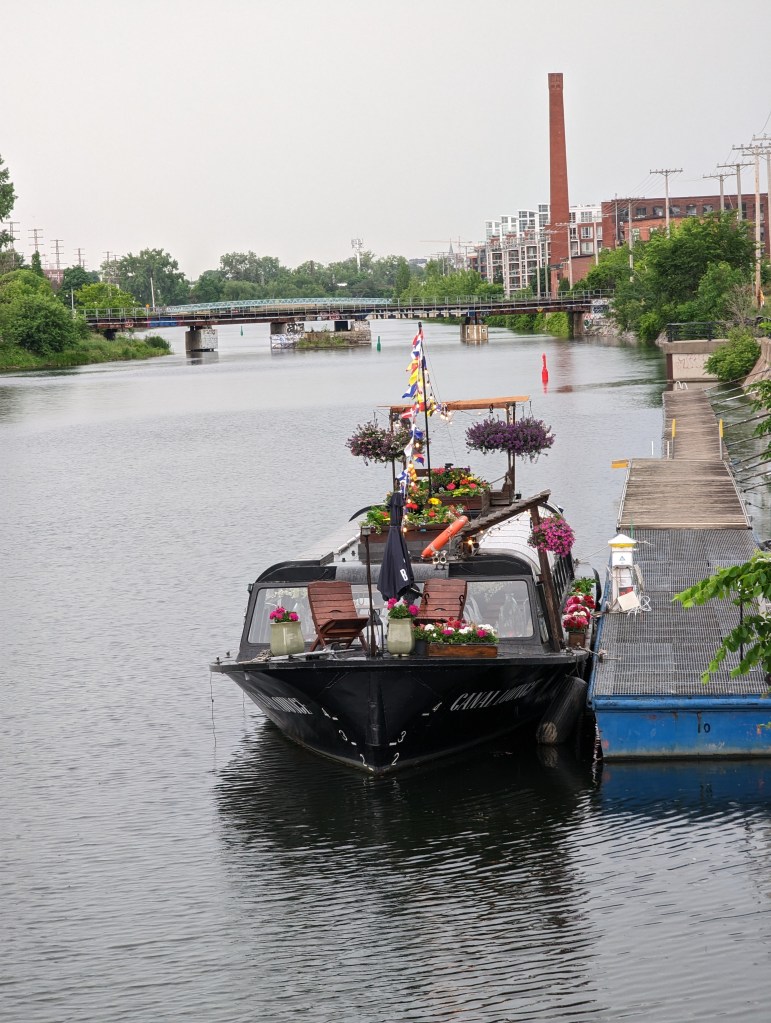
I wandered outside the market for a bit; there’s a canal that runs near it which is apparently used for transportation and recreation by the locals. I loved the swan boats and the boat covered with flowers.
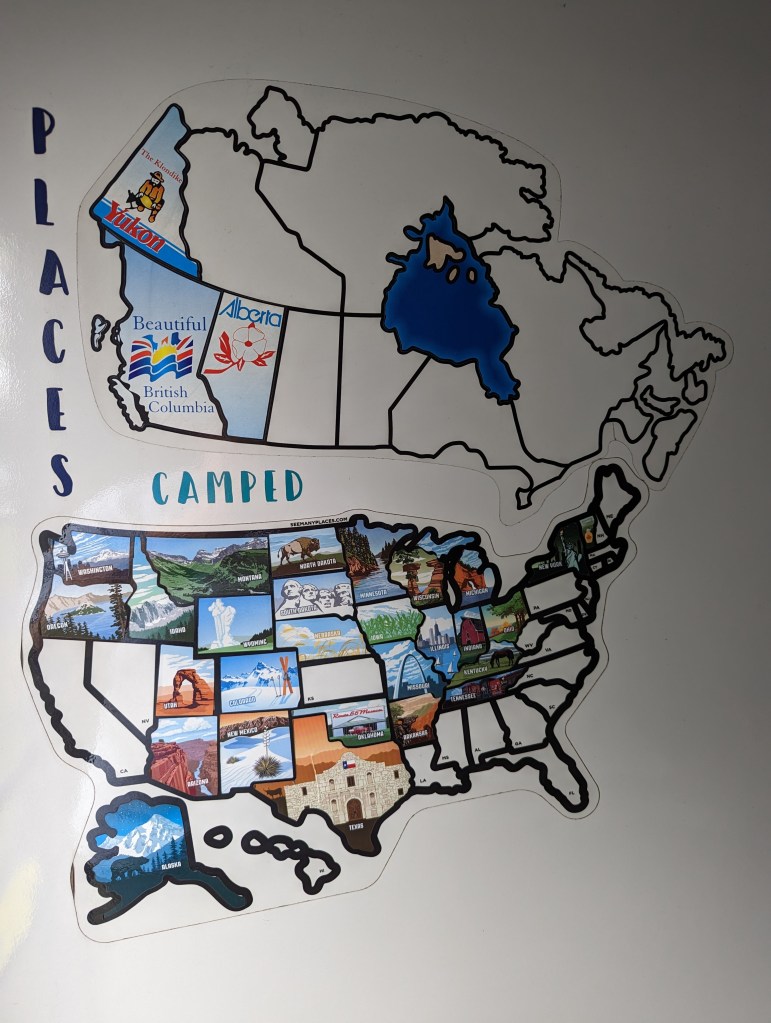
Finally, we headed back to the campground tired but having had a wonderful day. The next day was a travel day, from Montreal to Quebec City. Before I hitched up, I made sure to update my travel map. I think, if I counted correctly, I’ve camped in 28 states and 4 Canadian Provinces. Still more to come!
I got up early on June 14 as I had decided to get more diesel and the cheapest was 30 minutes away in Rutland. The reviews said they had DEF too; well, they did not but the extra time was so worth seeing a beautiful Vermont morning without the rain.
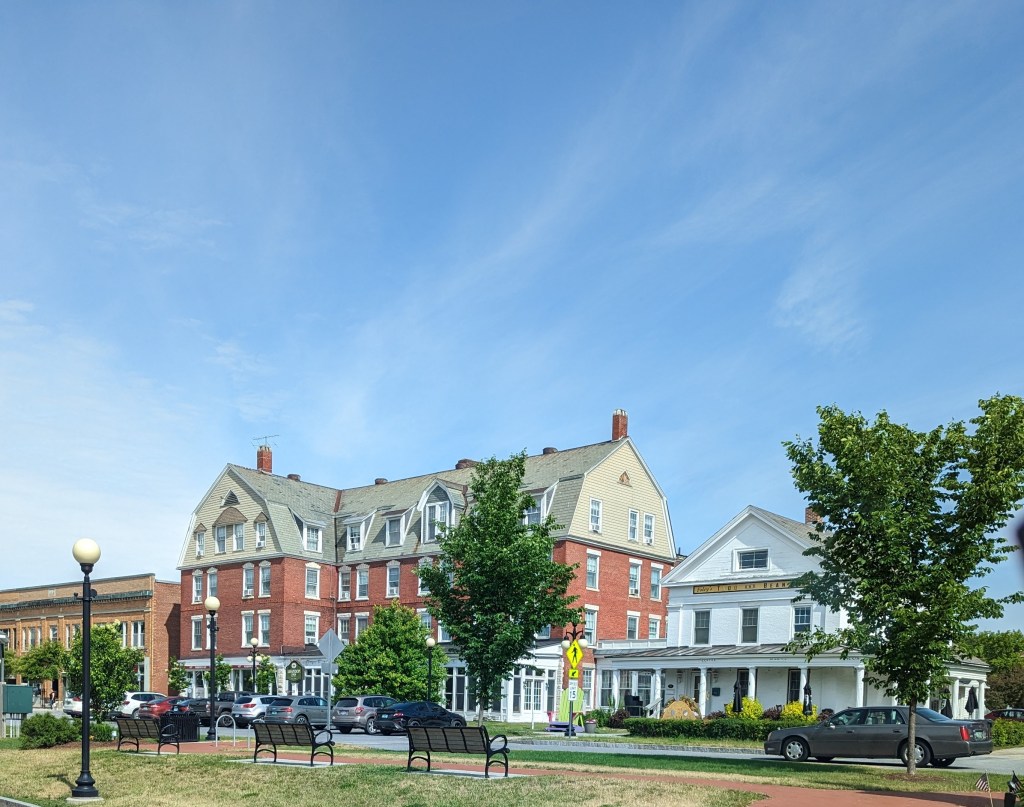
Brandon, Vermont was the closest little town to my campground. It had a really cute vibe and some really pretty churches.
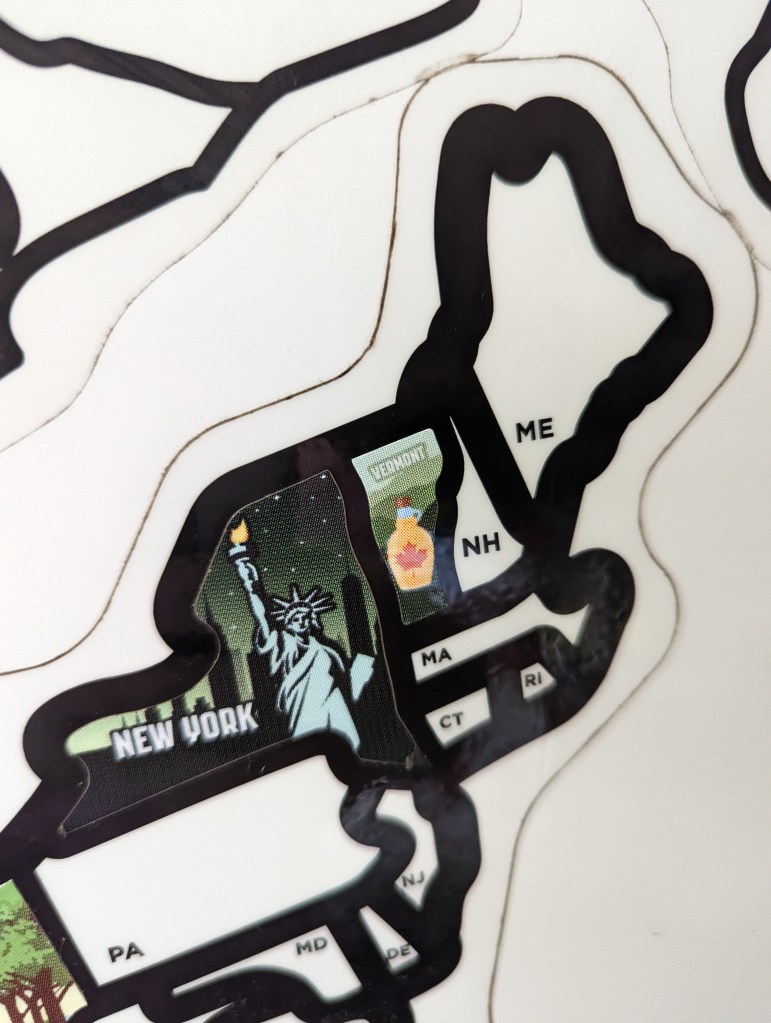
The Brandon Inn is quite prominentNot sure what kind of church this wasBrandon Congregational ChurchGot to add Vermont to the map!
I waited to hitch up until after 10am as I was trying to get a campsite in Schoodic Woods, which is part of Acadia National Park. They release sites 2 months from the date at 10am. Sadly, I struck out. So, hitched up and was on the road sometime after 11am. The plan was to take Vt 7 up to Burlington, to I-89. I’d gone to Burlington the day before, as they have a Costco there. It was crazy busy.
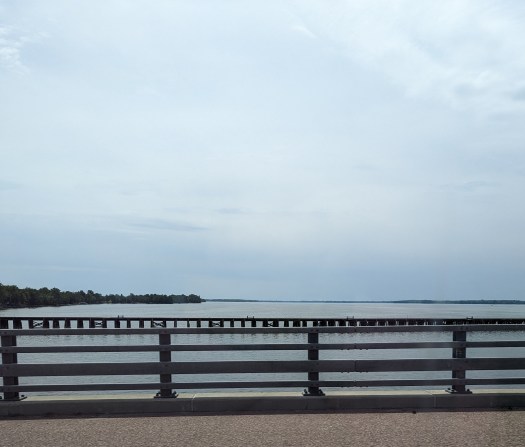
From I-89 the plan was to head north to Swanton and get off onto VT 78. This joins up to US2. All of that went swimmingly. However, there is a point in VT after crossing lots of water (as Lake Champlain is all through this area) where I should have gone north on US 2 but turned south. I realized my mistake quickly, but there was no place to turn around. My Google maps and RVLife GPS offered up routes, many unviable as they involved a u-turn, which you can’t do towing. I ended up driving 9 miles up a Lakeshore Road that was literally on the banks of Lake Champlain to get back to US 2. I was stressed to the max!
Lake Champlain
Luckily, I got back onto 2 North, drove through Rouse’s Point, NY and onto NY 11 which very quickly put me on I-87. I stopped at an Irving Oil at this junction for diesel and DEF, which they DID have at the pump. Then, I drove to the border where there was exactly no wait at all for a lane. The Canadian border agent was a bit concerned about my stated destination of Montreal (“you’re taking that-pointing at the fifth wheel- into Montreal????”). I assured her I was going to a campground and meeting friends, which prompted more questions about these so-called friends. She was also surprised at the length of time I’ll be in Canada, but after these few questions she wished me well.
I got to the KOA at 2:30, the very last person on the tour to arrive. We were to have a meeting at 3pm, which I was late too as my site was too short to fit my truck and fifth wheel without some tires in the grass.
While I was slightly late to the meeting, Jerry, Wendy, Charlie and Rae were very, very late. They’d gone to the Botanical Gardens and got stuck in traffic. Montreal is really hopping this week, as the Formula 1 race, the Montreal Grand Prix, is this weekend. Apparently, you can’t find a hotel anywhere near the city and there are tons of tourists flooding the area. So, traffic is a bigger challenge than might be otherwise.
Given that I was absolutely exhausted at this point, I said goodnight to all and went to bed. We were scheduled to do an all-day bus tour the next day and I knew I’d need some sleep. Stay tuned for some amazing pics of Montreal!
Well, it’s time to travel again. I’m joining some of the peeps I traveled with to Alaska, but this time we’re going to the Eastern Canadian provinces. It’s another Fantasy RV tour; totally worth it for others to worry about where we’re going, campgrounds, etc. We have to meet in Montreal, Canada on June 14. I’m typing this up on June 11 in Verona, NY.
We’ll be traveling through Quebec, Nova Scotia, Prince Edward Island, Newfoundland and Labrador, and finally New Brunswick. To get home, I’ll need to go through Maine and New Hampshire, 2 states I’ve never been to before, let alone camped in. The furthest east I’ve been in Canada was Niagra Falls and Toronto. So, it’ll all be new to me. Praying the wildfires don’t affect the trip too much.
I worked Friday, June 9th in clinic; had a wonderful send off by my High-Risk Asthma team (thanks for the snacks and tea, and Rachel had to send me with dental supplies). I finished up various tasks in my office and finally left Riley to head to where I keep the trailer. And this was what I saw as I left:
Was this a sign of things to come???
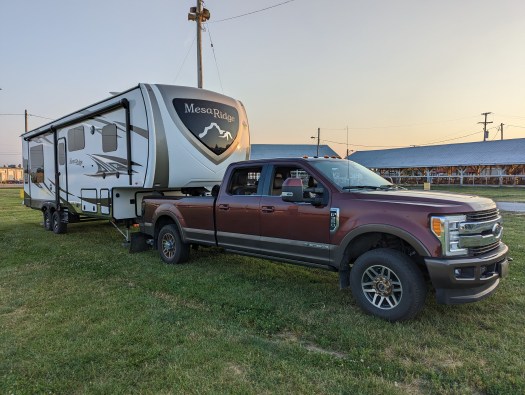
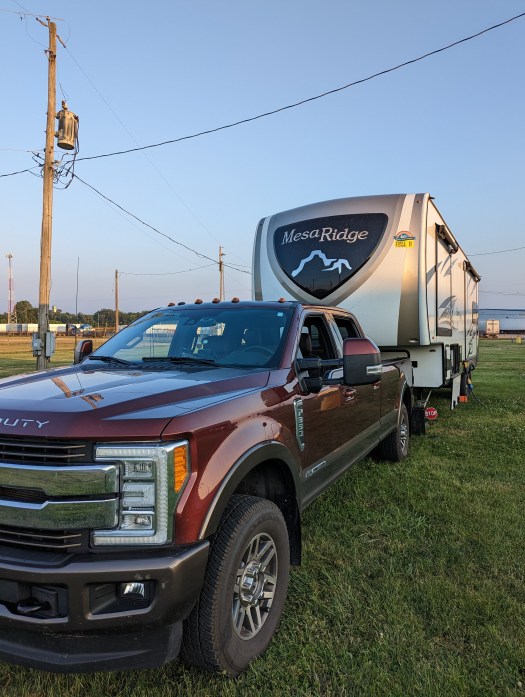
Since I worked, I decided to just go about 100 miles the first night. The Clark County Fairgrounds in Springfield, Ohio was my first stop. I’ll not bore you with the details of the struggles I had at this site, but it was not what I expected. No one could tell me where to go, there were hundreds of cars there for a cancer fundraiser and even more in the back for a horse show. I found a field on my own that turned out to be completely empty and got set up. I was near either the goat or swine pens. They were empty though.
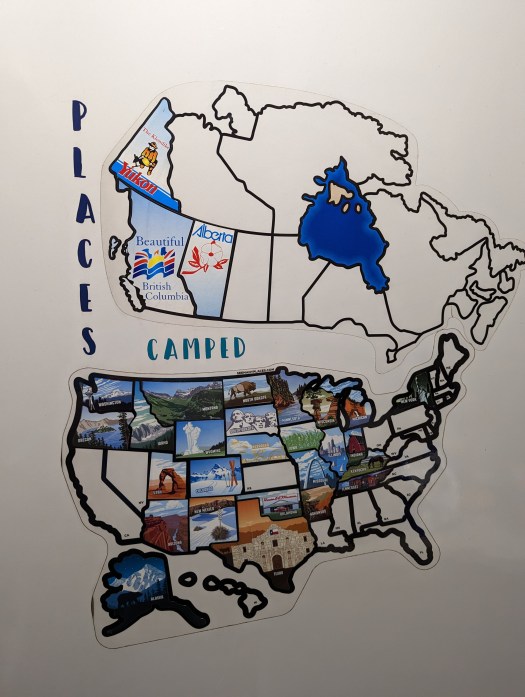
Old map
New map!
Saturday morning, I ran to the local Meijer for a few groceries. Got to add an Ohio sticker to the places camped map, which was exciting! I was on the road relatively later than I wanted to be due to some issues with tire pressures, but got it sorted out. I drove I-70 east to Columbus then went up I-71 towards Cleveland. Eventually got on I-90. It’s funny to think that I-90 was a major part of my life when I was a kid as it runs straight through Spokane; nearly every trip we took anywhere involved I-90. But it doesn’t seem as familiar to me out east.
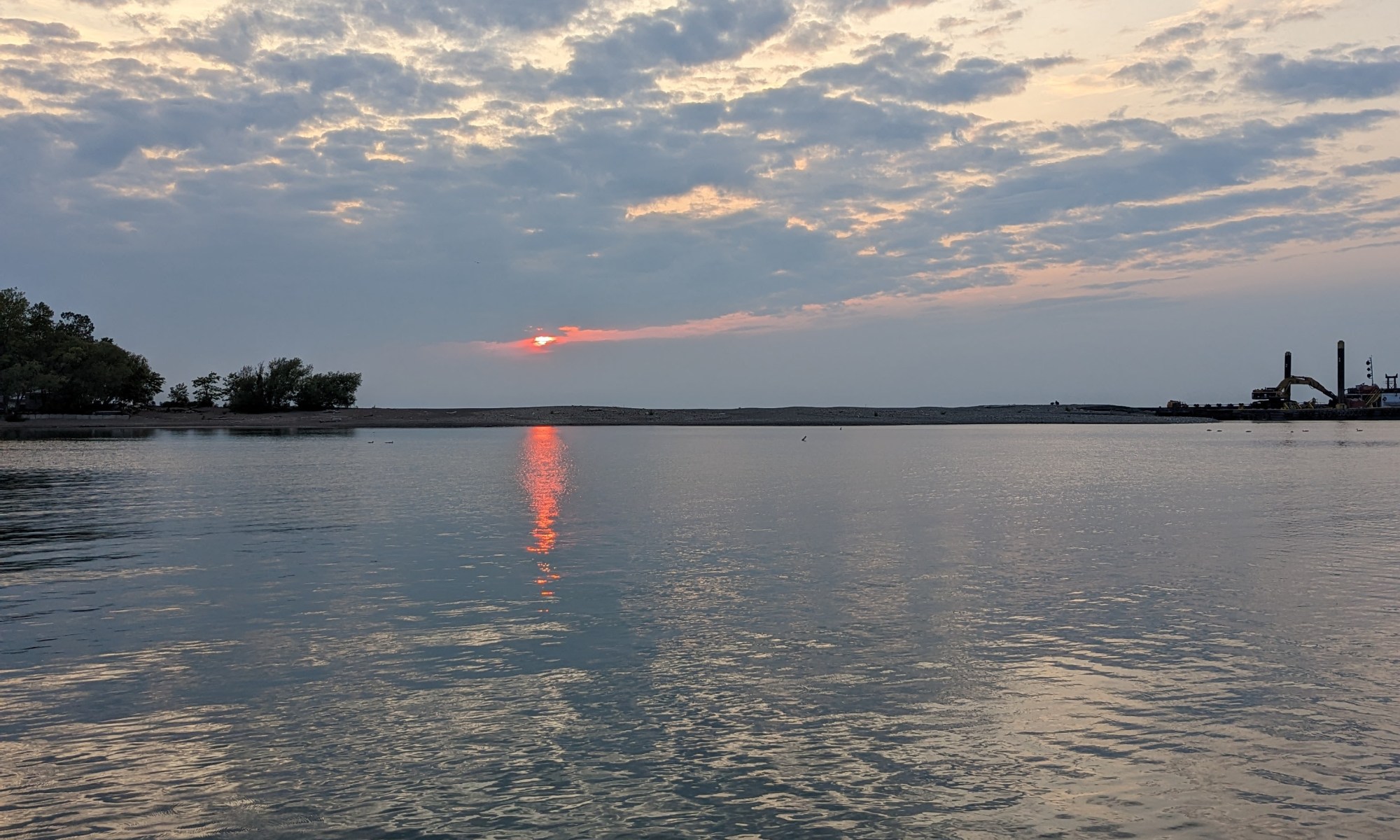
I made it to Westfield, NY after passing through northeastern Ohio and the tiny bit of Pennsylvania on the shore of Lake Erie. I spent the night at a very lovely KOA on the shores of the lake. I got in late enough to catch the sunset and not much else. There are grapes everywhere you look in this part of NY state! Wineries are clearly popular; don’t know if all the grapes are for wine or if some are for eating, but I couldn’t believe how many grape fields there were. I’d love to come back and explore this part of NY more in the future.
Sunset on the lakeshore
I left Westfield this morning and have traveled on the New York State Thruway exclusively today. I gave a silent shout out as I drove north across the Finger Lakes to my home for 4 years in the late 80s/early 90s. I never owned a car when I lived in New York, so all my travels were limited to catching rides with friends. We did manage to camp in the Thousand Islands and in the Catskills back in the day though. So, not my first time camping here (but my RV beats those old tents for real).
My campground tonight is in Verona, NY. It’s quite large, but not crowded. There are pretty nice sites, full hookups, and lots of trees and water. I got into my site and unhitched; it was definitely hotter here than on the lake! As I was cooling off inside a bit, someone knocked at my door. Imagine my shock when I opened the door and found Richard Hathaway! He and his wife Dana attended the RV rally I directed last year in Shipshewana and became interested in our Fantasy RV adventures. They decided to come on this trip, and we just happened to be at the same campground tonight–they are across the way from me! They have a new fifth wheel from last year, so I didn’t recognize it. Small world. We’ll separate tomorrow as they will cross into Canada from NY and head to Montreal, while I’m going to Vermont tomorrow.
Ok, that’s it for tonight. I’m posting in FB and Instagram. Will also share in texts for those who don’t have social media. In the past I’ve run into a lot of issues keeping up with my blog due to lack of WiFi. And Verizon wasn’t generous for data in Canada in 2019; it’s unclear if that’s changed. However, I think I have a plan for this. Stay tuned for more details! On to Brandon, Vermont tomorrow. I’ll be at Smoke Rise Campground for the next 2 days.
At the very beginning of this trip, we were introduced to the motto ‘No Bad Days in Alaska’. We were even given stickers for our vehicles that said this.
Still in Dawson City, I literally did nothing of interest for the entire day. It was productive, don’t get me wrong, but I didn’t tour anything or do anything fun or exciting. Continue reading “Day Thirty Six: A Down Day”
Dawson City. Once the capital of the Yukon, it exploded in the late 1890s after reports of the discovery of gold. Men, and some women, poured into the city from all over North America, only to find that all of the claims had been staked by the time they arrived. At one point, it was the largest city west of Winnipeg and north of San Francisco. Continue reading “Day Thirty Five: Dawson City”






















































































 Travel with Me!